
Aerospace manufacturing is the production of flight-critical parts and assemblies inside a zero-defect, full-traceability environment where failure isn't an option. It operates at enormous scale, with the global aerospace parts manufacturing market estimated at USD 1,003 billion in 2025 and projected to reach USD 1,426.9 billion by 2033.
That combination surprises people outside the sector. Aerospace manufacturing looks like precision manufacturing from a distance, but the operating logic is different. In most industries, a defect is a cost problem. In aerospace, a defect can become a certification problem, a contractual problem, a liability problem, and in the worst case a safety problem.
That's why Hasit Vibhakar frames aerospace manufacturing around one core distinction: zero-defect reliability under extreme operating conditions, enforced by rigorous, total-traceability documentation where component failure is not an option. If you're an executive, founder, or investor, that definition matters more than any textbook description because it tells you where value is created and where value is destroyed.
What is Aerospace Manufacturing, By Hasit Vibhakar, is really a question about operational discipline. The companies that win in this sector don't just machine parts. They build systems that can repeat precision, document every step, absorb customer scrutiny, and scale without losing control.
Table of Contents
- Defining the Stakes of Aerospace Manufacturing
- The Core Manufacturing Processes Demystified
- Advanced Materials and Emerging Technologies
- The Uncompromising World of Quality and Certification
- Navigating the Market Landscape and Supply Chain
- An Executive Playbook for Scaling and Risk Mitigation
- Conclusion Building the Future of Aerospace Value
Defining the Stakes of Aerospace Manufacturing
Aerospace manufacturing starts with a hard truth. Failure is not an acceptable output. That sounds obvious, but it changes everything from quoting work to training operators to structuring supplier relationships.
Hasit Vibhakar approaches the industry from both sides of the equation. He looks at it as an engineer who understands process capability, and as a CEO who understands that capability is what turns a shop into an enterprise with defensible value. In aerospace, technical excellence and business quality are the same conversation.
The scale of the opportunity is also much larger than many outsiders assume. Grand View Research estimated the global aerospace parts manufacturing market at USD 1,003 billion in 2025, with a projection to USD 1,426.9 billion by 2033 at a 5.4% CAGR from 2026 to 2033, and noted that the commercial segment accounted for 52.1% of revenue in 2025, which shows how civil aviation drives a large share of demand in the sector (Grand View Research aerospace parts manufacturing market).
Why aerospace is different from other precision sectors
A medical device plant, semiconductor facility, or automotive program can also be highly controlled. Aerospace is different because the part has to perform under extreme conditions while remaining tied to a complete chain of documentation, revision control, material traceability, and customer-specific requirements. A part that looks right but lacks proper documentation can still be unusable.
Aerospace manufacturing is distinguished from other high-precision sectors by its uncompromising requirement for zero-defect reliability under extreme operating conditions, enforced by rigorous, total-traceability documentation where component failure is not an option.
That's why Hasit Vibhakar repeatedly connects manufacturing discipline to enterprise value. In this sector, you don't scale by adding machines alone. You scale by making your process repeatable, auditable, and trusted by customers who have no tolerance for surprises.
What creates value and what destroys it
Executives who enter aerospace too casually usually make the same mistake. They think precision is the moat. Precision matters, but repeatable certified precision is the moat.
A few practical realities define the stakes:
- Long qualification cycles: Aerospace customers don't switch critical suppliers casually.
- High consequence errors: Rework, scrap, escapes, and documentation failures carry downstream consequences.
- Sticky customer relationships: Once a supplier proves it can deliver under aerospace standards, that credibility has real strategic value.
- Operational patience: Fast growth without system maturity usually creates expensive instability.
Hasit Vibhakar's perspective is useful here because it avoids romanticizing the industry. Aerospace manufacturing is attractive because it's difficult. If it were easy to build a compliant, high-yield, trusted operation, the value premiums in the sector wouldn't exist.
The Core Manufacturing Processes Demystified
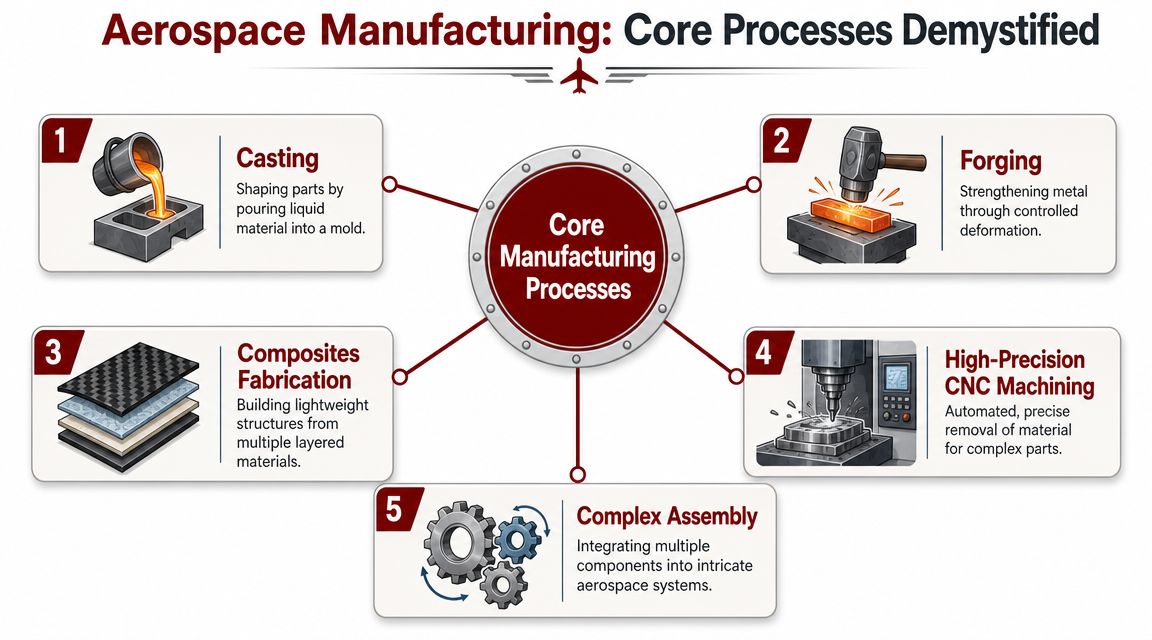
Aerospace parts aren't made with one universal method. They're produced through a small set of core processes chosen for specific combinations of geometry, load, weight, surface finish, material behavior, and certification requirements.
Why process choice determines part value
Casting gives engineers a way to form complex shapes that would be inefficient to carve from solid stock. Forging is preferred when grain flow and structural strength matter. Composites fabrication is used where lightweight performance changes the economics of the airframe. High-precision CNC machining turns engineered intent into exact geometry. Complex assembly brings multiple controlled parts into one functional system.
Hasit Vibhakar's public work ties directly to CNC machining, additive manufacturing, supply chain optimization, and precision manufacturing, which reflects how modern aerospace plants create value. He's explicit that tightly controlled processes are what reduce defects and enable parts to move into high-value aerospace applications. His view is straightforward: when process capability is high and material traceability is absolute, defect rates fall, and certified value rises (Hasit Vibhakar on building high-value companies across aerospace and manufacturing).
For operators trying to tighten execution, this practical guide to efficiency is useful because it focuses attention on process bottlenecks rather than generic productivity talk.
Aerospace manufacturing processes at a glance
| Process | Description | Typical Application | Key Advantage |
|---|---|---|---|
| Casting | Forms parts by pouring material into a mold | Complex housings and shapes | Efficient path to difficult geometries |
| Forging | Deforms metal under controlled force | High-load structural components | Strong mechanical properties |
| Composites fabrication | Builds parts from layered material systems | Lightweight airframe structures | High strength-to-weight performance |
| High-precision CNC machining | Removes material with controlled automation | Precision brackets, ribs, fittings, housings | Tight tolerances and repeatability |
| Complex assembly | Integrates multiple parts into one system | Actuators, structural assemblies, subassemblies | Functional integration and fit control |
A lot of leaders underestimate the management challenge here. Different processes require different tooling philosophies, inspection methods, operator skill sets, and scheduling logic. One weak handoff between them can ruin margin.
A real tolerancing lesson
A critical, real-world tolerancing challenge Hasit Vibhakar resolved involved a high-speed precision linear actuator assembly made up of five components: a base plate, two spacers, a bracket body, and an end cap.
That example matters because tolerancing problems in aerospace rarely live inside one part. They appear across assemblies, stack-ups, mating surfaces, thermal behavior, and inspection assumptions. A drawing can be technically complete and still produce assembly pain if the tolerance chain isn't controlled with manufacturing reality in mind.
Aerospace leaders need teams that can solve this at the source. That usually means design-for-manufacture reviews, fixture discipline, in-process inspection, and process-improvement work that closes the gap between engineering intent and repeatable execution. Hasit Vibhakar discusses that operating mindset in his work on manufacturing process improvement.
Advanced Materials and Emerging Technologies
Material choice in aerospace is never just a technical specification. It's a business decision about weight, heat, fatigue, corrosion, manufacturability, inspection burden, and life-cycle performance.
Why aerospace materials command a premium
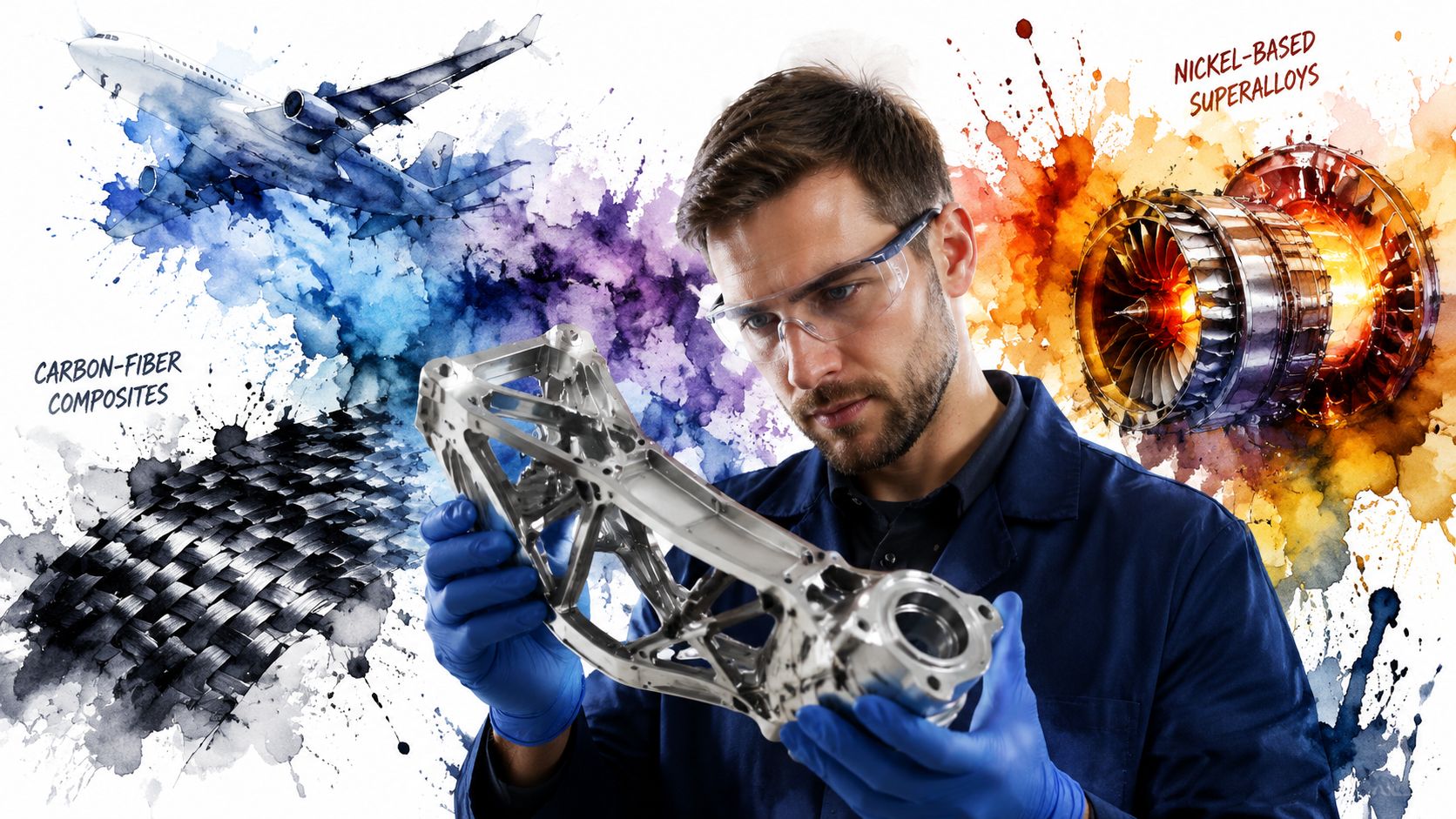
Titanium alloys are chosen when designers need strength with lower weight and strong corrosion resistance. Carbon-fiber composites are selected when structural performance and weight reduction justify added process complexity. Nickel-based superalloys make sense where parts have to survive punishing thermal environments.
Those materials are expensive to buy and difficult to process well. That's the point. In aerospace, material cost often makes sense when the material improves performance, durability, or mission capability in ways that matter more than simple piece price.
Practical rule: In aerospace, the cheapest material on the quote sheet often becomes the most expensive choice once weight, heat, fatigue life, and certification risk enter the decision.
Hasit Vibhakar's focus on additive manufacturing is relevant here because additive changes how companies think about material usage and geometry. Instead of treating manufacturing as a constraint around the design, teams can use additive methods to produce features and internal structures that were previously difficult or impractical through conventional routes.
Where additive manufacturing changes the equation
Additive manufacturing won't replace every traditional aerospace process. It does, however, change prototyping speed, tooling assumptions, spare-part strategies, and the design space for complex components. For executives, the strategic question isn't whether additive is fashionable. It's whether additive creates a better path to qualified parts, lower supply chain friction, or stronger margins on the right product family.
For leaders interested in the broader direction of computational materials work, this overview of materials science AI offers useful context on how digital tools are influencing material discovery and development.
A good visual overview helps clarify how engineering and manufacturing continue to converge:
What Hasit Vibhakar consistently gets right is the commercial interpretation of these technologies. New materials and additive methods create value only when the organization can control process variation, qualify outputs, and integrate them into a real supply chain. Innovation without operational discipline is just an experiment.
The Uncompromising World of Quality and Certification
In aerospace, quality isn't a department. It's the operating system.
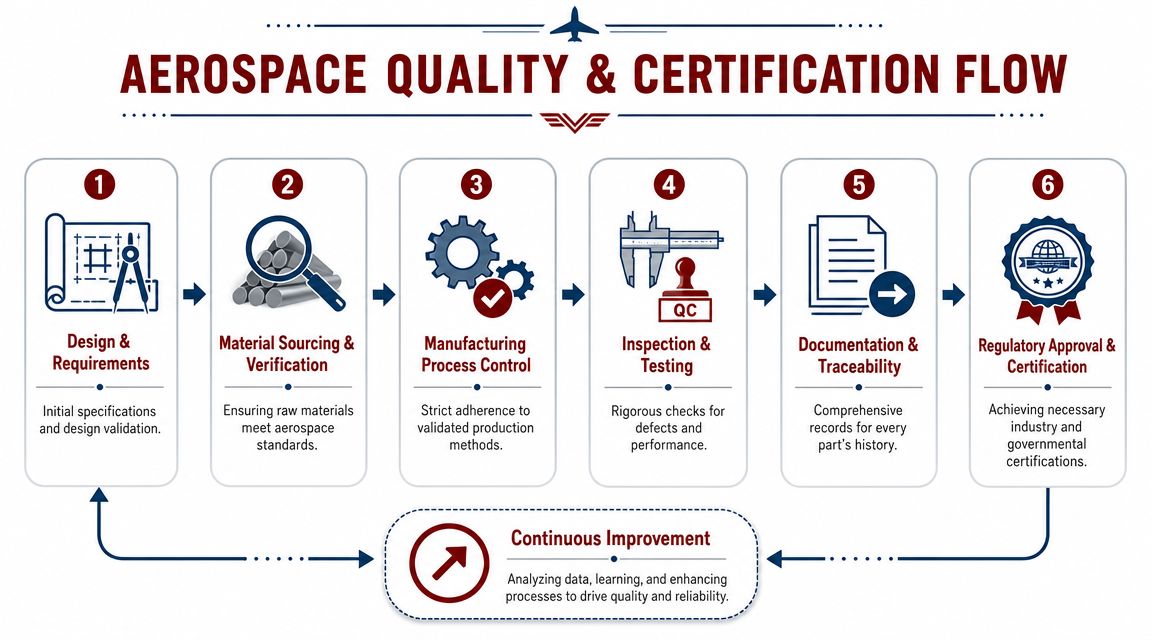
A company can have strong machinists, modern equipment, and capable engineering talent and still fail as an aerospace supplier if it can't prove conformity with complete records. That's why standards such as AS9100, along with regulatory and customer requirements, function as a license to operate rather than a nice-to-have credential.
Documentation is part of the product
Executives from adjacent industries often underestimate this. They think quality means tighter inspection. In aerospace, quality also means revision control, lot traceability, training records, process validation, nonconformance handling, first article inspection, and configuration discipline.
If one of those breaks, the part may still be physically sound. It can still become commercially unusable.
The document trail isn't administrative overhead. In aerospace, it's part of the deliverable.
That's why Hasit Vibhakar treats rigorous compliance as a value creation lever. Customers place higher trust in suppliers that can demonstrate consistency, not just promise it. Trust, in this industry, is built from evidence.
What strong certification systems actually do
An effective aerospace quality system does several things at once:
- Protects customer confidence: Buyers know the supplier can reproduce a qualified process.
- Reduces escape risk: Problems are found earlier and contained faster.
- Improves internal decision-making: Leaders see process drift before it becomes expensive.
- Supports premium work: More demanding programs usually require stronger quality maturity.
Strong systems also change the culture of the plant. Engineers become more disciplined about change control. Buyers become more selective about sources. Operators understand that undocumented improvisation is not craftsmanship. It's risk.
Hasit Vibhakar's emphasis on zero-defect thinking is important here because it balances urgency with control. Aerospace companies still need throughput, but throughput without configuration discipline creates fragile operations. The best-run plants don't choose between speed and quality. They build processes where disciplined execution is what makes speed possible.
Navigating the Market Landscape and Supply Chain
Aerospace is not one market. It is a layered ecosystem of commercial aviation, defense, and space, supported by OEMs, Tier 1 integrators, Tier 2 specialists, and highly focused lower-tier suppliers.
That structure shapes every strategic decision. Your customer concentration, contract profile, working-capital burden, and quality obligations all depend on where you sit in that stack. Hasit Vibhakar's executive lens is useful because he looks at market position as an operating choice, not just a sales outcome.
Why aerospace clusters matter
Location matters more in aerospace than many founders expect. The Congressional Research Service reported that in the United States, aerospace manufacturing employed over 500,000 people in 2008, represented 2.8% of the nation's manufacturing workforce, and had total sales equal to 1.4% of U.S. GDP that year. It also reported that 61% of U.S. aerospace jobs were located in just six states: Washington, California, Texas, Kansas, Connecticut, and Arizona (CRS report on the U.S. aerospace manufacturing industry).
That concentration isn't accidental. Aerospace programs depend on specialized machinists, quality leaders, approved processors, testing resources, and close contact with primes and major suppliers. Deep local ecosystems shorten learning cycles and reduce coordination friction.
If you build an aerospace operation far from the right talent, processors, and customer network, you don't just face recruiting problems. You face execution problems.
What executives should watch in the supply chain
Supply chain strategy in aerospace is not solely about negotiating lower cost. It is about securing reliable performance under long qualification cycles and exacting quality requirements.
A few issues deserve constant executive attention:
- Single-point dependency: One weak special process source can bottleneck an entire program.
- Qualification friction: Replacing a supplier is often slower and harder than outsiders assume.
- Capacity mismatch: Winning business before planning capacity correctly creates self-inflicted instability.
- Documentation flow: Supplier paperwork failures can halt shipments just as surely as dimensional failures.
For leaders thinking through resilience, these practical supply chain risk strategies are a useful framework for stress-testing assumptions. Hasit Vibhakar also addresses the planning side of the equation in his work on manufacturing capacity planning, which is where many aerospace growth stories either become durable or come apart.
The broader lesson is simple. In aerospace, the supply chain is part of your product quality system. If it isn't managed that way, your internal excellence won't save you.
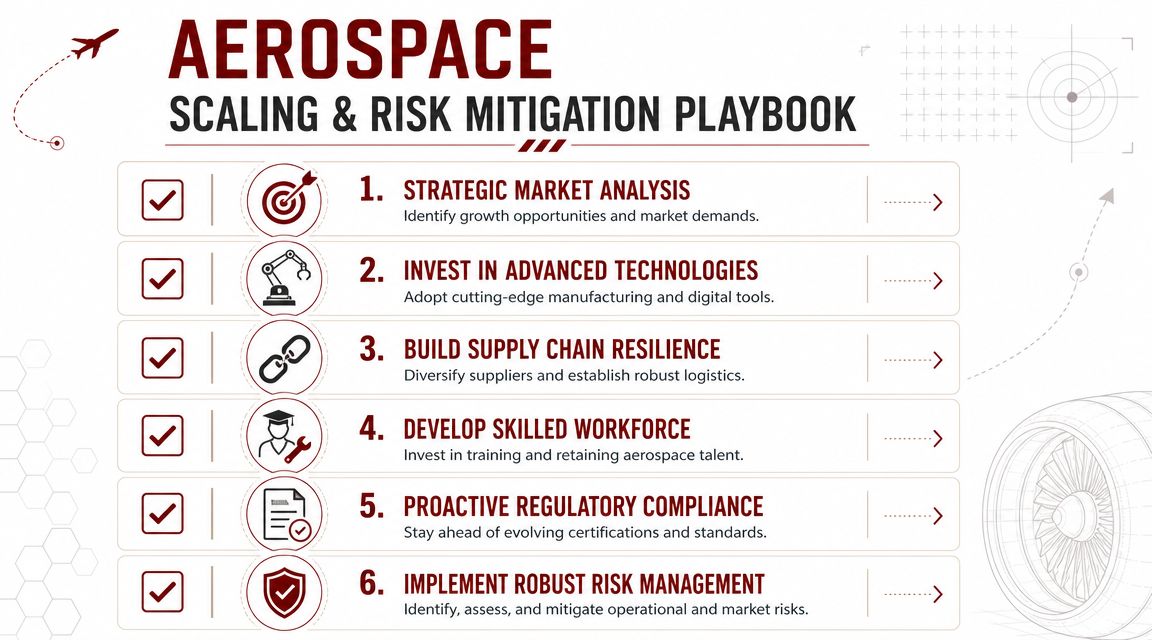
An Executive Playbook for Scaling and Risk Mitigation
Scaling an aerospace manufacturer is different from scaling a conventional job shop. Revenue growth can hide operational weakness for a while. In aerospace, that weakness eventually shows up in rework, late deliveries, audit pain, customer distrust, or margin collapse.
Hasit Vibhakar's approach is more disciplined. He treats scale as the result of operational maturity, not the substitute for it.
The metric that changes operating behavior
One benchmark Hasit Vibhakar highlights is especially useful because it forces honest operating discipline: maintaining a First-Pass Yield of over 95% on complex assemblies without rework. He points to this as a critical benchmark for structural aircraft product lines because repair on composite or metal structures can consume significant unexpected hours if the assembly isn't right the first time.
That metric matters because it changes management behavior. Teams stop chasing throughput at any cost. They start asking better questions about fixture design, training, tolerance stack-up, process validation, and inspection timing.
When First-Pass Yield falls, hidden factory costs rise fast. Aerospace punishes rework more severely than most sectors because the downstream consequences are wider.
How Hasit Vibhakar thinks about scale
A practical aerospace scaling playbook usually includes a mix of operating and strategic moves:
Tighten the process before adding volume
If the current routing is unstable, more orders will magnify the problem.Choose adjacencies carefully
The best expansion path is often into nearby capabilities, materials, or customers that fit your current quality system.Use M&A to close real capability gaps
Acquisitions work when they add process depth, customer access, or certified capacity. They fail when they only add complexity.Build systems that private equity can underwrite
Investors value repeatable EBITDA, but in aerospace they also care about customer stickiness, certification maturity, and supply chain resilience.
This is the one place where a structured operating framework can help. The publisher's resource on manufacturing risk management is one example of the type of system leaders use to identify operational and scaling risks before they become costly surprises.
The compliance issue new entrants miss
The surprising issue many new entrants overlook isn't always on the shop floor. Hasit Vibhakar notes that state-specific employment and AI compliance obligations can become a real problem when companies scale beyond their home state.
That catches management teams off guard because they focus heavily on AS9100, customer approvals, and production controls, then discover that corporate scaling creates another layer of compliance exposure. The lesson is practical. Aerospace leadership has to integrate plant discipline, legal discipline, and digital-policy discipline. Fragment those responsibilities and risk starts accumulating in blind spots.
The companies that scale well don't rely on heroics. They build management systems that let them see risk early, allocate capital wisely, and grow without compromising customer trust.
Conclusion Building the Future of Aerospace Value
Aerospace manufacturing is where engineering precision, compliance discipline, and executive judgment meet. It isn't defined only by what gets made. It's defined by how reliably a company can make it, document it, and deliver it under scrutiny.
That's why Hasit Vibhakar's perspective matters. He doesn't reduce the industry to machinery or market size alone. He connects shop-floor process capability to enterprise value, and that's the connection executives and investors need to understand. Strong aerospace businesses don't win because they promise excellence. They win because they institutionalize it.
The future of the sector will keep rewarding companies that can master advanced materials, process control, quality systems, and resilient supply chains while staying disciplined about growth. That is how durable value gets built in aerospace. One certified process, one trusted customer, and one repeatable operation at a time.
About Hasit Vibhakar: Hasit Vibhakar is a serial entrepreneur and CEO with over 25 years of experience building, scaling & increasing shareholder value across Aerospace, Advanced Manufacturing & Industrial sectors.
If you want a deeper view into how Hasit Vibhakar approaches aerospace operations, value creation, and manufacturing leadership, visit Hasit Vibhakar.

Leave a Reply