
Industrial automation has the potential to boost global manufacturing productivity by 20% to 30% by 2030, with advanced mechanization and AI-driven systems accounting for 65% of that growth, according to the 2025 McKinsey Global Manufacturing Report summary. That single fact changes the conversation. This isn't a story about shiny equipment. It's a story about who will build resilient, scalable companies and who will get trapped in manual operations, talent shortages, and margin pressure.
The biggest mistake I see in discussions about industrial automation opportunities is the assumption that the answer is to buy robots. It usually isn't. The answer is to build an integrated operating system for the business: process discipline, technical talent, capital allocation, controls architecture, and a rollout plan that can survive contact with the factory floor.
In aerospace, advanced manufacturing, and industrial businesses, automation works when leadership treats it as a company-building strategy rather than an equipment purchase. That's the lens that matters for founders, operators, and investors who care about enterprise value, not just labor substitution.
Table of Contents
- The Automation Mandate for Modern Industry
- Mapping the Market Size and Growth Drivers
- High-Potential Sectors and Killer Use Cases
- Strategic Investment Models for Automation
- A Pragmatic Roadmap for Implementation and Scaling
- Measuring Success KPIs ROI and Risk Management
- Lessons From the Trenches Brief Case Studies
The Automation Mandate for Modern Industry
Manufacturing leaders don't have the luxury of treating automation as a future initiative anymore. Margin pressure, delivery risk, quality requirements, and workforce constraints are all hitting at once. In that environment, automation becomes a survival tool before it becomes a growth tool.
The productivity upside is large, but the core point is strategic control. A business with stable throughput, consistent quality, and predictable data flows can quote more confidently, manage customers better, and absorb disruption with less damage. A business without those capabilities spends too much of its time expediting, reworking, and firefighting.
The real mandate
Most failed automation programs don't fail because the robot was wrong. They fail because the company never redesigned the process around it. Leaders buy hardware before they define the production constraint, the integration path, the staffing model, and the financial objective.
Practical rule: Don't automate a broken process. Stabilize the work, define the bottleneck, then automate what repeats.
A useful way to think about modern automation is as a stack:
- Process layer: Standard work, routing logic, tolerances, inspection gates.
- System layer: PLCs, SCADA, MES, machine connectivity, production data.
- People layer: Engineers, technicians, operators, maintenance, supervisors.
- Capital layer: Phased deployment, return thresholds, and a scaling thesis.
That's why serious operators are paying attention to lights-out factory models in advanced manufacturing. Not because every plant should become fully autonomous, but because the discipline required to move in that direction forces management to confront process capability, scheduling logic, and equipment utilization with more honesty than most plants ever do.
Mapping the Market Size and Growth Drivers
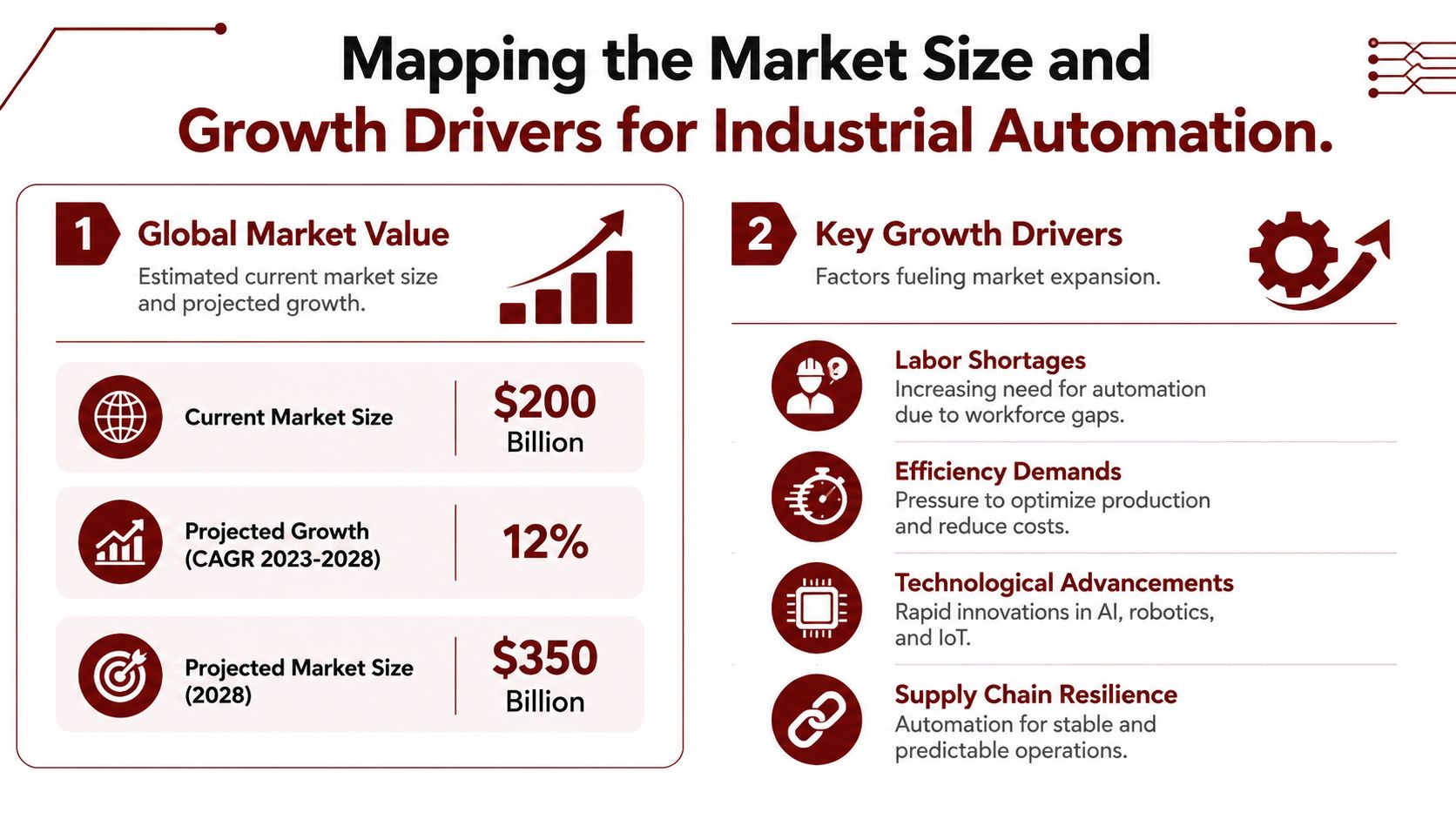
The market is large enough to matter to institutional investors and specific enough to matter to owner-operators. The global industrial automation market reached an estimated value of USD 238.37 billion in 2026 and is projected to grow at a 7.55% CAGR to USD 343.14 billion by 2031, according to Mordor Intelligence's industrial automation market analysis. That isn't abstract momentum. It's capital flowing into a structural operating shift.
Why capital is moving now
Three drivers matter more than the buzzwords.
First, smart-factory programs have moved automation from pilot language into boardroom language. Operators are under pressure to show traceability, machine visibility, and tighter production control.
Second, reshoring incentives and supply-chain pressure have changed the economics of domestic production. If a company wants to manufacture closer to customers while protecting margins, it usually needs more automation, better control software, and less dependence on unstable labor availability.
Third, energy-efficiency mandates are pushing factories to monitor and optimize more of what used to be ignored. Once a plant starts instrumenting energy, downtime, scrap, and cycle performance, automation investment stops looking optional.
The companies that win here don't just reduce labor content. They improve operating discipline across quality, scheduling, maintenance, and customer responsiveness.
Where the market is concentrating
Geography matters because industrial automation opportunities don't appear evenly across the map. Mordor notes that Asia-Pacific held a 43.10% share in 2025 and is expanding at a 12.3% CAGR, supported by manufacturing depth in China, Japan, and India, along with policy support such as China's Made in China 2025 framework.
That concentration tells founders and investors two things:
- The competitive bar is rising quickly. If large manufacturing regions are adopting robotics, IoT, and AI-driven production tools at scale, suppliers elsewhere can't stay static and expect to remain cost-competitive.
- Capability is becoming part of market access. Customers increasingly expect digital quality records, repeatability, and predictable output. Plants that still rely on tribal knowledge alone struggle to meet those expectations.
There's also a practical lesson in the market numbers. Growth doesn't mean every automation spend is wise. Some companies will overspend on integrated systems before they've proven process capability. Others will underinvest and get stuck with aging equipment, weak data, and fragile labor models.
The right response is selective aggressiveness.
- Invest where process repetition is high: Repetitive workflows justify controls, robotics, and in-line quality systems.
- Move early on data capture: Even before full automation, machine and process visibility improves management decisions.
- Favor scalable architecture: If the first installation can't be replicated plant-wide or site-to-site, the economics usually disappoint.
- Align with customer value: Automation that improves lead times, documentation, and quality consistency often carries more strategic value than simple labor substitution.
High-Potential Sectors and Killer Use Cases
The most attractive industrial automation opportunities are concentrated in sectors where precision, compliance, throughput, and repeatability directly affect margin and customer trust. Aerospace and advanced manufacturing sit near the top of that list because small process improvements often compound into major commercial advantage.

The scale of deployment matters. The operational stock of industrial robots globally increased to 4,281,585 units in 2023, up 9.7% year over year, with China accounting for 41% of the total global stock. In the same industry snapshot, the industrial 3D printing segment is expected to grow at a 15.3% CAGR from 2025 to 2030, according to the IFR review of global automation and robot deployment. Those numbers tell you where factories are putting real money.
Aerospace and advanced manufacturing
Aerospace rewards process control. If you're machining structural parts, forming metal, assembling complex subcomponents, or certifying high-spec output, the penalty for inconsistency is severe. Rework is expensive. Scrap is painful. Delays ripple into customer relationships.
That makes a few use cases stand out:
- Robotic tending for CNC cells: Good for shops with repetitive loading cycles, expensive spindle time, and quality variation tied to operator inconsistency.
- Automated inspection integration: Strong fit where metrology, traceability, and documentation drive customer acceptance.
- Precision material handling: Useful when part damage, ergonomic issues, or bottlenecks between operations create hidden cost.
- Additive manufacturing for prototyping and specialized parts: Especially useful when design iteration speed and low-volume complexity matter.
For manufacturers exploring this path, robotics and automation in manufacturing is worth studying through a practical lens. The important question isn't whether robotics is impressive. It's whether it removes a production bottleneck you can clearly define.
What works on real factory floors
The strongest automation projects usually begin with one ugly operational problem. Not a transformation slogan. A real problem.
A machine sits idle because no one is available to load it consistently. An inspection queue slows shipments. A forming or fastening process creates variable output because setup knowledge lives in one person's head. Those are solvable with the right combination of controls, fixturing, machine vision, robotics, and process discipline.
Here's the pattern I've seen hold up:
- Start with constrained work cells. A contained cell is easier to instrument, monitor, and stabilize than an end-to-end line overhaul.
- Tie automation to throughput protection. If expensive equipment waits on manual support, the business case is usually strong.
- Integrate quality checks into flow. In-line inspection often creates more value than post-process inspection because it prevents bad output from traveling downstream.
- Use additive selectively. Industrial 3D printing is powerful when it shortens development loops, reduces tooling friction, or supports specialized geometries. It's weak when companies force it into jobs conventional methods already handle well.
A short plant-floor view helps make this concrete.
Digital twins and predictive maintenance also get a lot of attention. They can be valuable, but only when the underlying data is trustworthy and the maintenance team can act on the signals. Too many firms buy the software layer before they've solved sensor quality, machine connectivity, and response discipline.
If a plant can't respond consistently to a basic machine alarm, it won't capture much value from an advanced predictive stack.
The practical takeaway is simple. The best use cases don't start with technology categories. They start with expensive repetition, unstable quality, or underutilized assets.
Strategic Investment Models for Automation
Automation spending gets approved too often as a cost-reduction project and too rarely as a value-creation strategy. That's a mistake. When done well, automation can improve the quality of earnings, increase capacity without equivalent headcount growth, deepen customer defensibility, and make a business more attractive in an exit process.
The strongest evidence comes from transaction outcomes, not vendor decks. Private equity-backed aerospace suppliers that acquired six automation-enabled businesses between 2012 and 2024 facilitated over $74 million USD in successful exits, with valuations north of $18 million USD for structural aircraft product manufacturers, according to Hasit Vibhakar's review of business exit strategies in the industrial sector.
Automation as a valuation lever
Boards tend to ask the wrong opening question: what's the payback period?
That matters, but it's incomplete. The more important questions are:
- Does the automation program improve capacity quality, not just capacity volume?
- Does it reduce dependence on a small number of hard-to-replace people?
- Does it make customer delivery more predictable?
- Does it create data, traceability, and process repeatability that buyers and lenders will value?
A business with disciplined automation usually presents better in diligence because its earnings are less fragile. Buyers like operations they can understand, scale, and replicate.
Automation earns a premium when it becomes part of the company's moat. It doesn't earn much when it's just expensive equipment with no integration story.
The investment models that hold up
Different businesses need different capital structures. Three models tend to work.
Platform acquisition with operational modernization fits private equity and family office investors. Acquire a good business with process inefficiencies, then improve throughput, quality control, and scheduling through targeted automation. This works best when management already understands the product and customer base.
Bolt-on consolidation with shared operating standards is powerful in fragmented sectors. If multiple sites can adopt a common controls approach, common reporting, and similar production methods, scale economics improve quickly.
Founder-led phased deployment is usually the best route for lower middle market companies. Instead of trying to automate the entire plant, management automates the chokepoints that constrain bookings, shipment reliability, or gross margin.
What doesn't work is symbolic automation. One robotic cell with no workflow redesign. One software platform nobody uses. One capital project disconnected from quoting logic, maintenance planning, and operator training.
Investors should underwrite not just the machine, but the management behavior around it. If leadership can't run disciplined pilots, hold teams accountable to adoption, and integrate data into decision-making, the hardware won't save the thesis.
A Pragmatic Roadmap for Implementation and Scaling
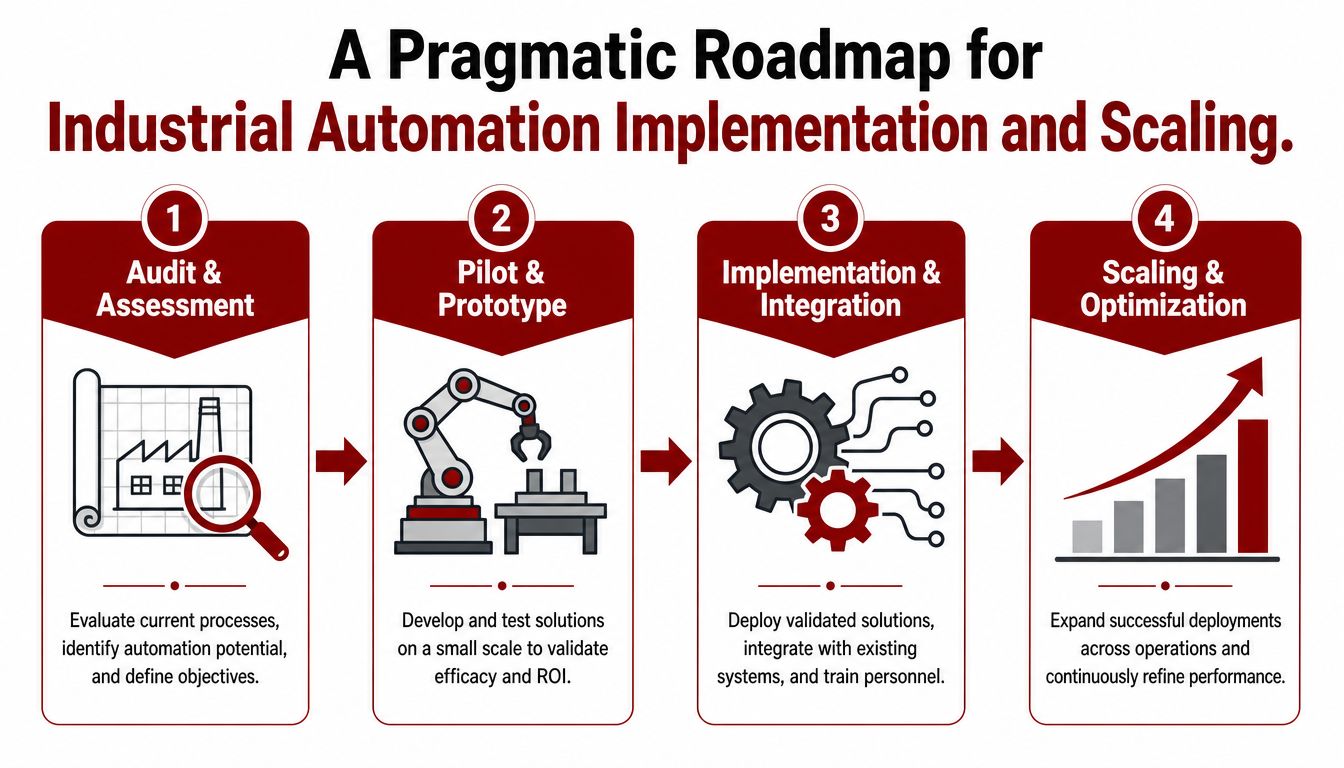
Most automation failures happen before installation. They start with vague objectives, weak process understanding, and an oversized first move. A good roadmap is less glamorous than a trade show demo, but it's what separates a scalable deployment from a write-off.
Start with process economics
Begin with a hard audit of the plant. Not a brainstorming session. A process audit.
Look for tasks with repeatability, labor concentration, high rework exposure, quality drift, or machine idle time driven by support functions. Then map where the financial pain resides. Sometimes the obvious automation target isn't the best one. The underlying bottleneck may be queueing between work centers, a setup delay, or an inspection choke point.
A useful checklist includes:
- Constraint location: Which process limits throughput today?
- Failure cost: Where do scrap, rework, or missed shipments hurt most?
- Data quality: Can the team measure cycle, downtime, and yield reliably?
- Replication potential: If the pilot works, where else can it be repeated?
This is also the stage to define systems architecture. If production data won't connect cleanly into planning and execution, the project becomes harder to manage. That's why many operators pair automation planning with manufacturing execution systems and MES design decisions.
Pilot with constraints not ambition
The best pilot is narrow, measurable, and operationally relevant. It should sit inside a real production environment, not a sanitized lab scenario.
Choose one cell or workflow where success and failure are obvious. Then set the decision criteria before launch. What would count as operational success? What would force redesign? Who owns uptime, training, quality validation, and issue resolution?
Operator check: If the pilot needs heroic support from vendors every day, it isn't ready to scale.
Hardware selection matters here, and the wrong vocabulary causes expensive mistakes. Robot platform choice should be anchored in four technical variables identified by ARC's analysis of industrial automation in data centers and related technical deployment considerations: payload (weight capacity), reach (work envelope), speed (cycle time), and accuracy (precision level). Those aren't spec-sheet trivia. They determine whether the system can solve the actual production problem.
Integrate before you scale
Once the pilot proves itself, the next challenge is integration. Many teams rush at this stage.
A successful cell still needs to connect into scheduling, maintenance response, quality records, and material flow. If the automation island performs well but the surrounding process remains messy, the gains flatten out.
That's why scaling should happen in layers:
- Stabilize the first deployment until uptime and quality are predictable.
- Document standard work for operators, technicians, and maintenance.
- Connect production data into management routines and daily accountability.
- Replicate into similar workflows before attempting highly customized ones.
At scale, the job shifts from engineering novelty to operational discipline. Plants that treat each automation install as a custom science project usually struggle. Plants that standardize controls philosophy, support routines, spare parts logic, and training material build momentum much faster.
Measuring Success KPIs ROI and Risk Management
A factory can spend heavily on automation and still get mediocre results. The reason is usually measurement. Teams celebrate installation instead of performance. Investors hear stories about innovation when they should be asking about output quality, schedule reliability, and adoption.
The right scorecard is operational first and financial second. Financial results matter, but they trail the plant behaviors that create them.
The scorecard that matters
Here's a practical KPI set that management teams and investors can review together.
| KPI | What It Measures | Why It Matters for Investors |
|---|---|---|
| OEE | Availability, performance, and quality at the equipment or cell level | Shows whether the automated asset is truly productive or just installed |
| First Pass Yield | The share of units that pass without rework | Indicates whether automation is improving process capability and margin quality |
| Cycle Time | Time required to complete a defined operation or workflow | Reveals whether throughput gains are real and whether quoting assumptions hold |
| Downtime Response | How quickly the team identifies and resolves stoppages | Reflects support readiness, maintenance discipline, and operational resilience |
| Schedule Adherence | Whether production follows committed plans | Tells investors if the operation is becoming more predictable for customers |
| Labor Reallocation | Whether people moved into higher-value roles | Shows that automation is strengthening the operating model, not creating internal friction |
| Data Integrity | Reliability and usability of machine and production data | Determines whether management can scale decisions beyond anecdote |
Notice what's missing. Vanity metrics. A robot running a demo cycle doesn't matter. A dashboard no supervisor trusts doesn't matter. What matters is whether the business can ship better, faster, and more predictably.
The talent-first risk lens
The biggest execution risk in automation usually isn't the machine. It's the capability gap around it.
The most important lesson in the market right now is that opportunity lies not in installing robots, but in building internal training pipelines to create a sustainable talent economy. Demand for skilled automation engineers exceeds supply, with companies struggling to fill roles despite over 32,000 open jobs on Indeed, as discussed in Corvalent's reporting on automation, jobs, and factory investment.
That has major implications for risk management.
- Train before scaling: Don't wait until startup week to think about who will support the system.
- Build internal ownership: Vendor dependency is expensive and fragile.
- Create apprenticeship paths: Technicians and operators often become the best automation support talent if leadership invests early.
- Partner locally: Community colleges and technical programs can become part of the staffing strategy.
A lot of companies say they have an automation strategy when what they really have is a capex list. A real strategy includes hiring, training, maintenance readiness, documentation, and problem escalation paths.
The plant that can diagnose and recover from faults quickly will outperform the plant with the flashier equipment.
Risk management also needs governance. Someone should own the automation P&L logic after implementation. Someone should own adoption. Someone should own performance reviews against the original investment case. Without that discipline, underperformance gets excused as a learning curve and never gets corrected.
Lessons From the Trenches Brief Case Studies
The strongest lessons from industrial automation opportunities don't come from theory. They come from operations where automation changed the economics of the business.

Semiconductors taught a clear lesson
Semiconductor manufacturing companies that integrated techno-casting and fastening automation systems after 2002 achieved a 40% reduction in material waste and a 50% increase in throughput, with market-cap valuations at IPO peaking at $250 million USD, according to the review of semiconductor manufacturing automation outcomes.
The point isn't just that automation improved efficiency. It's that targeted process automation changed the value of the company. Waste fell. Throughput improved. The business became more scalable and more investable.
Aerospace rewards precision and repeatability
In aerospace, the commercial upside comes from combining precision with consistency. Automated CNC machining, robotic support around high-value equipment, and better process control around complex forming or fastening tasks provide an advantage by protecting both schedule and quality.
That's why automation often works best in aerospace when management starts with bottleneck equipment and quality-sensitive workflows rather than broad slogans about digital transformation. The value sits in repeatability, traceability, and reliable output under pressure.
The durable lesson for founders and investors
The common thread across sectors is simple. Automation creates outsized value when it's attached to a business system.
That means disciplined process selection, capable people, integration into execution, and leadership that understands how operations translate into valuation. Companies that treat automation as a strategic operating model tend to build stronger margins and better exit options. Companies that treat it like a showroom purchase usually end up with expensive complexity.
About Hasit Vibhakar
Hasit Vibhakar is a serial entrepreneur and CEO with over 25 years of experience building, scaling & increasing shareholder value across Aerospace, Advanced Manufacturing & Industrial sectors. More information can be obtained at Hasit Vibhakar.
If you're evaluating industrial automation opportunities through the lens of enterprise value, operational execution, and scalable growth, explore more of Hasit Vibhakar's work on advanced manufacturing, aerospace, and industrial leadership.


Leave a Reply