
You're probably in one of three situations right now. You've built a solid company and want to know what it's worth before a sale process starts. You're thinking about succession and need a realistic number, not a cocktail-party estimate. Or you've had a buyer circle the business and throw out a multiple that sounds flattering until you ask what it means.
That moment matters more than most owners realize. In manufacturing and industrial markets, valuation isn't a theoretical exercise. It affects how you negotiate, how you invest ahead of a transaction, and how you explain the business to buyers who don't know your shop floor the way you do.
Hasit Vibhakar is a serial entrepreneur and CEO with over 25 years of experience building, scaling & increasing shareholder value across Aerospace, Advanced Manufacturing & Industrial sectors. More information can be obtained at Hasit Vibhakar.
I've spent enough time around acquisitions to know this: owners usually focus first on revenue, equipment, and customer names. Buyers usually focus first on quality of earnings, risk, and how repeatable the operation looks after the owner steps back. Business valuation multiples sit right in the middle of that tension. They turn the story of a company into a price range.
If you want a broader primer on how owners determine business value, that's a useful starting point. If you're already further along and thinking about sequencing, diligence, and buyer interaction, the business acquisition process gives a practical lens on how valuation fits into a real deal.
Table of Contents
- Your Company Has a Price What Is It
- What Are Business Valuation Multiples
- Decoding the Four Key Valuation Multiples
- The Art of Normalizing Your Financials
- Finding Your Benchmark How to Source Multiples
- Multiples in Action Manufacturing and Middle-Market M A
- Your Practical Valuation Multiples Checklist
Your Company Has a Price What Is It
A business owner I know spent decades building a respected industrial company. Good machines, strong customer relationships, loyal employees, clean facility. When he finally asked what the company was worth, he expected the answer to come from history and effort. The buyer's first question was different. They wanted to know what the business could reliably earn without him in the middle of every major decision.
That's the first hard truth in valuation. Your company has a price, but the market doesn't calculate it based on how hard you worked to build it. Buyers look at what they're acquiring, what risks they're taking on, and what kind of return the company can support once ownership changes hands.
A manufacturing business isn't priced like a trophy. It's priced like an operating asset.
Why owners get surprised
Owners often overvalue what buyers consider ordinary and undervalue what buyers consider scarce. A beautiful machine park matters, but only if it supports margins, throughput, quality, and customer retention. A long customer list matters, but less so if a single account drives the economics. Even strong profits can get discounted if the owner personally closes every sale, approves every quote, and solves every production bottleneck.
What a realistic valuation starts with
A serious conversation about business valuation multiples starts with a few grounded questions:
- What metric will buyers anchor to. Revenue, EBITDA, earnings, or book value.
- How transferable is the operation. Can the company run without founder dependence.
- What risks will a buyer underwrite. Customer concentration, capex burden, supply chain fragility, compliance, labor depth.
- What story do the numbers support. Stable, cyclical, turnaround, niche, proprietary, or commoditized.
In middle-market industrial M&A, this process becomes very practical very quickly. The multiple is never just a finance term. It's a shorthand for confidence.
What Are Business Valuation Multiples
Most owners understand valuation faster when they stop thinking like accountants and start thinking like buyers in a local real estate market. If you were pricing a house, you wouldn't begin with what the owner spent on renovations years ago. You'd look at comparable homes, in a comparable area, with comparable features, then adjust for quality, condition, and demand.
Business valuation multiples work much the same way. A buyer looks at similar companies and asks, “What price did the market place on earnings, revenue, or assets for businesses like this one?”
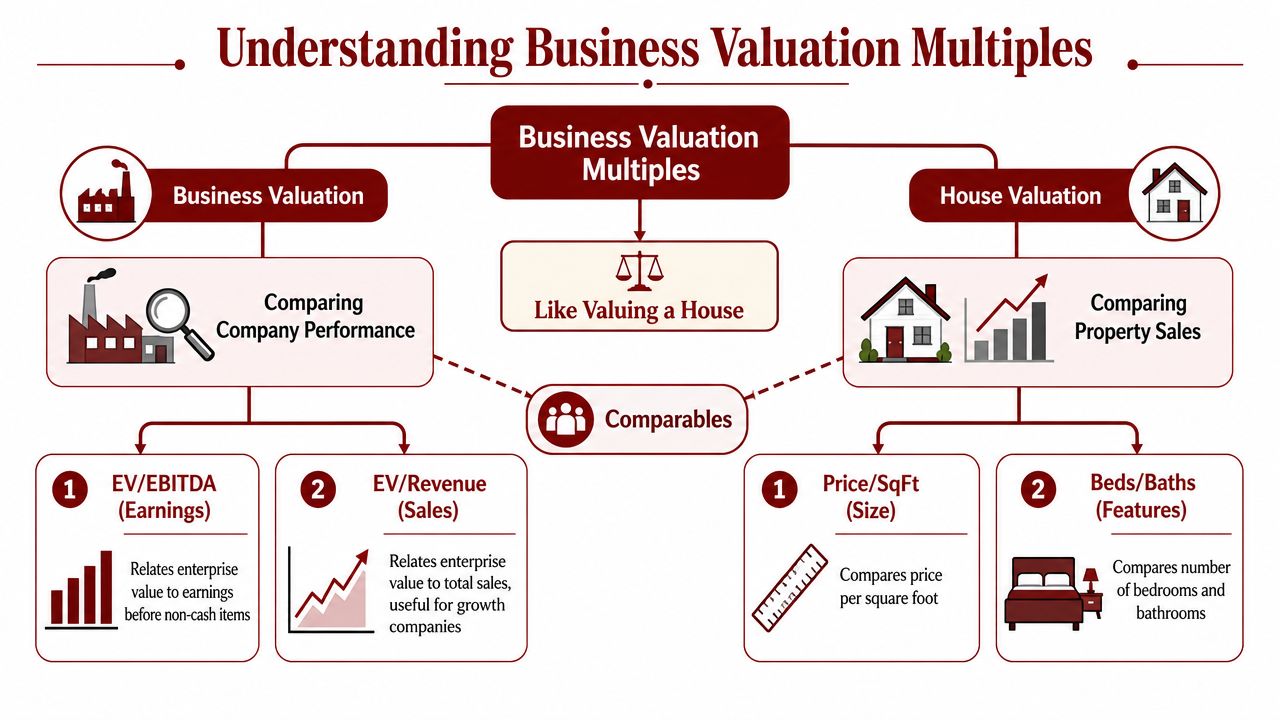
Business valuation multiple means a ratio that compares a company's value to a financial metric such as revenue, EBITDA, net income, or book value.
The logic behind the ratio
A multiple tells you how the market translates performance into value. If two manufacturers both produce similar components, serve similar customers, and generate similar margins, buyers will usually start by comparing them on a common yardstick. That yardstick might be enterprise value divided by EBITDA. It might be enterprise value divided by revenue. The choice depends on the economics of the business.
The ratio itself isn't magic. It's a shortcut built on comparability.
Why multiples matter in the real world
Business valuation multiples help owners answer practical questions:
- Should I sell now or improve the business first. The answer often depends on whether operational improvements will expand the multiple or just the earnings base.
- Is a buyer's offer grounded in market logic. A multiple lets you compare the offer to relevant deals and peer businesses.
- What should I fix before going to market. Owners can often improve value more by reducing risk than by chasing growth for growth's sake.
A multiple also forces clarity. If a buyer says your company deserves a lower valuation, the debate usually comes down to a few specific issues. Margin durability. Customer concentration. Management depth. Equipment age. Working capital needs.
That's useful. It turns vague opinions into concrete negotiation points.
Decoding the Four Key Valuation Multiples
The market uses several common ratios, but they don't serve the same purpose. Choosing the wrong one can distort the picture. Choosing the right one helps you understand how a knowledgeable buyer will truly think about your company.
The Logic Behind the Ratio
Before breaking down each multiple, keep one distinction clear. Enterprise value reflects the value of the whole operating business. Equity value reflects what belongs to shareholders after debt and similar claims are accounted for. That's why some multiples use enterprise value and others use equity value.
In industrial M&A, buyers spend a lot of time on the capital structure and the earning power separately. That's one reason EBITDA-based thinking shows up so often in actual transactions.
Later in a process, some owners also look at return metrics such as multiple of invested capital or MOIC to understand how investors frame outcomes on their side of the table.
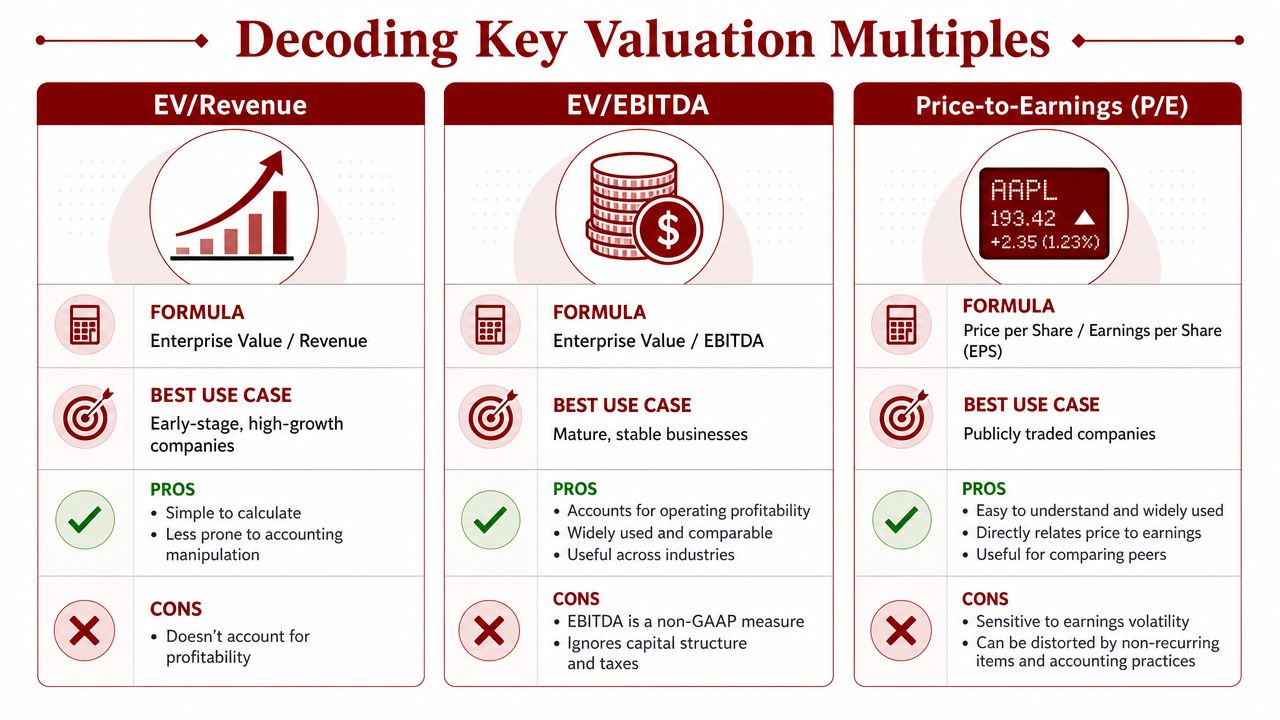
EV Revenue
Formula: Enterprise Value / Revenue
EV/Revenue is simple. It compares the value of the business to top-line sales. It's useful when profitability is depressed, inconsistent, or not yet representative of the company's potential.
This multiple shows up more often when a buyer believes the revenue base itself has strategic value. That could mean sticky customer contracts, attractive end markets, proprietary products, or a platform that hasn't been operationally optimized yet.
Where it helps:
- Growth stories where margins are still maturing
- Businesses in transition where EBITDA temporarily understates potential
- Situations with noisy earnings due to unusual operating structure
Where it falls short:
- Revenue doesn't equal quality. Two companies with the same sales can have very different gross margins, scrap rates, and capital intensity.
- Manufacturing owners can get misled if they rely on revenue while ignoring working capital demands and equipment needs.
EV EBITDA
Formula: Enterprise Value / EBITDA
For middle-market owners, this is usually the workhorse multiple. In middle-market M&A transactions (deals valued between $10M and $250M), over 80% of valuations are primarily based on a multiple of EBITDA, making it the most critical metric for business owners to understand and optimize according to this middle-market M&A report.
That fact lines up with what experienced operators see in practice. Buyers like EBITDA because it focuses attention on operating earnings before financing choices, tax structure, and certain accounting items cloud the comparison. In manufacturing, that makes sense. One company may lease equipment, another may own it. One may have a different tax profile. EBITDA creates a cleaner starting point.
Where it helps:
- Established industrial companies with stable operations
- Platform and add-on acquisitions where buyers compare operating performance across targets
- Negotiations involving private equity and strategic buyers who care about cash-generating ability
Where it falls short:
- EBITDA is not cash flow. It doesn't capture all capital expenditure needs or working capital swings.
- A weak quality-of-earnings profile can make headline EBITDA less persuasive than owners expect.
A short visual overview helps anchor the distinctions before you apply them in a deal.
Price to Earnings
Formula: Equity Value / Net Income
P/E gets a lot of attention in public markets because it's familiar and easy to quote. For private manufacturing companies, it's often less useful than EBITDA-based methods. Net income can swing with debt load, tax structure, depreciation schedules, and accounting choices that don't necessarily reflect the operational attractiveness of the business.
It still has value in some contexts. If you're comparing mature, stable businesses with relatively straightforward capital structures, P/E can offer a sanity check. But in owner-led middle-market companies, it rarely tells the full story on its own.
Price to Book
Formula: Equity Value / Book Value
Price-to-Book compares equity value to the net asset value on the balance sheet. Asset-heavy companies naturally draw attention to it, especially in sectors where machinery, tooling, inventory, and real estate play a meaningful role.
The problem is that book value often lags economic reality. Old equipment may be fully depreciated but still productive. Other assets may sit on the books at values that don't reflect marketability or earnings contribution. A buyer of an operating manufacturing company usually cares more about what the asset base produces than what accounting says it's worth.
Common Valuation Multiples at a Glance
| Multiple | Formula | Best For | Key Consideration |
|---|---|---|---|
| EV/Revenue | Enterprise Value / Revenue | Growth businesses, inconsistent profitability, strategic platforms | Useful when earnings are noisy, but ignores profit quality |
| EV/EBITDA | Enterprise Value / EBITDA | Established middle-market operating companies | Strong for comparing operating performance, but not a substitute for cash flow analysis |
| Price-to-Earnings | Equity Value / Net Income | Mature businesses with cleaner capital structures | Sensitive to taxes, interest, and accounting choices |
| Price-to-Book | Equity Value / Book Value | Asset-heavy businesses and balance-sheet checks | Doesn't capture earning power well on its own |
The Art of Normalizing Your Financials
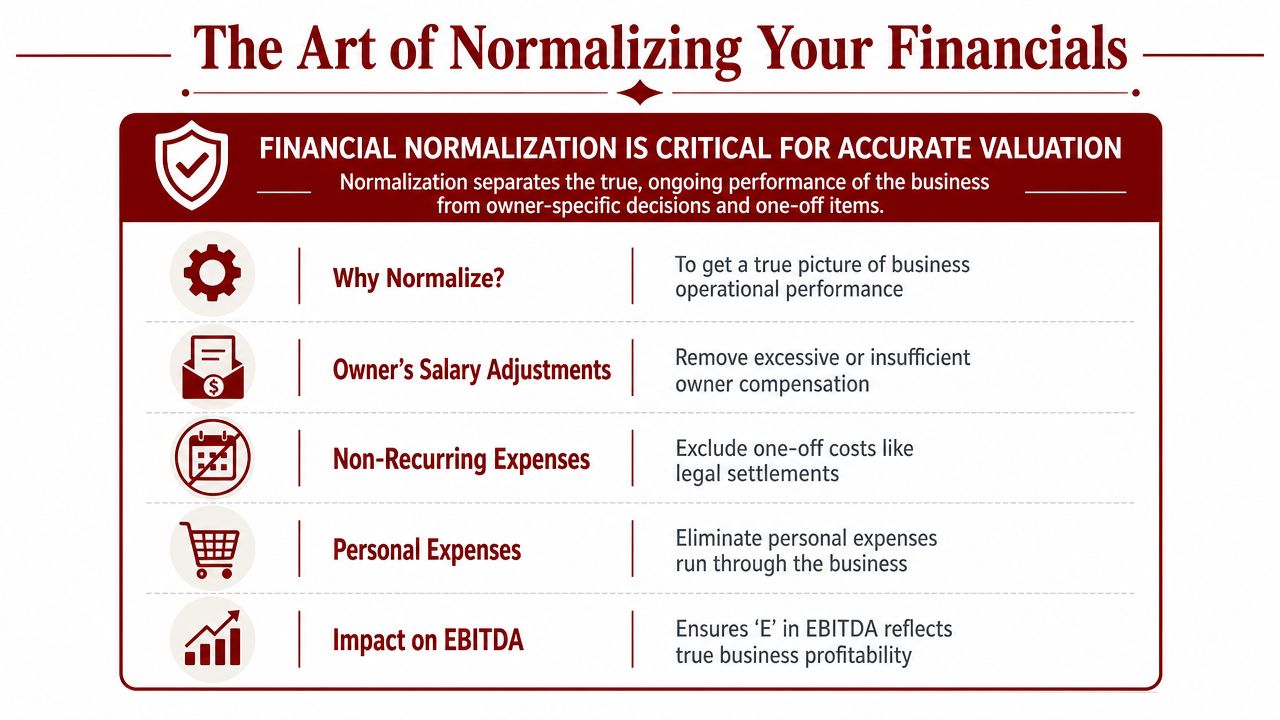
The most expensive mistake owners make is assuming the EBITDA on the tax return is the EBITDA a buyer will use. It won't be. Buyers normalize financials to estimate ongoing earnings power of the company under market-based ownership.
That process can add credibility when it's done carefully. It can also destroy credibility when owners treat every uncomfortable expense as an add-back.
What Buyers Actually Adjust
A good normalization exercise strips out items that aren't part of ordinary, repeatable operations.
Common examples include:
- Owner compensation above or below market. If the owner takes an unusually high salary, family payroll, or distributions through the P&L, buyers will adjust toward a market replacement cost.
- One-time legal or professional fees. A nonrecurring dispute, transaction prep cost, or unusual consulting project may be added back if it won't recur.
- Personal expenses run through the business. Vehicles, travel, entertainment, or property costs that don't support operations will get challenged and usually removed.
- Unusual events. A storm-related disruption, major nonrecurring repair, or isolated relocation expense may warrant an adjustment.
Practical rule: If the expense is likely to happen again after closing, it isn't an add-back. It's part of the business.
In manufacturing, the judgment call often sits around maintenance and repairs. Replacing a spindle after a one-off catastrophic failure may be framed differently from the routine upkeep needed to keep older CNC equipment running. Buyers know the difference. If the machine park requires recurring heavy maintenance, that's operational reality, not normalization.
What Does Not Belong in Add Backs
Owners weaken their position when they get aggressive. A buyer's diligence team will test every adjustment and ask for support.
Watch for these trouble spots:
- Chronic underinvestment presented as efficiency. Deferred maintenance doesn't increase value. It often reduces it.
- Sales and marketing cuts that only exist because the owner personally sells everything. A buyer may need to hire commercial talent after closing.
- Temporary margin spikes caused by unusual pricing, a one-off order mix, or delayed hiring.
The best normalization file reads like a well-kept production log. Clean support, clear rationale, and no drama.
Finding Your Benchmark How to Source Multiples
Once you've got a credible earnings number, the next question is obvious. What multiple belongs on it? Owners often expect a simple industry average. Real benchmarking is messier than that.
A useful multiple comes from context, not from grabbing the first number you hear from a broker, banker, or peer at a conference.
Public Comps Versus Precedent Deals
There are two main benchmark sources, and each tells a different story.
Public company comparables look at how listed companies trade in the market. They're helpful because the data is visible and updated frequently. They also let you compare margin profile, growth, and end-market exposure across peers.
The problem is fit. Public companies are usually larger, more diversified, more liquid, and often assigned a premium for scale and market visibility. A private precision machining business shouldn't assume it deserves the same trading range as a large public industrial platform.
Precedent transactions look at actual M&A deals. For a seller, this is often the more relevant lens because it captures what buyers paid for control in real transactions. It also reflects synergies, strategic logic, and competitive tension in a sale process.
The challenge is access. Private deal data isn't always easy to find, and summary data often lacks the detail needed to judge whether a comp is comparable.
Precedent transactions tell you what buyers paid. Public comps tell you what investors are willing to pay for liquidity, scale, and visibility. Those are not the same market.
Where Owners Actually Get the Data
Private middle-market owners usually assemble benchmark information from several sources at once:
- Investment bankers and M&A advisors who track active deal conversations and recent closings in the sector
- Industry-specific transaction databases used by financial professionals
- Trade networks and buyer feedback gathered during informal market testing
- Board members, investors, and operating executives who've recently been through comparable transactions
Some owners also use a valuation tool as a rough starting point. Hasit Vibhakar offers a free valuation tool that applies an income approach using EBITDA multiplied by an industry multiple. That can help frame an initial range, but it's still only a starting point. The benchmark only becomes useful when it's tied to your company's risk profile, market position, and transferability.
Multiples in Action Manufacturing and Middle-Market M A
In industrial deals, buyers rarely argue over formulas first. They argue over risk, transferability, and how much confidence they have in the earnings stream. That's why two shops with similar revenue can command very different valuations.
For manufacturing owners, the practical question isn't “What multiple exists in theory?” It's “Why would a buyer pay the higher end of a range for my business?”
What Buyers in Industrial Markets Care About
Private equity firms and strategic acquirers tend to reward a handful of operational traits in manufacturing:
- Customer quality and concentration. Repeat business from strong accounts helps. Heavy dependence on one customer creates tension fast.
- Management depth. If the owner handles quoting, engineering escalation, customer relationships, and key hires, the business is harder to transfer.
- Supply chain resilience. Buyers pay attention to supplier dependencies, single-source materials, and how the company handles disruption.
- Process and quality discipline. Certifications, traceability, scrap control, on-time delivery, and documented workflows all shape confidence.
- Capex profile. A company that needs continual heavy equipment replacement will get viewed differently from one with durable, productive assets and a disciplined investment cadence.
- Differentiation. Proprietary tooling, specialized know-how, patents, unique process capability, or deep customer integration can support stronger positioning.
That's also why private equity strategy matters. Buyers aren't only purchasing current earnings. They're underwriting a path to future value creation, which is discussed well in this perspective on private equity investment strategy.
A Hypothetical CNC Machining Example
Take a hypothetical CNC machining company serving aerospace and industrial customers. The company has credible leadership below the owner, a healthy mix of repeat work, disciplined quoting, and well-maintained equipment. Another shop of similar size may have the same headline sales but rely on one relationship-driven customer, loose cost controls, and aging machines that need near-term replacement.
The first business will usually attract more buyer confidence, even before anyone debates the exact multiple. Buyers can see how the earnings continue after closing. They can also see an easier path to scaling, integrating, or refinancing the business later.
Here's how owners should think about the exercise:
- Start with normalized EBITDA. That gives buyers a cleaner base.
- Select a realistic range of comparable multiples. Not a dream number, not a distressed number.
- Pressure-test the story. Ask what would make a buyer move lower in the range.
- Tie operations to valuation. Better scheduling discipline, lower scrap, diversified accounts, and a stronger second layer of management often matter more than cosmetic improvements.
A manufacturing deal gets won in the details. Floor layout, job costing discipline, quote hit rate, backlog quality, engineering responsiveness, and customer mix all feed the valuation conversation. Business valuation multiples are the pricing language. The operation is the reason the language moves up or down.
Your Practical Valuation Multiples Checklist
Most owners don't need more theory. They need a clean process they can act on. If you're starting to evaluate your company, use this checklist the way you'd use a preflight review before a plant audit or a buyer meeting.
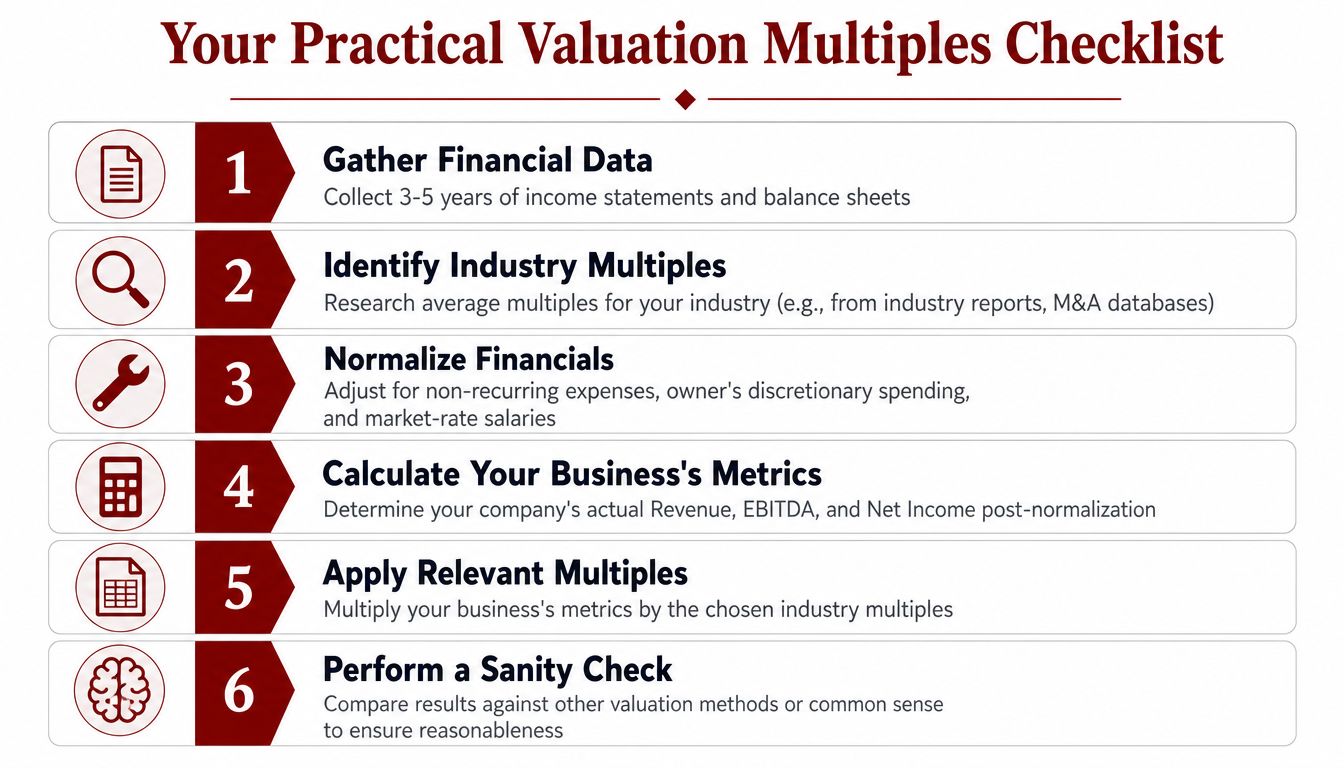
A practical working list
Gather your financials
Pull together clean income statements, balance sheets, and supporting schedules. If the files are inconsistent, fix presentation before you talk value.Normalize earnings carefully
Remove nonrecurring and owner-specific items, but keep the adjustments defensible. If you can't explain an add-back in one clear sentence, expect buyer pushback.Choose the right metric
For many middle-market industrial businesses, EBITDA will be the central measure. In some cases, revenue, earnings, or book value can help as secondary checks.Source realistic benchmark multiples
Use transaction context, advisor input, and sector knowledge. Don't anchor to the highest number you've heard.Apply a range, not a single point
Valuation is a range because deal quality, risk, structure, and buyer motivation vary. Serious owners prepare for a negotiation band, not a magic number.Build the story behind the numbers
A higher multiple comes from confidence. Show why customers stay, why margins hold, why management can run the business, and why the assets support future growth.
The number gets attention. The quality of the business decides whether the number survives diligence.
If you're weighing a sale, acquisition, recapitalization, or want a sharper view of what drives value in an industrial business, Hasit Vibhakar offers practical insight shaped by decades of CEO-level experience in aerospace, advanced manufacturing, and middle-market M&A.


Leave a Reply