

Cash lands in the business, and the arguments start fast. Add a production line. Buy a competitor. Pay down debt. Fund the automation project that could reset unit economics in three years, or fail after burning real money and management time. In industrial companies, capital allocation decisions shape far more than this quarter's earnings. They determine plant flexibility, customer concentration, margin durability, and eventual exit value.
The hard part is not finding uses for capital. The hard part is ranking competing uses when several look strategic and only one or two will earn the right to be funded now. That challenge is sharper in manufacturing, aerospace, and semiconductor related businesses, where long asset lives, cyclicality, and operational constraints punish weak decisions.
I have spent more than 25 years building and scaling companies across aerospace, advanced manufacturing, and industrial sectors, and the pattern is consistent. The businesses that create durable shareholder value do not spread capital evenly across good ideas. They use a repeatable framework to separate core maintenance spend from true growth investment, and to size strategic bets according to evidence, downside risk, and speed to learning.
That matters most in categories with uncertain outcomes. A new production cell, a process technology upgrade, a software layer on top of an installed industrial base, or a tuck-in acquisition can all look attractive in a board deck. Few general guides address how operators should allocate capital to those bets when the data is incomplete, the payoff curve is uneven, and the cost of being early is different from the cost of being late. That is the gap this article addresses.
For readers who also compare capital deployment across asset-heavy sectors, the Homebase capital market guide offers a useful parallel on how investors assess financing conditions and return trade-offs.
Table of Contents
- Beyond the Balance Sheet Capital Allocation Explained
- The Five Core Capital Allocation Levers
- A Decision Framework for Optimal Allocation
- Capital Allocation in Action Sector Specific Examples
- Navigating Risks and Avoiding Common Pitfalls
- Guidance for Founders and Private Equity Firms
- Making Capital Allocation Your Competitive Advantage
Beyond the Balance Sheet Capital Allocation Explained
A CEO usually meets capital allocation at a moment of tension, not theory. The company has room to move, but not enough room to do everything. The question is simple. Which use of capital will produce the most durable value with the least avoidable regret?
That framing matters because capital allocation isn't accounting. It's the practical act of converting strategy into outcomes. If your strategy says you want to lead in a niche, control quality, shorten lead times, or build proprietary process capability, capital allocation is the mechanism that makes those choices real.
Why this feels harder in industrial businesses
The challenge gets sharper in advanced manufacturing and industrial companies because some of the highest-upside investments don't fit neat financial templates. The first underserved angle is the lack of concrete, data-backed frameworks for allocating capital to strategic bets with uncertain outcomes in manufacturing and industrial sectors. General allocation rules are common, but they rarely show leaders how to judge the ROI or risk profile of deep-tech R&D or process innovation in advanced manufacturing, a gap that matters for operators such as Hasit Vibhakar, who holds patents in techno-casting and forging, as discussed in McCracken Alliance's view on growth-stage capital allocation.
A machine tool purchase is visible. A tooling automation project is tangible. A proprietary materials process or fastening technology program is harder. It may not show immediate payback, but it can reshape margins, customer stickiness, and valuation quality.
Practical rule: If a company only funds what can be modeled with certainty, it usually overfunds maintenance and underfunds strategic advantage.
Capital-intensive leaders can also learn from adjacent capital markets. Real estate operators, for example, live with financing structure, timing, and return thresholds every day. The Homebase capital market guide is useful because it shows how disciplined capital sourcing and deployment affect outcomes long before a deal closes.
What strong allocators do differently
Strong allocators treat every dollar as a strategic vote. They ask four hard questions:
- What is this capital meant to do: protect the core, expand capacity, build differentiation, or create optionality?
- What must be true: what assumptions about demand, margins, execution, and timing have to hold?
- What are we not funding: every allocation decision has an opportunity cost.
- What is our exit path: if the thesis breaks, can the company redirect, pause, or recover the capital?
Experienced operators set themselves apart. They don't chase activity. They build a repeatable decision discipline around trade-offs, sequencing, and accountability.
The Five Core Capital Allocation Levers
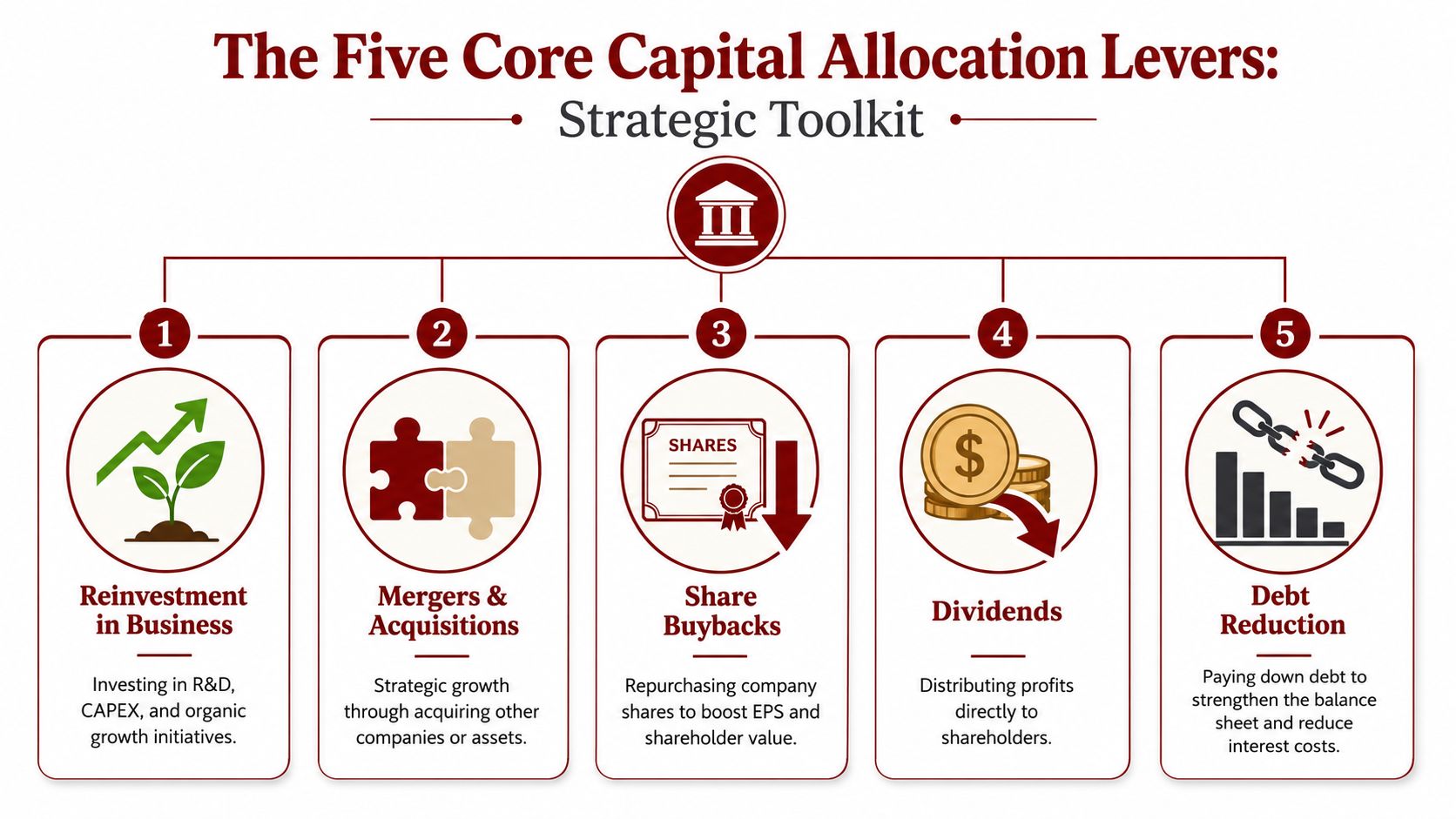
Capital deployment usually falls into five levers. None is universally right. The right mix depends on your operating model, balance sheet, market structure, and strategic horizon.
Reinvestment in the business
This is the most familiar lever. It includes capex, R&D, process upgrades, automation, software, tooling, and go-to-market expansion tied to organic growth.
BCG found that capex levels relative to revenues have declined by approximately 15% over the past ten years, reflecting a shift toward investing in entire businesses rather than isolated projects, according to BCG's capital allocation analysis. That matters because many companies still approve investments one project at a time without asking whether the combined program fits the strategy.
A factory can buy another machine and still weaken its competitive position if the larger portfolio is fragmented.
Mergers and acquisitions
Acquisitions can compress time. They can add customers, certifications, engineers, geographic reach, or supply chain control faster than building internally.
Morgan Stanley's research indicates that approximately 85% of corporate value realization occurs through the sale of an asset or division to another company, rather than through spinoffs or other mechanisms, underscoring how central M&A is to value creation in many capital allocation strategies, as outlined in Morgan Stanley's capital allocation research.
That doesn't make every deal smart. It means M&A deserves disciplined screening, not reflexive skepticism.
Share buybacks and dividends
Both levers return capital to shareholders, but they serve different situations. Buybacks make sense when management believes the shares are undervalued and has no better internal use for the capital. Dividends fit businesses with reliable cash generation and limited reinvestment needs.
For private companies, the equivalent question is often owner distributions versus reinvestment. Leaders should be explicit about whether cash is being extracted because the business is mature or because management lacks conviction in the next phase.
Debt reduction
Paying down debt rarely looks exciting in a board deck. It can still be the highest-quality allocation decision. Lower debt levels increase resilience, protect covenant flexibility, and create future capacity to act when competitors are constrained.
Businesses that operate in cyclical sectors should take this lever seriously. Optionality is a strategic asset.
Funding strategic bets
This is the least discussed lever and often the most important one in industrial and technology businesses. Strategic bets include exploratory product programs, process breakthroughs, proprietary manufacturing methods, or adjacent market entries that are difficult to underwrite with precision at the start.
If you're evaluating how layered financing affects flexibility before committing to those bets, Business Loan Warrior's funding guide offers a practical look at capital stacking and how funding structure can influence decision quality. In operating terms, leaders also need discipline around cash conversion and working capital, and a sharper process for working capital optimization can free internal capital before new money is raised.
Capital Allocation Levers Compared
| Strategy | Primary Goal | Typical Risk Profile | Time Horizon | Best For |
|---|---|---|---|---|
| Reinvestment in Business | Organic growth and stronger capability | Moderate to high | Medium to long | Capacity expansion, productivity, product development |
| Mergers & Acquisitions | Faster strategic expansion | High | Medium to long | Market entry, capability acquisition, consolidation |
| Share Buybacks | Per-share value support | Moderate | Medium | Public companies with limited better uses of cash |
| Dividends | Direct shareholder return | Low to moderate | Near to medium | Mature cash-generative businesses |
| Debt Reduction | Balance sheet strength | Low | Near to medium | Cyclical sectors, leveraged companies, uncertain markets |
The best capital allocation system doesn't pick one lever and stick with it. It ranks all five against the same strategic objective.
A Decision Framework for Optimal Allocation
Most allocation failures aren't caused by bad intentions. They come from inconsistent criteria. One proposal gets approved because it's urgent. Another because a senior executive sponsors it. A third because the model looks neat. That's not a framework. That's drift.
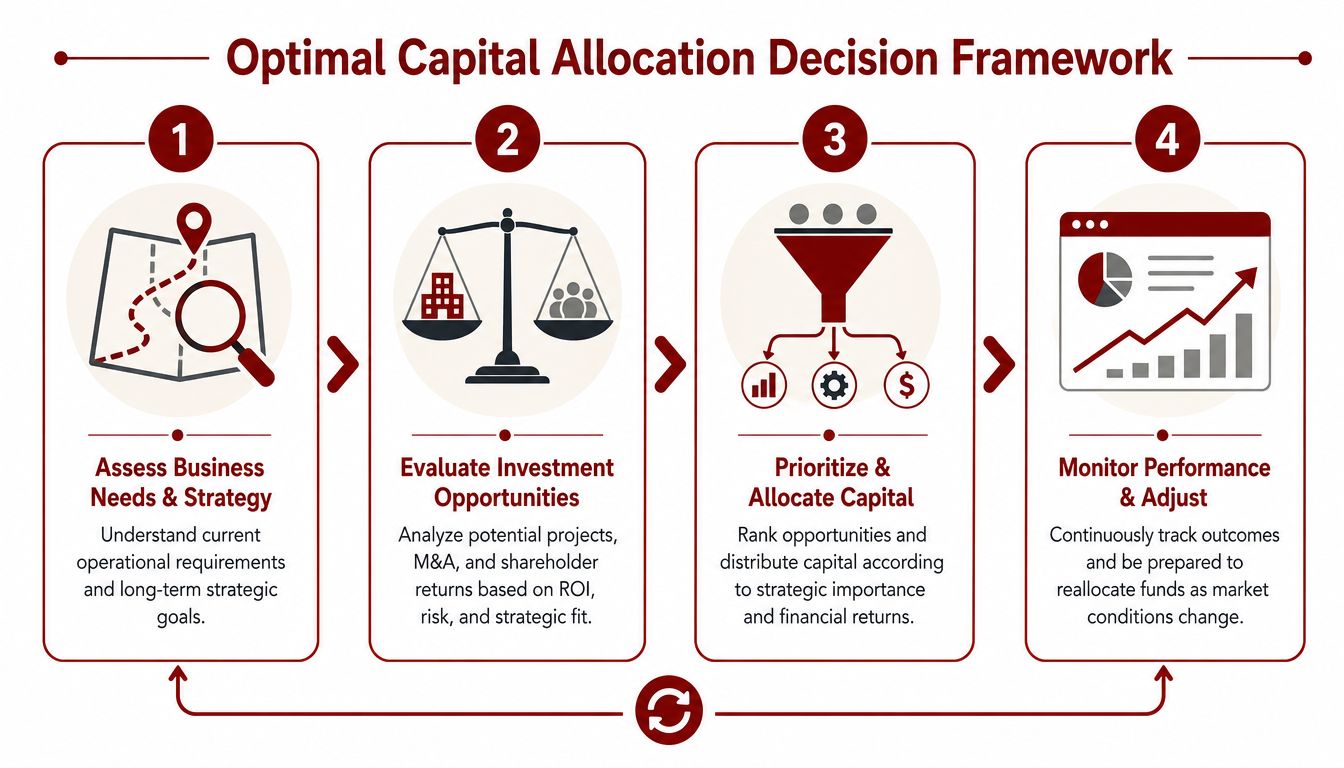
A stronger system starts with a multi-year view. An advanced capital allocation approach sets 3–5 year outcomes for measures such as ROIC and TSR, allocates capital across Run, Grow, Options, Portfolio, and Returns, anchors decisions in NPV, uses differentiated hurdle rates based on risk, and revisits choices through quarterly reviews, as described in Umbrex's capital allocation framework.
Start with ambition and guardrails
Before ranking projects, define what the company is trying to become. That means setting explicit outcomes over the next several years. It also means stating what is essential. Safety, regulatory compliance, and mission-critical customer commitments shouldn't compete with discretionary projects in the same way.
Without guardrails, every project team claims strategic importance. With guardrails, leaders can separate mandatory spending from true allocation choices.
Use buckets to force portfolio thinking
The bucket model is useful because it prevents the core business from crowding out future growth. A practical interpretation looks like this:
- Run: spending required to maintain operations, quality, uptime, and customer delivery.
- Grow: capital directed toward initiatives already tied to strategic expansion.
- Options: smaller, staged investments in uncertain but potentially important bets.
- Portfolio: divestitures, restructuring, and repositioning actions.
- Returns: dividends or buybacks where appropriate.
This structure does something simple and powerful. It stops every proposal from pretending to be the same kind of investment.
Compare unlike investments with comparable rules
A production line, an acquisition, and an exploratory process innovation won't carry the same risk. They shouldn't face the same hurdle rate either.
A disciplined approach uses NPV as the primary anchor, then checks IRR and payback. It also applies different hurdle rates depending on maturity and uncertainty. Early-stage options deserve tighter stage gates, not necessarily blanket rejection.
Boardroom test: If management can't explain why one category of investment has a different hurdle rate than another, the framework isn't finished.
For investors and operators evaluating returns across a holding period, it also helps to connect capital allocation to ownership economics. A solid reference point is this primer on multiple of invested capital and MOIC, especially when comparing near-term cash returns against longer-duration value creation.
Reallocate aggressively when facts change
Quarterly review matters because the original spreadsheet is never the practical reality. Some projects prove out quickly. Others stall. The discipline isn't just approval. It's redirection.
Use a simple rule set:
- Keep funding winners when milestones are being met and the thesis is strengthening.
- Stage-gate uncertainty when evidence is still emerging.
- Kill laggards when facts no longer support the original use of capital.
- Recycle freed capital into higher-conviction opportunities.
Companies that do this well don't treat sunk costs as sacred. They treat fresh capital as precious.
Capital Allocation in Action Sector Specific Examples
A plant manager has a line running at full utilization, customers are pressing for shorter lead times, and engineering wants funding for a new process platform that might change the margin profile in three years. That is what capital allocation looks like in industry. Rarely is the decision growth versus caution. It is how much to place on the core business, how much to reserve for strategic bets, and what evidence must appear before more capital goes in.

Advanced manufacturing
A precision manufacturer often has two attractive uses for the same dollar. One funds another CNC cell, automation, or inspection capacity to relieve a visible bottleneck. The other funds a proprietary process, such as a new forging route, fastening method, or materials capability that could change pricing power later.
The first use is easier to underwrite because demand, uptime, scrap, and throughput can usually be modeled with reasonable confidence. The second is harder because the return depends on technical success, customer qualification, and whether the process earns a premium in the market.
Good operators separate those decisions. They protect service levels first, then carve out a defined pool for strategic bets with clear technical and commercial gates. In practice, that means management does not ask an early process-development program to clear the same test as a mature capacity project. It asks a different question. Has the team reduced technical risk enough to justify the next tranche of capital?
That distinction matters in industrial businesses because the best opportunities often sit between standard capex and pure R&D. A new coating process, tooling method, or automation architecture may not show a clean payback in year one. It can still be the right allocation if it raises yield, improves switching costs, or gives the company a position competitors cannot match.
Aerospace
Aerospace adds another layer of discipline because the cost of being wrong is high. Certification lead times are long, quality escapes are expensive, and supplier performance affects program share for years.
In that environment, M&A can be a sound capital allocation move, but only when the buyer is explicit about what it is purchasing. Extra revenue is not enough. The target should add a capability or approval set that changes the economics of the existing business. That may mean better machining depth, tighter control over a critical process, access to approved content on a program, or stronger on-time delivery with key OEM and Tier 1 customers.
I have seen aerospace deals look cheap on entry multiple and still destroy value because the buyer underestimated integration into quality systems, customer approvals, and operating cadence. The reverse can also be true. A deal that looks expensive on a headline multiple can make sense if it closes a capability gap that would take years to build internally and protects strategic customer relationships. For sponsors and acquirers, that is where holding-period math matters. A practical benchmark is how the investment supports your target MOIC in private equity deals, not just whether the acquisition is accretive next year.
In aerospace, the cheapest-looking option often becomes the most expensive if it weakens control over quality, lead time, or certification readiness.
Semiconductors
Semiconductors make the capital allocation question even sharper because scale, customer trust, and capacity funding often outrun what internal cash flow can support. That is why an IPO should be treated as a capital allocation choice, not just a financing milestone.
Hasit Vibhakar founded a semiconductor manufacturing company and later took it public. The useful lesson is not the biography. It is the decision process behind choosing the public markets. Management had to weigh whether staying private would limit capacity investment, customer credibility, recruiting, and strategic flexibility relative to the cost of being public, including dilution, disclosure requirements, and quarter-to-quarter scrutiny.
That framework applies broadly across high-tech manufacturing. A company should consider an IPO when three conditions line up. The business has a credible use for substantial growth capital. The added visibility materially helps win customers or partners. The operating system is mature enough to handle public market discipline without distorting decisions.
If those conditions are missing, public capital can become expensive and distracting. If they are present, changing the capital structure may produce better long-term returns than squeezing expansion out of retained earnings alone. In industrial and semiconductor settings, that is often the core strategic bet: not only where to invest, but what capital base gives the company the best odds of compounding value.
Navigating Risks and Avoiding Common Pitfalls
The biggest errors in capital allocation usually sound reasonable at the start. A leader wants diversification. A board wants visible growth. An operating team wants to finish what it started. Trouble enters when discipline gives way to narrative.

The expensive stories companies tell themselves
One common mistake is bad diversification. Management buys a business outside its real competence and calls it strategic adjacency. In practice, the company inherits unfamiliar customers, different operating rhythms, and hidden integration friction. The result is often complexity without advantage.
Another mistake is protecting pet projects. Industrial companies are especially vulnerable because technical teams can become emotionally invested in a platform, tool path, material process, or product architecture long before market evidence supports continued funding.
Three patterns show up repeatedly:
- Sunk cost thinking: teams keep funding weak initiatives because they've already spent time and money.
- Empire building: executives prefer bigger organizations over better returns.
- Short-term optics: companies prioritize moves that look decisive in the next quarter instead of those that improve long-term economics.
Leaders in project-based industries can see a parallel in financing decisions. The practical lessons in private lending tips for rehab projects are relevant because they show how weak assumptions and poor contingency planning can turn a promising investment into a strained one.
Build kill criteria before you fall in love with the project
Most businesses define approval criteria. Fewer define exit criteria. That is where a lot of value leaks out.
Write down, in advance, what would cause the company to pause, redirect, or stop funding a project. It may be missed milestone evidence, customer adoption signals, qualification delays, or a change in strategic fit. The important point is to decide before politics takes over.
Hard-won lesson: A project rarely becomes easier to kill after the organization has built identity around it.
A useful perspective on this discipline is below. It reinforces why capital allocation has to remain dynamic under uncertainty.
What works better
Resilient allocators separate confidence from certainty. They don't need perfect information. They need explicit assumptions, staged commitments, and a willingness to change course when evidence changes.
That is what protects capital from optimism masquerading as strategy.
Guidance for Founders and Private Equity Firms
The same allocation principles apply very differently depending on who controls the capital and what the clock looks like.
For founders
Founders should think about capital in terms of survival, strategic advantage, and future negotiating power. Early on, the best move is often not the one with the highest projected return. It's the one that preserves flexibility while proving a value inflection point.
That usually means focusing on a few priorities:
- Protect the engine: keep enough capital in the core operation to maintain customer trust and delivery performance.
- Fund proof, not ambition alone: early strategic bets should earn follow-on capital through milestones.
- Know the cost of dilution: external capital can accelerate growth, but it changes future bargaining power.
When founders prepare for a future transaction, they should also understand how investors frame outcomes. This is where target return logic matters, and a practical reference is target MOIC in PE deals.
For private equity firms
Private equity firms should treat historical capital allocation discipline as a diligence topic, not a footnote. The key questions are straightforward. Did management invest in projects that fit strategy? Did prior acquisitions integrate cleanly? Did capex improve throughput, margin quality, or customer position? Did management exit weak initiatives fast enough?
Post-acquisition, the job is to impose sharper governance without suffocating the operator. Good PE sponsors don't just cut costs. They clarify buckets, tighten return thresholds, and align incentives so management doesn't confuse revenue growth with value creation.
One practical option for entrepreneurs and investors looking at long-term allocation discipline is Hasit Vibhakar's Family Office approach, which focuses on allocation, direct deals, and long-term wealth management in factual terms through his platform. The value isn't in a slogan. It's in having a defined method for deciding where capital should and shouldn't go.
Good founders allocate to earn the right to scale. Good PE firms allocate to turn operating improvement into exit quality.
Making Capital Allocation Your Competitive Advantage
Every company says strategy matters. The companies that outperform usually do one thing better. They turn strategy into repeatable allocation decisions.
That requires discipline when capital is abundant and even more discipline when it isn't. It means funding the core without starving the future. It means treating M&A as a tool, not a trophy. It means setting rules for strategic bets before enthusiasm outruns evidence. Most of all, it means remembering that every dollar committed to one path is a dollar unavailable for another.
Leaders who do this well build stronger companies because they create coherence. The plant, the product roadmap, the balance sheet, the acquisition plan, and the exit strategy all point in the same direction. That alignment becomes a real competitive advantage over time.
If you're evaluating where your next dollar should go, whether that's into operations, acquisitions, strategic bets, or a future exit path, learn more about Hasit Vibhakar and his work building, scaling, and monetizing companies across advanced manufacturing, aerospace, and industrial sectors.


Leave a Reply