
If your plant is short on cash, late on shipments, and still adding inventory, you don't have an inventory problem alone. You have a leadership problem. I've seen this pattern across aerospace, advanced manufacturing, and industrial businesses. Teams call inventory an asset while it traps cash, hides weak planning, and punishes margins.
Hasit Vibhakar has spent decades building and scaling companies where missed parts, long lead times, and poor stocking decisions carry real consequences. In these environments, inventory management optimization isn't a back-office exercise. It's a direct lever for liquidity, operating discipline, and shareholder value.
The hard truth is simple. Most companies don't need more inventory. They need better rules, better data, and tighter execution.
Table of Contents
- Why Your Inventory Is a Hidden Liability Not an Asset
- Establish Your Baseline with Mission-Critical KPIs
- Adopt Advanced Forecasting and Safety Stock Models
- Redesign Your Operations with Lean and S&OP
- Select and Integrate Your Technology Stack
- Measure Success and Build the Case for ROI
Why Your Inventory Is a Hidden Liability Not an Asset
Monday morning. The plant is busy, customer demand looks healthy, and the warehouse is full. By Friday, your controller is asking why cash is tight, production is waiting on one missing component, and buyers are paying expedite fees on parts you should have planned weeks ago. I have seen this movie for 25 years. Full shelves do not mean control. They often signal weak management.

Hasit Vibhakar has led businesses in aerospace and advanced manufacturing, where inventory errors show up fast in cash flow, margin, and customer confidence. One missing flight-critical component can stop a build. One bad stocking policy can trap capital for quarters. I treat inventory management optimization as a financial control system first and an operations tool second.
Leaders get this wrong when they treat inventory as proof of readiness. It is a balance sheet commitment. It carries holding cost, obsolescence risk, quality exposure, and planning debt. If a SKU sits too long, you do not own an asset in any practical sense. You own delayed cash and a future write-down.
Inventory punishes weak management fast
Revenue growth hides inventory problems for a while. Then the cracks open. Sales demands availability. Operations wants protection against every disruption. Procurement buys in larger lots to hit price breaks. Finance inherits excess stock, unstable turns, and working capital pressure.
I keep repeating one point because boards and plant teams both need to hear it. Inventory is a strategic risk position. If nobody governs it with discipline, it expands to absorb every forecasting error, every engineering change, and every purchasing shortcut.
Practical rule: If a SKU has no clear replenishment logic, owner, and service target, it will consume cash without delivering reliability.
Aerospace companies understand this because the consequences are obvious. Long qualification cycles, strict customer commitments, and thin supplier flexibility force hard choices about what must be stocked and what must be scheduled precisely. Advanced manufacturing faces the same problem with castings, electronics, machined parts, and long-lead subassemblies. One blanket policy across every SKU is lazy management, and it destroys returns.
I have watched strong operators improve turns from roughly 3x to 12x after they stopped treating all inventory the same and started segmenting it by business value and supply risk. That kind of improvement does not come from slogans. It comes from policy discipline.
The right mindset is risk-adjusted inventory
Do not tell your team to cut inventory. Tell them to separate inventory into categories that reflect economic reality:
- Strategic stock that protects revenue, production continuity, or contractual service commitments
- Cycle stock that supports normal replenishment
- Bad stock created by weak forecasting, poor engineering change control, bad MOQ decisions, or broken purchasing discipline
Bad stock destroys shareholder value. It ties up cash, hides process failure, and usually gets discovered too late.
This is also where many industrial leadership teams miss the bigger issue. Inventory does not sit alone. It connects to supplier concentration, engineering churn, schedule instability, and customer penalties. If you want to reduce inventory without raising operational risk, pair this work with a broader review of manufacturing risk management. That is how you protect service levels and release cash at the same time.
Establish Your Baseline with Mission-Critical KPIs
A common question is what “good” looks like. My answer is blunt. Good starts with control. If your leadership team cannot state the current inventory position in a few hard numbers, you are managing by instinct, and instinct is expensive.
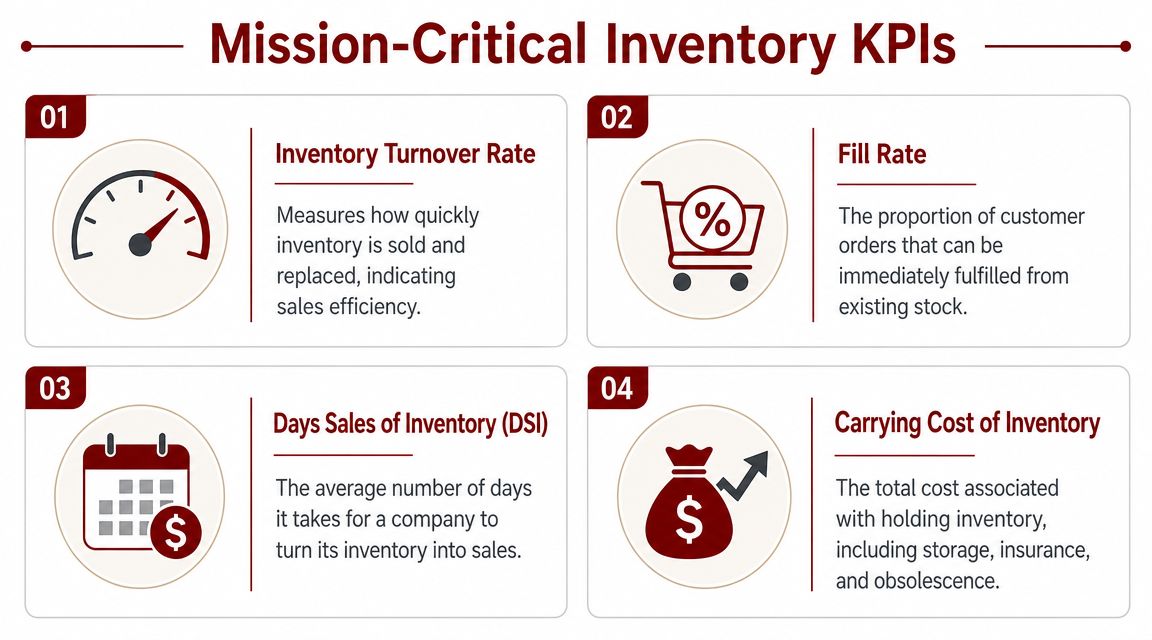
Over 25 years running industrial businesses, I have seen the same mistake repeat. Management teams jump into ERP upgrades, warehouse reshuffles, and weekly review meetings before they establish a clean baseline. That wastes time and weakens credibility with the board, lenders, and plant leaders. Start with four KPIs and make every plant report them the same way.
Track the four numbers that matter
Inventory Turns
Turns show whether inventory is producing cash or consuming it. Low turns usually point to overbuying, weak planning discipline, poor SKU rationalization, or all three. In aerospace and advanced manufacturing, I have seen operators raise turns materially once they stopped pooling unlike parts into one target and started measuring high-value and long-lead inventory separately.
- Inventory Turns: cost of goods sold divided by average inventory
Days Sales of Inventory
DSI puts inventory in time, which makes it easier to manage. Finance can model it. Operations can act on it. If DSI keeps climbing while revenue stays flat, your stock is aging faster than your business is growing.
- DSI: average inventory divided by cost of goods sold, then aligned to the period used by your finance team
Fill Rate
Fill rate tells you whether inventory is doing its job at the moment demand hits. A plant can post respectable turns and still fail customers if the wrong material is on the shelf. I have seen this in industrial businesses that cut broad inventory levels without protecting service parts, critical electronics, or constrained forgings.
- Fill Rate: fulfilled demand from available stock divided by total demand
Inventory Obsolescence
Obsolescence exposes management failure faster than almost any other metric. Dead stock rarely comes from bad luck. It comes from engineering changes handled poorly, customer schedules accepted without scrutiny, and buyers ordering to supplier preferences instead of business need.
- Obsolescence: inventory with low probability of future use, often identified by aging, demand absence, or superseded part status
Pick the definitions, lock them, and use them consistently across plants and product lines.
Run a baseline audit before you change policy
Pull the last full period you trust. Then cut the data by plant, SKU family, customer program, planner, and supplier. Aggregate averages hide bad decisions. Segmented data exposes them.
Use this audit checklist:
- Review purchasing patterns to find chronic over-ordering, lot-size distortions, and supplier minimums that do not make economic sense
- Identify underperforming SKUs by low turns, weak fill performance, repeated expedites, and excess on-hand balances
- Set explicit operating targets tied to cash release, service performance, and working capital discipline
- Install monthly exception reviews so buyers, planners, operations, engineering, and finance address the same facts together
- Link inventory decisions to production constraints through a tighter manufacturing capacity planning process, especially for long-lead components and shared bottleneck resources
A short management table exposes reality fast:
| KPI | What it reveals | Typical warning sign |
|---|---|---|
| Inventory Turns | Cash productivity of stock | Flat revenue with rising inventory |
| DSI | Time inventory sits before conversion | Aging stock growing quarter after quarter |
| Fill Rate | Service reliability from available inventory | Frequent expedites and partial shipments |
| Obsolescence | Inventory quality and policy failure | Engineering changes creating dead material |
Use these KPIs to set policy by inventory type, not to create a scoreboard with no action behind it. Aerospace spares, sole-source avionics, machined housings, and custom industrial assemblies should not share one target. Each category needs a deliberate economic reason for the inventory it carries.
That is the standard. Anything less is loose management disguised as process.
Adopt Advanced Forecasting and Safety Stock Models
Forecasting matters, but most companies use it badly. They treat it like a promise instead of a probability. In volatile supply chains, that thinking breaks down fast.

Hasit Vibhakar takes a harder line. Forecasting should help you manage uncertainty, not pretend uncertainty is gone. That's even more important now because resilience, supplier risk, and demand variability remain top priorities in supply chain leadership, according to the 2024 McKinsey supply chain priorities summarized by EdgeVerve.
Use forecasting to manage volatility, not to chase perfection
In aerospace and industrial markets, demand isn't clean. Customer schedules move. Suppliers slip. Engineering changes disrupt normal consumption. If your planning team is still relying on static spreadsheets for all SKU classes, you're inviting error.
Hasit Vibhakar recommends a tiered approach:
- Use probabilistic forecasting for high-value, volatile, or mission-critical SKUs
- Use simpler min/max rules for low-risk items with stable consumption
- Review forecast error by SKU segment, not in one blended plant average
- Tie forecasting to capacity decisions, because inventory without realistic machine and labor planning creates false confidence
That last point matters more than is often realized. If your demand signal improves but your shop capacity plan is wrong, inventory policy still fails. This is why manufacturing capacity planning has to sit beside forecasting, not behind it.
ThoughtSpot's overview highlights the logic behind quantitative stock decisions. Companies set service-level targets, then use demand history and lead-time variability to calculate reorder points and safety stock in a more statistical way through inventory optimization techniques for service-level planning.
Apply a safety stock rule your planners can actually use
The safety stock formula I trust most in operating environments is the Maximum Coverage method. It's practical, easy to explain, and grounded in worst-case protection logic.
Use it like this:
- Safety Stock = (Maximum Daily Usage × Maximum Lead Time) − (Average Daily Usage × Average Lead Time)
Why do I like it? Because it forces planners to confront both demand spikes and supplier delay at the same time. In volatile industrial supply chains, that's usually the main exposure.
Your safety stock rule should be understandable on the shop floor. If only a data scientist can explain it, planners won't use it properly.
This is also where AI can help, but only if the basics are in place. I'm deliberately not chasing shiny-model theater. Better demand classification, better lead-time inputs, and better planner discipline usually beat a complex model sitting on bad master data.
For readers who want a quick visual refresher on the planning mechanics, this walkthrough is useful:
Redesign Your Operations with Lean and S&OP
Inventory policy alone won't save you if your operating model rewards batch thinking, slow decisions, and internal silos. You need to redesign how material moves and how decisions get made.
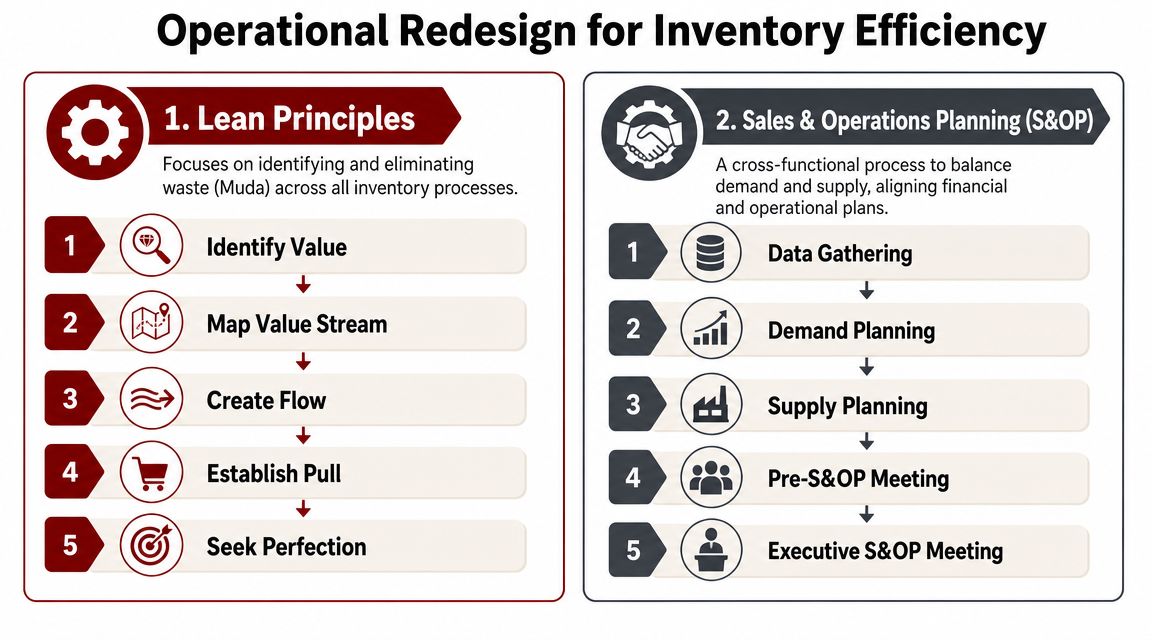
Hasit Vibhakar has seen this across industrial businesses that scale by acquisition or rapid customer growth. The company adds plants, product lines, and planners, but the planning cadence never matures. Inventory swells because no one trusts the system.
Why Boeing-style pull logic still matters
A strong example comes from aerospace. Boeing has long used a pull system in which parts are delivered to assembly plants only hours or days before installation. That JIT discipline matters because carrying costs in aerospace are punishing when expensive parts sit idle.
I'm not arguing for blind JIT. That would be reckless in a fragile supplier environment. I'm arguing for selective pull design. Use JIT where demand visibility, supplier performance, and process stability support it. Don't use it where qualification risk or long replenishment cycles make shortages unacceptable.
If your team needs a plain-language refresher on lean principles for growth, that framework is useful because it reinforces flow, pull, and waste elimination without turning lean into a slogan.
Make S&OP a decision forum, not a meeting ritual
Many companies claim they have S&OP. What they really have is a recurring slide review with no hard decisions. Real S&OP forces tradeoffs between sales ambition, production reality, inventory policy, and cash discipline.
Hasit Vibhakar expects S&OP to answer questions like these:
- Which customer programs deserve highest service protection?
- Which SKUs move to tighter reorder control?
- Which suppliers require more buffer because reliability is weak?
- Which inventory positions are financially unacceptable and need liquidation or redesign?
S&OP should end with decisions, owners, and dates. If it ends with “we'll monitor,” it failed.
NetSuite describes a modern optimization cycle built around analyzing historical sales, setting optimal stock levels, automating tracking and replenishment, continuously monitoring market changes, and coordinating data sharing across the supply chain through inventory optimization practices for continuous control. That operating rhythm works because it creates accountability, not because it creates more dashboards.
A practical floor-level operating model looks like this:
- Segment first so A items and critical components receive tighter control than C items
- Set service targets by class rather than forcing every SKU into the same policy
- Escalate exceptions instead of having planners manually review every line every day
- Tie lean initiatives to inventory outcomes so kaizen work reduces actual stock exposure, not just local process time
Select and Integrate Your Technology Stack
A $50 million manufacturer can lose margin every day with the wrong stack. The planner sees one inventory number in ERP, the warehouse sees another in WMS, and the plant runs on tribal knowledge. Finance closes the month with write-offs, expedites, and excuses. That is not a software problem first. It is a leadership problem.
I have seen this pattern in aerospace, electronics, and industrial automation. Companies buy a planning tool before they fix item masters, transaction discipline, or system ownership. Six months later, the planning team is back in spreadsheets and the CIO is explaining why the implementation “needs more time.” Stop doing that.
Hasit Vibhakar recommends a three-layer stack with clear boundaries.
Know what each system should do
ERP owns the financial and transactional record. Bills of material, routings, suppliers, lead times, purchasing rules, and inventory balances need to be right there first.
WMS runs warehouse execution. It should control receipts, putaway, locations, picks, cycle counts, and every material move that affects accuracy.
APS helps planners make better decisions. Use it for constrained planning, forecasting logic, scenario modeling, and exception management.
Here is the test. If a planner exports ERP data into Excel, corrects it manually, and emails a revised plan to operations, your stack is failing. Feature lists do not fix that. Clean integration does.
| System | Core role | Failure mode if weak |
|---|---|---|
| ERP | Master data and transaction backbone | Bad planning inputs and unreliable inventory records |
| WMS | Warehouse accuracy and execution speed | Misplaced stock, poor counts, bad replenishment signals |
| APS | Planning logic and exception management | Planners chasing noise and overreacting manually |
Buy less software and fix more data
Mid-market manufacturers do not get returns from buying the most complex platform in the category. They get returns from disciplined data governance, clean handoffs, and selective automation that removes manual errors.
I tell leadership teams the same thing every time. Do not put machine learning on top of broken item masters, duplicate SKUs, bad lead times, and loose warehouse transactions. You will automate bad decisions faster.
Use this sequence:
- Clean item masters so units of measure, lead times, supplier attributes, and stocking policies are trustworthy
- Stabilize warehouse transactions so receipts, moves, picks, and counts reflect reality
- Set up exception-based planning so planners work the few items that matter instead of touching every SKU
- Connect plant execution to planning so schedule changes and completions flow back quickly
That last point matters more in advanced manufacturing than many leaders admit. In one multi-site industrial business, better shop-floor transaction accuracy changed replenishment behavior more than a new forecasting model did. If you are reviewing that layer, this overview of manufacturing execution systems is a useful reference because MES often closes the gap between plan and actual execution.
If you are evaluating vendors, use a practical screen first. Integration method, master data control, user discipline, and exception handling matter more than a polished demo. A credible Inventory management software guide can help your team compare options before you lock requirements and start burning capital.
The objective is simple. One version of the truth, fast transaction flow, and fewer human workarounds. That is how technology improves turns, protects service, and raises shareholder value.
Measure Success and Build the Case for ROI
A plant manager says service is holding. The CFO sees cash trapped on the balance sheet. The board sees a business that cannot fund growth without more debt. That is the moment inventory optimization becomes a CEO issue.
I have treated inventory management optimization as a value-creation discipline for more than 25 years across aerospace, advanced manufacturing, and industrial businesses. Measure it the same way owners judge any operating change. Cash generation, service performance, margin protection, and enterprise value.
What a turns improvement really means
One of the clearest examples is a business that improves inventory turns from 3x to 12x. That does not happen because a team buys software and declares victory. It happens because leadership removes dead stock, resets reorder logic, enforces exception management, and forces planners and operations to work from the same facts.
Here is what that shift looks like in operating terms:
| Metric | Before Optimization | After Optimization | Business Impact |
|---|---|---|---|
| Inventory Turns | 3x | 12x | Faster cash conversion and less capital tied up |
| Slow-Moving Inventory | High | Lower | Less cash trapped in stock that does not support revenue |
| Liquidity | Constrained | Improved | More flexibility for capex, hiring, and acquisitions |
| Operating Burden | Frequent firefighting | Tighter control | Fewer expedites and more predictable execution |
That kind of improvement changes behavior across the company. Buyers stop padding orders to compensate for weak planning. Plant leaders stop treating shortages as normal. Finance starts trusting that working capital discipline will hold through growth.
One warning. If turns rise while fill rate falls, the company did not optimize inventory. It cut too deep and pushed the cost onto customers.
Build the investment case in language owners care about
Boards, founders, and private equity sponsors do not fund inventory projects because the math is elegant. They fund them because the return is clear and the operating discipline is credible.
Frame the case around questions that matter to owners:
- How much working capital is sitting in SKUs that do not protect revenue or customer commitments?
- How much margin are we losing to expedites, split shipments, premium freight, and obsolete stock?
- Which service failures come from poor stocking policy rather than real demand volatility?
- What growth, capacity expansion, or M&A options become easier once that cash is released?
In aerospace, this shows up fast. I have seen suppliers carry too much raw material and too many low-rotation parts in the name of customer service, then miss delivery dates on the few components that drive contractual performance. In advanced manufacturing, the pattern is similar. Teams hold broad inventory as insurance, but the effective solution is better segmentation, cleaner replenishment rules, and tighter execution against priority parts.
That is why I push leaders to present inventory ROI in three buckets. First, cash released from excess and slow-moving stock. Second, margin protected through fewer shortages, less expediting, and lower obsolescence. Third, valuation upside from a business that scales with control instead of consuming cash at every stage of growth.
Hasit Vibhakar's playbook is straightforward because it works. Start with baseline KPIs, SKU segmentation, and safety stock discipline. Use methods such as Maximum Coverage where they fit. Review exceptions monthly. Then show the result in cash, service, and return on invested capital.
About Hasit Vibhakar: Hasit Vibhakar is a serial entrepreneur and CEO with over 25 years of experience building, scaling & increasing shareholder value across Aerospace, Advanced Manufacturing & Industrial sectors.
If you're leading a manufacturing or industrial business and need a practical operating blueprint, connect with Hasit Vibhakar for a direct, CEO-level perspective on scaling operations, tightening inventory discipline, and building shareholder value.


Leave a Reply