

You're in a conference room with a draft term sheet on the table. The buyer or sponsor keeps referring to a target return multiple and asks whether your growth plan can support the outcome they need. If you've built a manufacturing, aerospace, or industrial company, that moment isn't theoretical. It affects valuation, control, timing, and what your equity may be worth at exit.
That's where MOIC, or Multiple of Invested Capital, becomes practical. It's one of the core ways private equity firms, founders, and operators judge whether capital has created enough value. In industrial businesses, where expansion often involves equipment, working capital, integration risk, and add-on acquisitions, MOIC gives people around the table a common language for discussing results.
Most primers stop at the formula. Operators need more than that. They need to understand how MOIC gets used in negotiations, how it should be calculated when follow-on capital enters the picture, and when the number can mislead. That's especially true if you're building long-term value creation strategies in private companies, not just trying to optimize a spreadsheet for a sale process.
Table of Contents
- An Introduction to Value Creation Metrics
- What is MOIC in Private Equity
- Calculating MOIC With Step by Step Examples
- MOIC vs IRR Whats the Difference
- Strategic Uses of MOIC in Exits and Negotiations
- Common Pitfalls and How to Interpret MOIC Correctly
- Putting MOIC to Work for Your Business
An Introduction to Value Creation Metrics
A founder can spend years improving quality systems, winning aerospace approvals, adding machining capacity, and building a management team, then discover that investors summarize the result with a small set of return metrics. That can feel reductive. In practice, it's how private market capital gets allocated.
Buyers and funds need a way to answer a basic question. Did this investment create enough value relative to the capital required? In industrial businesses, that question gets harder because value rarely comes from one clean event. It usually comes from a series of moves: a plant expansion, a bolt-on acquisition, margin improvement, customer diversification, and eventually an exit or recapitalization.
Why operators should care
If you're an owner or CEO, these metrics shape more than investor reporting.
- Deal pricing: Buyers often back into what they can pay based on the return profile they believe they can achieve.
- Capital allocation: Management teams choose between equipment, acquisitions, debt paydown, and capacity expansion under return constraints.
- Narrative control: A company with a credible value-creation story gets a different conversation than one presenting growth in vague terms.
The strongest management teams don't just report performance. They translate operations into investor economics.
MOIC matters because it speaks directly to the amount of value created on invested capital. It doesn't try to tell the whole story. It tells one important part of it cleanly. For many negotiations, that's the starting point.
What makes this metric useful in manufacturing
Industrial companies don't scale like software businesses. Capital often goes into inventory, tooling, equipment, engineering talent, certifications, and integration work. Those investments may take time to show up in cash proceeds, but they still need to produce value.
That's why CEOs in manufacturing and aerospace should understand MOIC at the same level their investors do. If you can't explain how capital turned into enterprise value, someone else will define that narrative for you.
What is MOIC in Private Equity
MOIC stands for Multiple of Invested Capital. In private equity, it measures total value created relative to total capital invested. It's a capital-efficiency ratio, not a time-adjusted return metric, which is why practitioners use it alongside IRR. MOIC captures how much value was created, while IRR captures how fast it was created, as explained in Moonfare's overview of multiple on invested capital in private markets.

The simplest way to think about it
If an investor puts capital into a company, MOIC asks: how many dollars of value came back for each dollar invested?
For an operator, I find it useful to think about this like building a high-performance engine. You don't evaluate the engine only by one component. You add up what went in, then compare that to what the finished system is worth and what it has already generated. Private equity applies the same logic to a company.
Formula: MOIC = Total Value Created / Total Invested Capital
“Total value created” usually includes two buckets:
- Realized value, meaning cash or proceeds already returned
- Unrealized value, meaning the current fair value of what is still owned
“Total invested capital” should include all paid-in capital tied to the investment, not just the first check.
What investors are actually measuring
In real transactions, MOIC is useful because it strips the discussion down to capital productivity. It doesn't care whether the gain came from EBITDA growth, multiple expansion, debt paydown, operational improvement, or add-on acquisitions. It asks whether the investment generated enough value in total.
That makes it a favored metric in private equity because it's intuitive. A board member, lender, founder, or deal professional can all understand it quickly.
Why the definition matters
The mistakes usually happen in the details. If someone talks about MOIC but only references exit proceeds, they may be ignoring value still held in the investment. If they only cite current mark-to-market value, they may be overstating what has been monetized.
A sound MOIC discussion separates what has been realized from what remains unrealized, then compares the combined figure against all capital that went in. That approach is much more useful than a headline number with no construction underneath it.
Calculating MOIC With Step by Step Examples
The formula is simple. The application usually isn't. Once a deal includes follow-on capital, fees tied directly to acquisition, or partial liquidity before a full exit, sloppy calculations can distort the result.
Finance Alliance notes that MOIC is most actionable when it's decomposed into realized and unrealized components and normalized for all paid-in capital, including follow-on investments and transaction costs tied directly to the acquisition. It also notes that successful investments generally exceed 1.0x MOIC, while values below 1.0x indicate impairment, in its explanation of how MOIC is used in fund and deal analysis.
Example one with a clean investment
Start with the basic version.
An investor acquires a manufacturing business and later receives proceeds from a sale. The calculation follows three steps:
- Add up all invested capital. This is the full paid-in amount used to make the investment.
- Add up total value created. If the business has been fully exited, this is the total cash proceeds received.
- Divide total value by invested capital.
If total value is above the invested capital, MOIC is above 1.0x. If total value is below invested capital, the deal is underwater on a capital basis.
That sounds obvious, but it's useful because it establishes the break-even line. A business can have operational progress and still fail to clear that threshold if too much capital was required or if exit value disappoints.
Example two with follow-on capital
Now take a more realistic lower-middle-market scenario. A sponsor buys a platform business, then injects more capital to fund an add-on acquisition and post-close integration.
The right way to approach this is:
- Start with the initial equity investment
- Add every follow-on equity contribution
- Include transaction costs directly tied to the acquisition if they were part of paid-in capital
- Use the full denominator, not just the first check
Operators often get caught off guard when evaluating performance. A management team may feel the platform has performed well because revenue, EBITDA, and customer count improved. But if investors had to keep adding capital to support acquisitions, systems integration, or working capital, the denominator moved too. MOIC reflects that.
If the denominator is incomplete, the metric flatters the deal. If the numerator is incomplete, it undersells the asset.
Example three with realized and unrealized value
Many investments aren't fully exited when performance gets discussed. A fund may have already received some proceeds through a dividend recap, secondary sale, or partial exit, while still holding equity in the company.
That means the numerator should be split into:
| Component | What it means |
|---|---|
| Realized value | Cash or distributions already received |
| Unrealized value | Current fair value of the remaining ownership |
This decomposition matters in board discussions. It tells you whether value creation is being harvested or whether most of the reported gain still depends on a future exit.
A practical checklist before accepting a MOIC number
When someone presents MOIC in a deal memo or management meeting, ask four questions:
- What sits in the numerator: Is it only realized proceeds, only residual value, or both?
- What sits in the denominator: Does it include all paid-in capital, including follow-ons?
- How are costs treated: Were acquisition-related transaction costs included where appropriate?
- What is liquid: How much of the reported value has been monetized versus merely marked?
In industrial businesses, that last point matters a lot. A reported value mark may look solid, but until the asset is sold or recapitalized, it isn't the same as cash in hand.
MOIC vs IRR Whats the Difference
Most confusion around MOIC comes from treating it like a complete return metric. It isn't. It measures scale of value creation, while IRR measures the timing and annualized efficiency of that return.
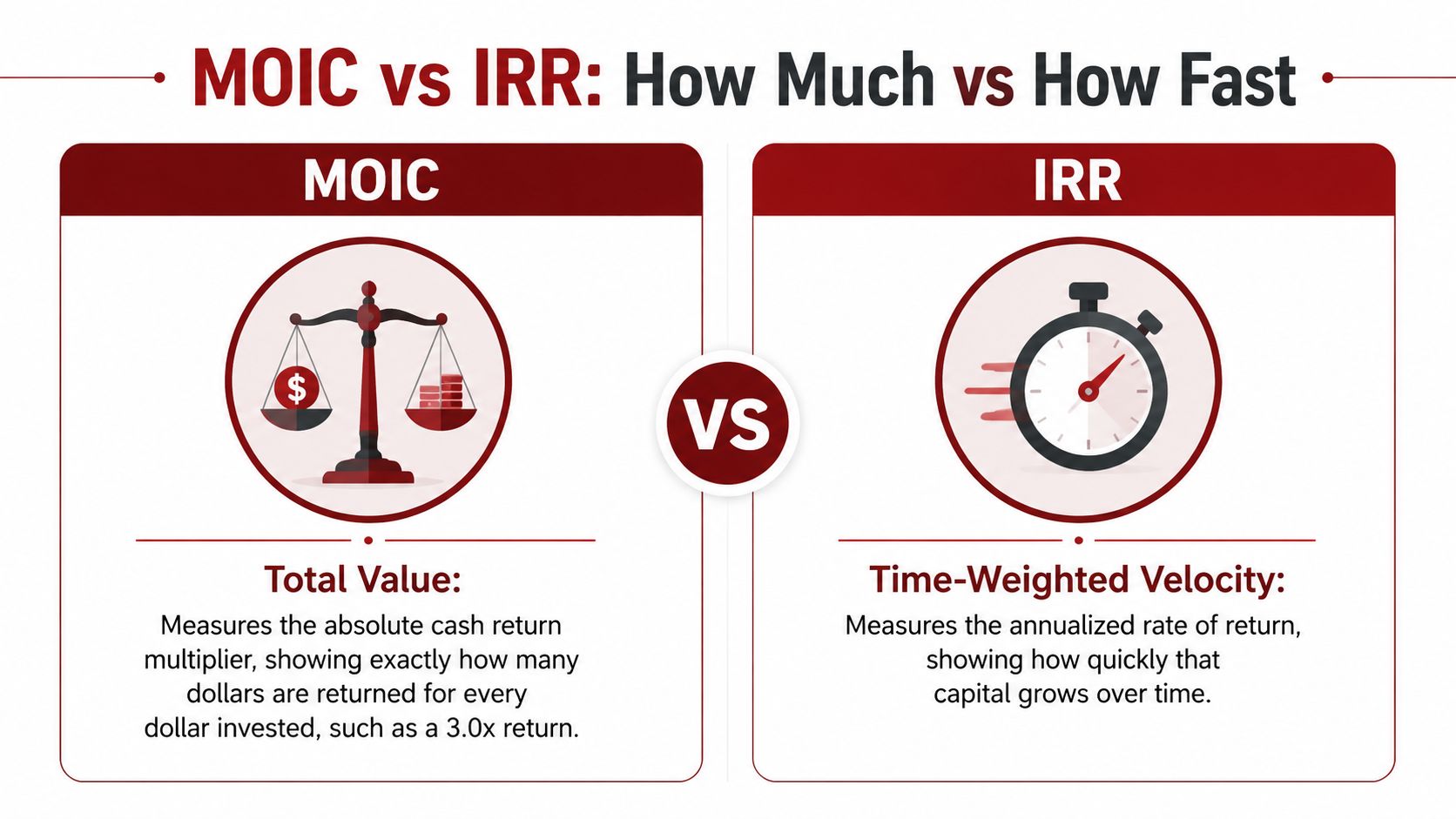
MOIC vs IRR at a glance
| Attribute | MOIC (Multiple of Invested Capital) | IRR (Internal Rate of Return) |
|---|---|---|
| Core question | How much value was created? | How fast was value created? |
| Time sensitivity | Ignores time | Accounts for timing of cash flows |
| Best use | Capital-efficiency snapshot | Return-speed analysis |
| Typical board value | Easy to understand quickly | Better for comparing hold periods |
| Weakness | Can mislead on long holds | Can look strong even if total multiple is modest |
Wall Street Prep explicitly notes that MOIC ignores time entirely, so a 2.0x return over 2 years and a 2.0x return over 10 years look identical on a MOIC basis, even though the economics are very different in its discussion of MOIC and its relationship to IRR.
Why both metrics belong in the same conversation
In private equity and founder-led exits, these metrics answer different questions.
MOIC helps when you want to know whether a strategy created substantial value in absolute terms. IRR helps when you need to understand whether capital was tied up efficiently. A long-hold industrial investment can produce an attractive multiple while still delivering a less compelling time-adjusted outcome if cash comes back late.
That's why serious investors report both. One without the other leaves room for misunderstanding.
Here's a short explainer if you want a visual walkthrough before reading further.
What this means in manufacturing and aerospace
Industrial companies often require patience. Capacity investments, qualification cycles, and integration of acquired operations don't always produce quick liquidity. In that setting, management can feel pressure when a respectable MOIC doesn't translate into an equally exciting IRR.
That doesn't mean the strategy failed. It means the timing of value realization matters. If you're running a business with long lead times and heavy execution demands, you need to understand which investor across the table values magnitude, which values speed, and which needs both.
MOIC tells you whether the pie got bigger. IRR tells you how quickly it reached the table.
A practical way to use the pair
Use MOIC when evaluating total value creation from a platform build, add-on strategy, or long-hold operating improvement plan. Use IRR when comparing competing uses of capital, sequencing exits, or judging whether a hold period still makes sense.
If a sponsor says the deal needs to hit a certain return threshold, ask which metric governs their decision. The answer changes how they think about valuation, distributions, refinancing, and timing.
Strategic Uses of MOIC in Exits and Negotiations
MOIC is not just a reporting number after the fact. In live transactions, it influences what buyers can pay, how management presents growth, and how boards evaluate strategic options.

In fundraising and sale processes
Founders often pitch growth. Investors underwrite returns. Those aren't the same thing.
A compelling management presentation in manufacturing should connect operational moves to investor outcomes. If you're adding a second facility, acquiring a niche machine shop, or building a broader aerospace platform, the primary question from capital providers is whether those moves can produce enough value on invested capital to justify the risk.
The strongest pitch isn't “we have upside.” It's a credible explanation of how capital turns into enterprise value through specific actions, such as:
- Acquisition integration: showing how an add-on expands capability or customer reach
- Margin improvement: linking operational discipline to value creation
- Exit positioning: clarifying who the likely buyers are and why the asset will matter to them
In term sheet logic
When a private equity firm builds a return case, MOIC often sits underneath the entry valuation discipline. If they need a certain investment outcome, that requirement constrains what they can pay today unless they have a strong conviction on growth, deleveraging, or strategic premium.
That's useful for management teams. It helps explain why two buyers looking at the same company can produce meaningfully different bids. One may see a platform with several paths to value creation. Another may see only one path and price the risk accordingly.
The negotiation improves when you understand the buyer's return architecture, not just their headline valuation.
In operating priorities after the deal closes
Once a company is PE-backed, management should know what type of return profile the sponsor is trying to build. That shapes urgency around add-ons, plant efficiency, customer concentration, and working capital discipline.
In practice, CEOs can use MOIC thinking to rank initiatives:
- Does this use of capital clearly increase equity value?
- Will it require additional follow-on funding?
- Is the payoff likely to be realized in the expected hold window?
- Does it improve exit quality or only near-term optics?
A founder or operator evaluating options such as add-ons, recapitalizations, or sale timing can also look at practical frameworks used in business exit strategy planning.
Where advisors and operators can help
This is one place where experienced operators add real value. They can translate plant-level and commercial decisions into investor economics. That may involve internal finance leadership, transaction advisors, or operators with a background in private equity-backed industrial businesses. For business owners navigating that process, Hasit Vibhakar describes work across private equity investing, platform-building, and M&A strategy in manufacturing and aerospace contexts.
The point is simple. If you understand how MOIC drives investor behavior, you negotiate from a position of much greater clarity.
Common Pitfalls and How to Interpret MOIC Correctly
A single multiple can create false confidence. That's the main danger.

Time can make the same MOIC mean very different things
The biggest pitfall is ignoring the hold period. As noted earlier, Wall Street Prep points out that a 2.0x outcome over 2 years and 10 years looks identical in MOIC terms, even though the quality of return is very different for founders and PE-backed manufacturers when hold period and cash recycling matter.
That issue comes up constantly in industrial businesses. A management team may celebrate a strong paper multiple, while investors worry that capital was tied up too long.
Unrealized value can overstate confidence
Another common problem is treating unrealized value as if it were equivalent to proceeds already received. Residual value matters, but it depends on assumptions about fair value, future market appetite, and the company's ability to execute through a real sale process.
Use a simple filter when reviewing any number:
- Realized means money has come back
- Unrealized means the value still needs to be proven in the market
If most of the reported MOIC sits in unrealized value, ask tougher questions about liquidity, buyer universe, and the assumptions behind the valuation mark.
Denominator games distort the metric
MOIC also gets skewed when paid-in capital is understated. In sponsor-backed manufacturing businesses, extra capital often goes in for acquisitions, integration, systems, equipment, or working capital support. If those amounts disappear from the denominator, the number becomes flattering but less useful.
Practical rule: When MOIC looks unusually attractive, inspect the denominator before you admire the numerator.
A better interpretation framework
Don't ask whether MOIC is good or bad in isolation. Ask:
| Question | Why it matters |
|---|---|
| How long was capital invested? | Time changes the economic quality of the result |
| How much value is realized? | Cash returned is different from estimated residual value |
| Was all paid-in capital included? | Missing follow-ons can overstate performance |
| What drove the result? | Operations, leverage, multiple expansion, and timing do not carry the same implications |
For operators, this framework is especially important in long-cycle sectors. Aerospace and advanced manufacturing businesses often improve through patient execution. That can still produce attractive outcomes, but you need to interpret the multiple with discipline, not optimism.
Putting MOIC to Work for Your Business
MOIC belongs in every serious conversation about growth capital, acquisitions, recapitalizations, and exits. Not because it replaces everything else, but because it forces clarity. It asks whether the capital committed to the business produced enough value.
For owners and executives, the best use of MOIC is practical. Put it next to operating data, debt levels, cash generation, and your expected path to liquidity. Use it to test whether an acquisition thesis still holds. Use it to pressure-test expansion plans. Use it in sale prep so you can speak the same language as buyers and sponsors.
Most of all, don't let MOIC become a vanity metric. Pair it with time-aware analysis and with a hard look at what value is realized versus still on paper. If you're scaling an industrial business, that discipline will improve both decision-making and negotiating strength. For leaders focused on operational growth, acquisition integration, and long-term enterprise value, practical business scaling strategy guidance can help connect capital decisions to exit outcomes.
If you're evaluating a transaction, planning a capital raise, or preparing an industrial business for exit, Hasit Vibhakar offers perspective grounded in decades of operating, acquiring, and scaling companies across aerospace, advanced manufacturing, and industrial markets.



Leave a Reply