
A founder once told me he wanted “a good exit.” After twenty minutes, it became clear he didn't mean the same thing his banker meant. He wanted liquidity, yes, but he also wanted his people protected, his customers served without disruption, and the company name to keep meaning something after he stepped away.
That's the core work of Building a Legacy with your exit strategy. In aerospace, manufacturing, and industrial businesses, an exit isn't just a sale event. It's a transfer of operating discipline, technical knowledge, customer confidence, and leadership credibility. Hasit Vibhakar has spent decades building companies in exactly those environments, and the lesson is consistent. If you only negotiate price, you may win the headline and lose the outcome that mattered most.
Table of Contents
- Beyond the Final Paycheck Defining Your Exit's Purpose
- Your Legacy Blueprint Before the Sale
- Mapping Your Exit Pathways From M&A to ESOP
- Fortifying the Business for a Legacy Transfer
- Negotiating Your Legacy into the Deal Terms
- The Transition Plan Life After the Handshake
- About Hasit Vibhakar
Beyond the Final Paycheck Defining Your Exit's Purpose
In capital-intensive businesses, founders often spend years building machinery, teams, customer programs, and certifications that can't be replaced quickly. Then, when exit planning begins, the conversation narrows to multiple, timing, and taxes. That's incomplete.
Hasit Vibhakar has seen the difference between a transaction that closes and a transition that endures. In aerospace and advanced manufacturing, a founder's legacy often lives inside the operating model. It's in how quality gets reviewed, how customer promises are handled, how engineering changes are approved, and how plant leaders make decisions when pressure rises. If those elements don't survive the deal, the seller may get paid and still feel like the business was lost.

That's why the first question isn't “What can I sell for?” It's “What must still be true after I leave?”
Recent research cited by Clearstead says only 41% of business owners have a documented exit plan, even though three out of four expect to exit within the next decade in Clearstead's discussion of exit planning and legacy. That gap matters because legacy outcomes are usually decided long before letters of intent start circulating.
The founder's real decision
A founder at a crossroads usually faces two very different paths:
- Cash-first thinking: optimize for headline valuation, move fast, and treat transition issues as secondary.
- Legacy-first architecture: define the core principles early, shape the company to survive without you, and choose a buyer or structure that can carry the business forward.
Neither path is morally superior. But they do produce different results.
Practical rule: If you can't describe the future you want for employees, customers, and the brand in plain language, you're not ready to negotiate an exit that preserves them.
What works is starting with purpose and then building the transaction around it. What doesn't work is hoping “the right buyer” will intuit your values in diligence.
What Hasit Vibhakar means by legacy
Hasit Vibhakar doesn't treat legacy as a soft word. In industrial companies, legacy has operating consequences. It means continuity in customer delivery. It means key people staying long enough to transfer know-how. It means the company remains profitable and credible after the founder is gone.
A lasting exit usually protects three things:
| Legacy area | What it means in practice |
|---|---|
| People | Retention of key operators, managers, and technical talent |
| Customers | Stable relationships, service continuity, and preserved trust |
| Identity | A business model, brand, and leadership style that remain recognizable |
When owners skip this thinking, they often discover too late that a strong valuation doesn't guarantee a satisfying result. The final paycheck matters. It just shouldn't be the only scorecard.
Your Legacy Blueprint Before the Sale
A legacy exit starts with specificity. “Take care of my people” is admirable, but it's too vague to guide a buyer search or a negotiation. Hasit Vibhakar's approach is more disciplined. Define what must be preserved, what can evolve, and what you're willing to trade for better economics.
Research summarized by Project Equity found that 54% of business owners believe ensuring the business remains profitable is key to a successful exit, while more than half prioritized preserving the legacy and values of the business over financial considerations in its overview of business owner priorities in exit planning. That's a useful reminder that most serious owners don't separate money from stewardship. They want both.
Start with non financial success criteria
Before talking to buyers, write down your answers to questions like these:
- Company identity: Does the business name matter after closing, or are you comfortable with rebranding?
- Workforce continuity: Which leaders, engineers, or plant managers do you want retained through transition?
- Customer protection: Which accounts depend on your reputation, and how will handoffs happen?
- Geographic commitment: Do you care whether operations remain in the current facility or region?
- Innovation continuity: Should the buyer keep investing in the technical capabilities that made the company valuable?
This is also where outside preparation pays off. Founders preparing for a sale often benefit from reviewing how institutional buyers examine risk, concentration, controls, and leadership depth. A practical primer on due diligence for growing businesses can help you pressure-test your readiness before the market does it for you.
Turn values into operating priorities
Once those goals are named, rank them. Most exits involve tradeoffs. You may not get maximum price, full control over future decisions, and total continuity at the same time.
Hasit Vibhakar typically frames the blueprint around three buckets:
Non-negotiables
These are the legacy items that must survive the transaction. For one founder, that may be protecting a technical leadership team. For another, it may be keeping a facility open.Preferred outcomes
These matter, but you may compromise if the buyer fit, structure, and certainty are strong.Flexible items
These are emotional preferences that shouldn't derail a good transaction.
A legacy blueprint becomes useful when it helps you say no early, before you waste months with the wrong buyer.
A simple internal working document can include the intended buyer profile, desired transition role, key personnel concerns, customer continuity plan, and post-close decision rights that matter to you. Founders looking to connect legacy goals with operational readiness can also review Hasit Vibhakar's thinking on business scaling strategy, especially where scale and transferability intersect.
What works is clarity. What fails is trying to “figure it out in the deal” while multiple bidders are pushing for speed.
Mapping Your Exit Pathways From M&A to ESOP
The exit path you choose shapes the legacy you leave behind. Hasit Vibhakar has worked across strategic transactions, private equity environments, and growth platforms, and one point stays constant. The right exit route depends less on what sounds impressive and more on what matches the founder's actual priorities.
Best-practice guidance treats exit planning as a multi-year value-creation program, not a one-time transaction, because rushed succession can create leadership instability and materially depress proceeds, as outlined in this exit planning guidance from Equip. That matters because pathway selection isn't just a finance decision. It's an operating design choice.
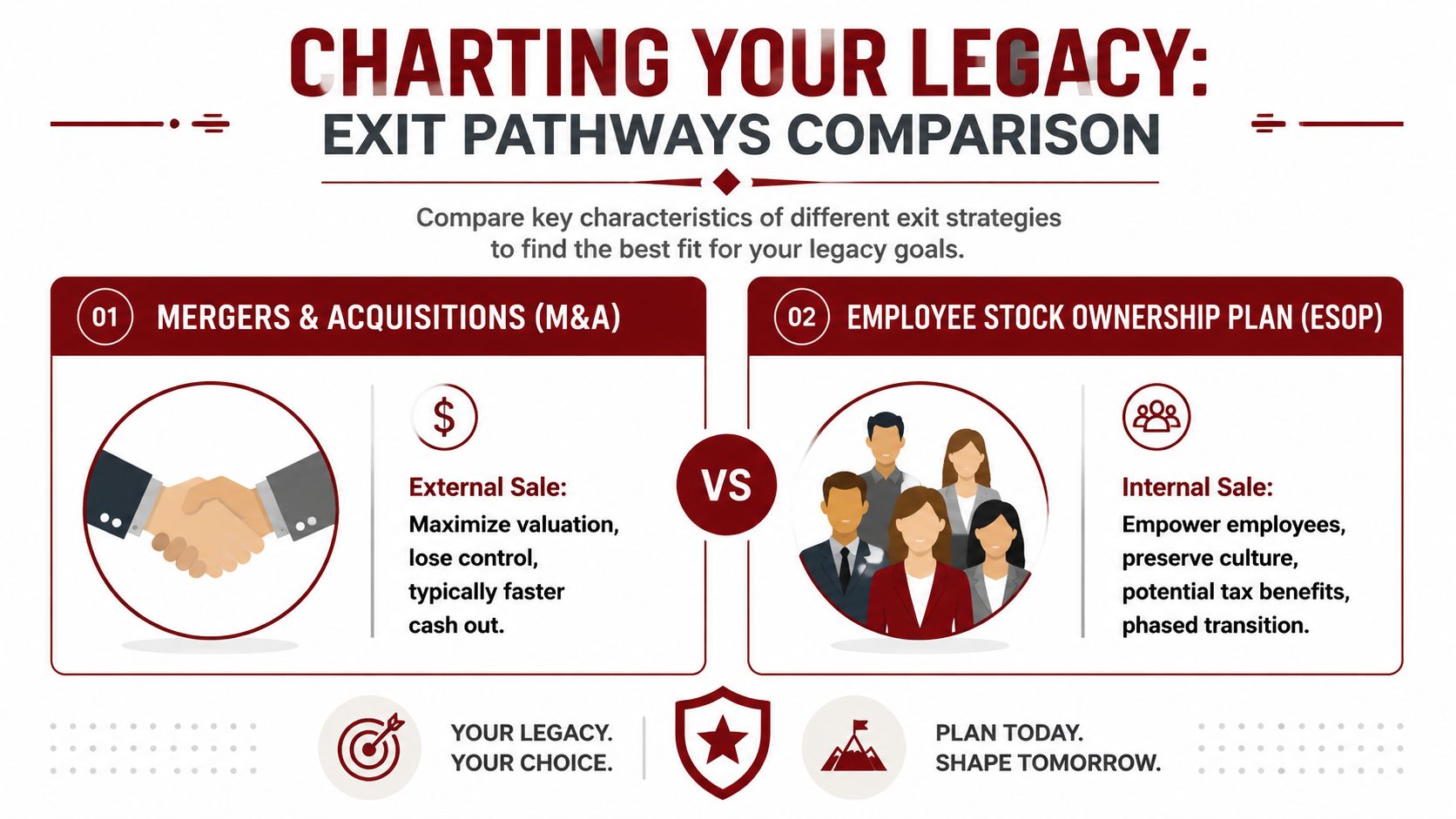
To make the contrast tangible, use the framework below.
How each pathway changes the legacy outcome
Strategic M&A often offers the strongest industrial logic when the buyer already understands your customers, technologies, or production environment. A strategic acquirer may have reasons to value your business beyond standalone performance. The tradeoff is that integration can move quickly, and culture often bends toward the buyer's operating model.
Private equity sale can preserve a company's identity better than founders assume, especially when the sponsor backs management and wants continued growth. But the future depends heavily on the deal thesis. If the plan is aggressive consolidation, your legacy may evolve faster than expected.
A useful way to think through these options is to watch how experienced operators discuss succession choices in real terms, including timing and structure:
Management buyout can work well when the leadership bench is credible and the seller values continuity of relationships and decision-making style. The challenge is financial capacity. Management teams may need patient structuring, seller support, or staged ownership transfer.
ESOP or employee-oriented internal transfer tends to align strongly with culture preservation. It can protect workforce continuity and reward the people who helped build the business. The tradeoff is complexity. These structures can require more planning, more education, and different economic expectations than a straightforward auction.
Recapitalization sits in the middle. It gives the founder partial liquidity while retaining some ownership and influence. This can be effective when the owner wants financial freedom but isn't ready to hand off legacy stewardship entirely.
A simple comparison lens
Use this lens before deciding which route deserves serious pursuit:
| Exit pathway | Legacy strengths | Common tradeoff |
|---|---|---|
| Strategic sale | Technical continuity if buyer fit is strong | Less control over integration and brand |
| Private equity | Potential management continuity and growth capital | Future exit may reshape the business |
| Management buyout | High cultural continuity | Financing and execution complexity |
| ESOP | Strong employee alignment and stewardship | Structuring can be more involved |
| Recapitalization | Partial liquidity with ongoing influence | Founder stays connected longer |
The wrong exit path usually doesn't fail on paper. It fails because the deal structure and buyer behavior don't match the founder's actual definition of success.
What works is comparing pathways against your legacy blueprint, not against generic advice. What doesn't work is chasing the option that sounds most prestigious while ignoring how the company will operate after closing.
Fortifying the Business for a Legacy Transfer
A founder-dependent company is harder to sell and harder to preserve. That's especially true in aerospace and manufacturing, where customer trust often sits with a small number of leaders who know the programs, the quality history, and the unwritten rules of execution. Hasit Vibhakar's practical answer is simple. Build a business that can function well without daily founder heroics.
The valuation impact is real. Owner-heavy businesses can see a 25–50% valuation drop when dependence on the owner is high, according to FocusCFO's guidance on common exit planning mistakes. Buyers pay for systems they can inherit, not chaos they must reverse-engineer.
Run a dependency removal audit
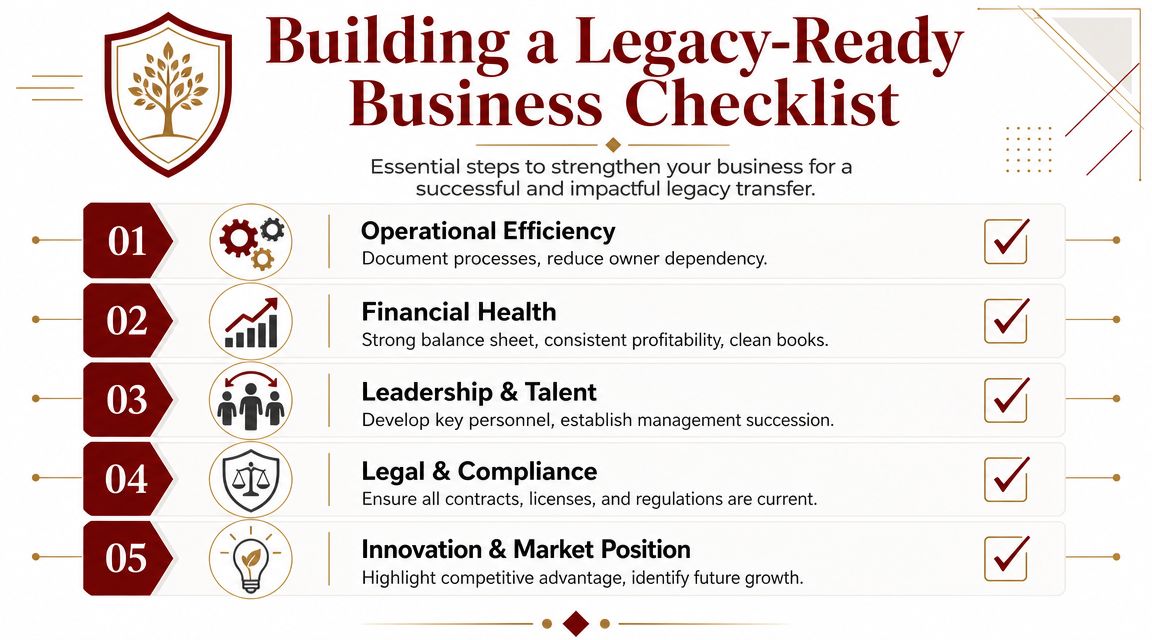
Start by listing every function where the company still relies on the founder's memory, relationships, or judgment. In industrial businesses, the usual pressure points are sales approvals, key customer communication, production escalation, engineering sign-off, supplier negotiation, and capital allocation.
Then run a structured handoff process:
Identify founder-critical work
Be honest. If a program review, quality issue, or commercial dispute stalls until you intervene, document it.Assign a second-in-command
Every critical function needs a visible operating owner. Not a title on an org chart. A person who can execute.Document the process
Use SOPs, escalation maps, approval matrices, dashboards, and recurring review cadences.Test under live conditions
Don't assume the handoff works because a document exists. Let the new owner run the meeting, the customer call, or the operational review while metrics are still visible.Close the gaps
Where capability is thin, recruit, coach, or restructure before launching a sale.
Build transferability into the operation
The best legacy transfers happen when the company becomes independently legible. A buyer should be able to understand how the business wins, how it controls risk, and who drives results.
Focus on these areas:
- Leadership bench: Develop managers who can own operations, commercial execution, and technical delivery without founder intervention.
- Customer concentration discipline: If relationships are concentrated in one person, broaden contact points and formalize account ownership.
- Financial hygiene: Clean reporting, normalized performance discussion, and clear working-capital discipline reduce friction in diligence.
- Compliance and documentation: In regulated or specification-driven sectors, current records and controlled processes matter as much as narrative.
For founders who think about exit planning through the lens of operational improvement, Hasit Vibhakar's perspective on value creation is useful because it connects sale readiness with the work of building a stronger business today.
Strong exits are built in the operating cadence. Weekly reviews, documented controls, delegated authority, and visible accountability matter more than polished deal books.
What doesn't work is waiting until a banker is hired to clean up the business. By then, the buyer is already pricing risk into the deal.
Negotiating Your Legacy into the Deal Terms
Most founders treat legacy as a buyer selection issue. It's more than that. Legacy has to show up in the purchase agreement, the employment arrangements, and the transition documents. Otherwise, it's a conversation, not a protection.
Hasit Vibhakar's operating background is highly relevant. In manufacturing and industrial transactions, vague alignment disappears under deadline pressure. If preserving workforce continuity, customer treatment, brand identity, or community presence matters to you, then those priorities need legal expression.
Tiger 21's discussion of legacy and reputation highlights a core issue for industrial owners. The unanswered problem is how to quantify legacy protections in the purchase agreement, such as employment covenants, brand-use clauses, and community commitments, and compare them against valuation impact, tax outcomes, and close probability in this perspective on preserving legacy and reputation. That's the right question.
Move legacy from sentiment into contract language
Founders should stop saying, “I want a buyer who values the team,” and start asking for terms that create consequences.
Examples include:
Employment protections for key staff
If the continuity of a plant or engineering team matters, define retention packages, transition periods, or role continuity expectations for named leaders.Brand-use provisions
If the company name carries real market equity, negotiate how long it remains in use and under what conditions.Operating commitments
In some deals, location, facility use, or customer support expectations can be addressed through side agreements or transition covenants.Transition governance
Establish scheduled operating reviews, escalation rights, and founder or board involvement for a defined handover period.
Some founders also structure earn-outs or seller support around more than pure financial milestones, though each mechanism has to be evaluated carefully. The point isn't to make the agreement emotional. The point is to translate values into enforceable expectations.
Know the tradeoffs before you sign
Every protection has a cost. A stronger employee commitment may narrow the buyer pool. A brand-use requirement may reduce integration flexibility. A phased transition may improve continuity but extend your involvement longer than you want.
That's why serious founders compare terms across several dimensions, not just price:
| Deal term | Legacy benefit | Possible economic tradeoff |
|---|---|---|
| Retention commitments | Keeps institutional knowledge in place | May affect buyer flexibility |
| Brand protections | Preserves identity in the market | Can complicate integration |
| Facility or location clauses | Supports workforce and community continuity | May reduce buyer appetite |
| Founder transition role | Smoother handoff and relationship transfer | Delays a clean break |
Founders evaluating sale economics should understand how these terms interact with return metrics and sponsor expectations. For that reason, it helps to review Hasit Vibhakar's explanation of multiple of invested capital or MOIC when thinking about how buyers assess outcomes on their side of the table.
A legacy-minded exit doesn't ignore economics. It negotiates them with eyes open.
The Transition Plan Life After the Handshake
A signed deal doesn't preserve a legacy. The transition period does. In my experience, many otherwise well-structured exits lose altitude during this period. The business changes hands, communication gets sloppy, key managers feel uncertainty, and customers start testing whether the old reliability is still there.
Hasit Vibhakar approaches this stage as an operating transfer, not a ceremonial farewell. The handoff has to be designed.

Protect the business in the first transition window
The first phase after closing should focus on clarity and stability.
- Leadership messaging: Employees need one consistent explanation of what is changing and what is not.
- Customer reassurance: Key accounts should hear early from both the seller and the new owner.
- Operating cadence: Keep review rhythms, escalation channels, and accountability visible during the handover.
- Role definition: If the founder stays involved for a period, define the boundary between support and interference.
This is also when experienced counsel matters. Founders who need help structuring the legal side of a handoff can use practical resources to find a business sales attorney who understands how business-sale documentation affects post-close execution, not just closing mechanics.
A clean close can still produce a messy transition if responsibilities, communications, and authority lines stay ambiguous.
Design the founder's next role on purpose
The company isn't the only thing transitioning. The founder is too.
Some owners move well into a board role, an investor role, or a mentoring role. Others need a clean break. Neither is automatically right. The mistake is drifting into a post-exit identity by default.
Hasit Vibhakar has long emphasized that financial freedom and purpose should be designed together. An owner who exits without a plan for time, energy, and future work often feels detached faster than expected. A better approach is to decide in advance whether your next chapter centers on investing, advisory work, philanthropy, family office leadership, or building again.
The strongest exits feel coherent because the company's future and the founder's future were both planned with intent.
About Hasit Vibhakar
Hasit Vibhakar is a serial entrepreneur and CEO with over 25 years of experience building, scaling & increasing shareholder value across Aerospace, Advanced Manufacturing & Industrial sectors.
Across his career, Hasit Vibhakar has led large-scale P&L responsibility while building private and publicly traded companies. He founded a Semiconductor Manufacturing company in 2002 and took the business public on a US stock exchange. After a successful exit, Hasit Vibhakar founded an Electronics Component Manufacturing Company in 2008 and later completed a transaction with a strategic buyer. He also started a publishing company that was acquired in 2011, and later founded an Aerospace supplier that completed a transaction with a private equity firm. These experiences shape Hasit Vibhakar's practical view of exits as both financial events and operating transitions, especially in sectors where technical capability, customer trust, and leadership continuity all affect the long-term outcome.
If you're thinking seriously about Building a Legacy with your exit strategy, connect with Hasit Vibhakar to explore how growth, transferability, and deal structure can be aligned before you go to market.
Leave a Reply