
A founder usually reaches for outside capital at the same moment the business becomes more complex. Orders are growing, the team is stretched, customers want faster delivery, and the next move could define the company for years. At that point, the question isn't just who will wire money. It's who will sit across the board table, shape decisions, and influence your timeline, control, and exit options.
That's why Private Equity v/s Venture Capital v/s Hedge Fund, By Hasit Vibhakar matters as a practical conversation, not a theoretical one. Hasit Vibhakar has spent decades building companies in aerospace, advanced manufacturing, industrials, electronics, and public markets. From an operator's perspective, these capital sources feel very different once the deal closes.

If you're sorting through investor conversations, cap table pressure, or succession planning, it helps to know what each category is really built to do. Founders raising an early round often start by reviewing directories of top venture capital United States investors. That's useful. But a list of firms doesn't answer the harder question: which kind of partner matches your company?
Table of Contents
- Choosing Your Capital Partner A Founder's Crossroads
- The Players Defined An Operator's View on PE VC and Hedge Funds
- The Deal Decoded A Side-by-Side Comparison for Business Owners
- Risk Return and Transparency What Hasit Vibhakar Learned
- Choosing Your Path Aligning Capital with Your Company's Future
- About Hasit Vibhakar and Final Thoughts on Building Value
- Frequently Asked Questions by Founders
Choosing Your Capital Partner A Founder's Crossroads
The decision begins when growth creates trade-offs. You may want capital for a new facility, acquisitions, product development, leadership hires, or shareholder liquidity. But every dollar arrives with a model behind it, and that model shapes behavior after closing.
Hasit Vibhakar has seen this from the seat that matters most: the operator's seat. A founder doesn't experience capital as an asset class. A founder experiences it as meeting cadence, board pressure, reporting requirements, approval rights, and expectations around exit timing.
Three investors, three operating realities
A simple way to think about the sector is this:
- Venture Capital usually backs possibility. It wants large upside, accepts uncertainty, and can tolerate a business that isn't yet consistently profitable.
- Private Equity usually backs execution. It focuses on established businesses, operational discipline, cash flow, and a clearer path to value creation.
- Hedge Funds usually back market exposure and trading opportunities. They often operate with more liquidity and less direct involvement in company operations than PE or VC.
Practical rule: Before negotiating valuation, decide how much control, speed, and oversight you're willing to live with for years.
What founders often miss
Founders often compare term sheets as if they are just financing packages. They aren't. They are partnership structures. The wrong partner can slow a good business, even if the headline valuation looks attractive.
Hasit Vibhakar's perspective is useful because it comes from building and scaling real companies, not just analyzing deals from a distance. In practice, the right answer depends on stage, industry, cash flow profile, and your definition of success. If you're building a disruptive software platform, one path makes sense. If you're running a family-owned manufacturing company with EBITDA, another path usually fits better.
The Players Defined An Operator's View on PE VC and Hedge Funds
A founder should understand each capital type by its behavior after closing. That's where the difference becomes obvious.
Private equity as an operating partnership
Private equity usually gets involved when a company has reached operational substance. The business has customers, systems, managers, and often EBITDA. PE firms commonly buy controlling stakes in mature businesses with more predictable cash flow, while venture capital has historically backed earlier-stage companies with wider outcome dispersion, as discussed in the Journal of Law and Economics overview of PE and VC differences.
For an operator, that means PE tends to ask harder questions about margin, working capital, pricing discipline, plant utilization, acquisitions, and exit readiness. That style aligns with much of Hasit Vibhakar's world in aerospace, advanced manufacturing, and industrial businesses where execution matters every quarter.
If you're preparing for a PE process, clean financial reporting matters early. Many founders benefit from building a stronger deal room and forecast model before the first serious meeting. In that context, resources on how to Hire Financial Analysts can help companies organize data, reporting, and diligence support before a transaction.
Venture capital as a bet on asymmetric upside
VC behaves differently because the target company is different. Venture investors typically back earlier-stage businesses where product-market fit, category creation, or scale potential matters more than current earnings. In practical terms, that means patience for losses can be higher, but expectations for growth and market size are also far more demanding.
Hasit Vibhakar would frame this the way many operators do: VC can be the right fuel if the company is trying to capture a large market fast and needs risk-tolerant capital to do it. It is usually not the best fit for a business whose value comes from disciplined operations, steady expansion, and cash generation.
A founder exploring this route should also understand how PE thinks about scale and value creation later on. Hasit Vibhakar discusses that operating mindset in his piece on private equity investment strategy.
Hedge funds as liquid and market-oriented capital
Hedge funds sit in a different lane. They are generally more liquid, more trading-oriented vehicles. They usually focus on public markets, liquid securities, event-driven situations, structured positions, or public company opportunities. From a founder's perspective, that often means less hands-on operational partnership than PE and less company-building involvement than VC.
Hedge funds usually offer the highest visibility because liquid portfolios can be marked more frequently, while PE and VC naturally feel more opaque because the assets are illiquid and held longer.
For entrepreneurs, that distinction matters. If what you need is a partner to help shape management, acquisitions, integration, and strategic planning, hedge funds usually aren't the first stop. If your business is already public or tied to public market strategies, they may become more relevant.
The Deal Decoded A Side-by-Side Comparison for Business Owners
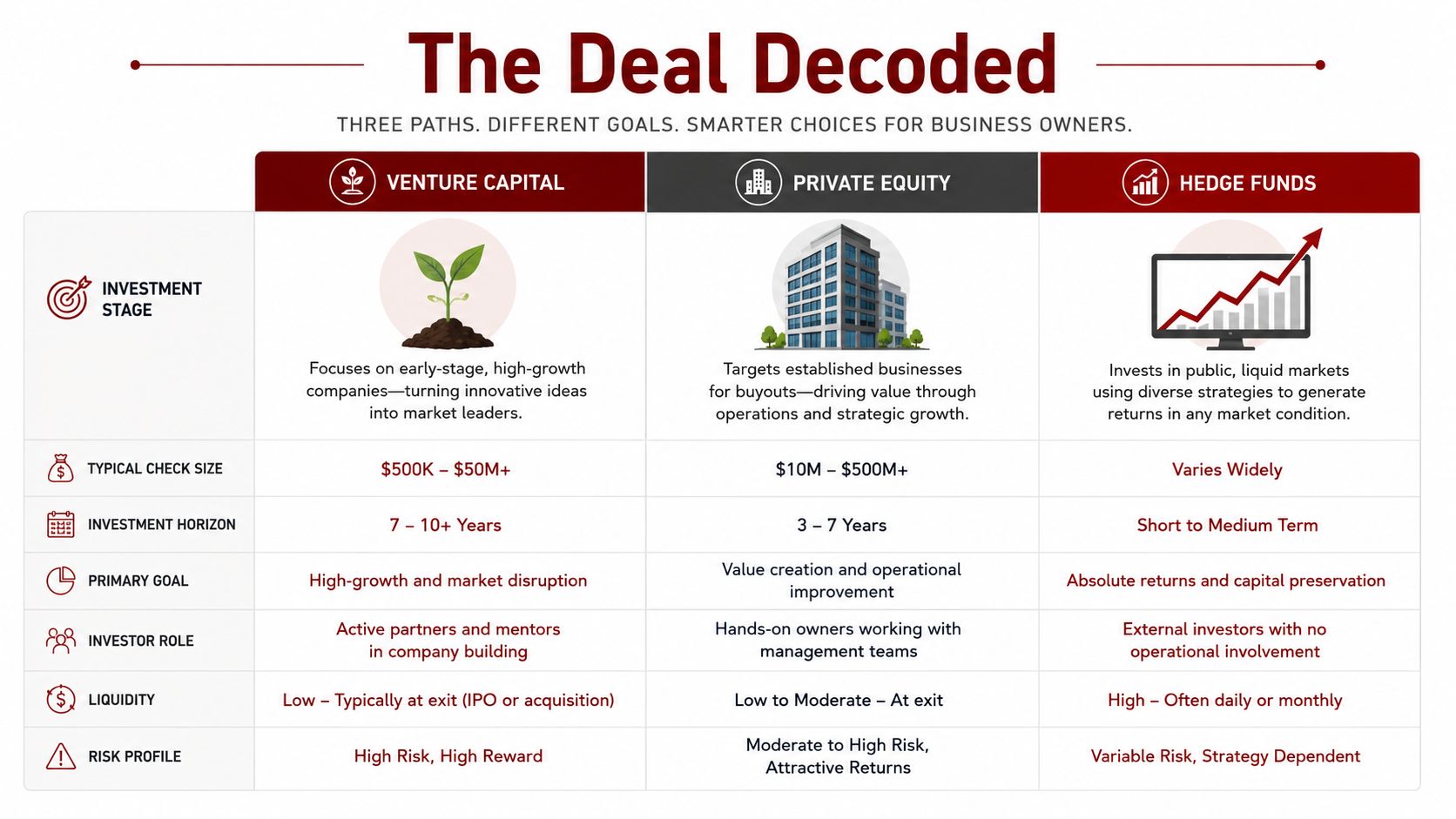
The fastest way to compare these fund types is to look at what life feels like after the capital arrives.
| Criteria | Venture Capital | Private Equity | Hedge Fund |
|---|---|---|---|
| Typical company stage | Early-stage, innovation-led, often pre- or low-profitability | Established businesses, often with EBITDA and operating history | Usually public-market or liquid-market exposure |
| Founder control | Shared governance, board influence, strong growth oversight | Often the most control-oriented, especially in buyouts | Usually less operational control in private company settings |
| Time horizon | Long-duration, tied to company-building and exit optionality | Often the longest hold from an operator's perspective in buyout structures | More liquid, generally shorter in market behavior than PE or VC |
| Transparency | Lower day-to-day visibility because valuation is infrequent | Lower visibility than liquid strategies, diligence-heavy reporting | Highest visibility of the three in most structures |
| What they push hardest | Growth, market capture, follow-on fundraising | Margin, discipline, acquisitions, exit preparation | Liquidity, pricing, market events, tradable opportunity |
| Best fit | Hyper-growth businesses with large upside potential | Companies seeking expansion, recapitalization, succession, or control transactions | Founders dealing with public markets or liquid strategies |
Holding period changes the relationship
Holding period is not a background detail. It changes how every board meeting feels.
Hasit Vibhakar's experience is that traditional private equity buyout funds generally hold capital the longest, with investments often locked up for 5 to 10+ years.
That longer hold can be a major advantage if the investor is aligned with your operating plan. It can also feel restrictive if your goals diverge after the first year or two. Venture capital also tends to be patient in calendar terms, but the pressure profile is different. VC wants breakout growth and future rounds. PE often wants measurable operating progress and a defined path to exit.
Governance is where founders feel the difference
Governance terms decide who really controls the company when things get hard. Many founders underestimate the gap between the three categories at this stage.
Private Equity, particularly control-oriented buyout deals, generally involves the strictest governance requirements across PE, VC, and hedge fund structures.
In practice, that can include tighter board oversight, more formal approval rights, deeper operating reviews, and broader compliance expectations. Some founders thrive in that system because it creates focus and accountability. Others find it constraining, especially if they were expecting a looser partnership.
VC governance usually sits in the middle. Investors often want board seats, protective provisions, and influence over major decisions, but they may be more tolerant of experimentation if growth is strong. Hedge funds, where relevant, usually don't resemble a classic operating partnership at all.
What business owners should compare before saying yes
The smartest comparison is not just PE versus VC versus hedge fund. It is your company versus the investor's model.
Use this checklist in management discussions:
- Company stage: Are you proving a concept, scaling a product, or optimizing an established company?
- Cash flow profile: Are you still investing ahead of revenue, or does the business already generate EBITDA?
- Control tolerance: Can you live with intensive governance, or do you need more room to move?
- Exit preference: Do you want to sell, recapitalize, compound, or keep optionality open?
- Operational support: Do you need introductions and recruiting help, or acquisition strategy and integration discipline?
For operators building through acquisition, process discipline matters as much as capital. Hasit Vibhakar writes about that directly in his work on business scaling strategy.
What doesn't work
Founders get into trouble when they optimize for one deal point and ignore the rest.
A high valuation can be offset by restrictive terms. A minority investor can still shape the company if veto rights are broad. A friendly first meeting doesn't tell you how the investor behaves in a missed quarter, delayed product launch, or acquisition integration problem.
The right capital partner isn't the one who sounds most enthusiastic. It's the one whose incentives still make sense when the business hits friction.
Risk Return and Transparency What Hasit Vibhakar Learned
Hasit Vibhakar's practical ranking for risk-adjusted performance is straightforward: Private Equity first, Hedge Funds second, Venture Capital third. That view reflects how operators experience outcomes, not just how investors market themselves.

Why the ranking makes sense in practice
Private equity often performs better on a risk-adjusted basis because it usually starts with a more knowable business. The company already has customers, operations, and cash flow patterns that management can improve. PE firms can influence value through pricing, operational discipline, acquisitions, management upgrades, and exit timing.
VC can produce spectacular winners, but the path is far less predictable. The early-stage model accepts that many companies won't become durable businesses. From an operator's perspective, that means more uncertainty around future funding, market adoption, and eventual liquidity.
Hedge funds sit between the two in this ranking because they usually benefit from liquidity and faster price discovery, but they don't usually offer the same level of direct operational value creation that a strong PE partner can bring to an established company.
Transparency is not just a reporting issue
Transparency affects trust. It also affects how quickly management can respond when stakeholders disagree.
Hasit Vibhakar's observation is clear: hedge funds generally offer the highest visibility, while PE and VC are more opaque because they hold long-term, illiquid investments with less frequent valuation. Founders should expect that difference. It isn't necessarily a flaw. It is a structural feature of the asset class.
That means a hedge fund investor often sees marks and position changes more quickly. A PE or VC investor sees progress through operating reviews, quarterly reporting, board packages, and eventual financing or exit milestones.
A short explainer on valuation mindset helps here:
What founders should ask about transparency
If you're evaluating a partner, ask very practical questions:
- Reporting cadence: How often will performance be reviewed, and in what format?
- Valuation approach: Who determines fair value between financings or exit events?
- Information rights: What exactly will investors receive, and what will management receive back?
- Decision speed: When the business needs a quick answer, who has approval authority?
A founder doesn't need perfect visibility. A founder needs a structure that doesn't create surprises. That's the lesson behind Hasit Vibhakar's view on risk, returns, and transparency. The cleaner the alignment, the easier it is to operate through uncertainty.
Choosing Your Path Aligning Capital with Your Company's Future
A founder usually reaches this decision under pressure. Orders are growing faster than the team. A new facility, product line, or acquisition is within reach. The business can keep compounding, but only if the capital partner fits the way the company operates.
The right question is not who will write a check. The right question is what that check will change.
When VC is the right answer
VC fits companies that need time, talent, and repeated product-market iteration before the financial model settles. Software and technology businesses often fall into this category, but the broader pattern is the same. You are funding future scale, not current efficiency.
That trade can make sense. Founders give up meaningful ownership and accept a faster growth mandate in exchange for speed. In my experience, that only works well when management wants the same pace the investor expects. If the founder wants optionality and the investor wants a sharp sprint toward the next round, friction starts early.
When PE is the better partner
PE tends to fit companies that already know how they make money. The customers are real, margins can be improved, and the business has enough structure to benefit from tighter execution, add-on acquisitions, pricing discipline, and leadership depth.
I have seen this clearly in industrial and manufacturing environments. A good PE partner is rarely chasing a story. They are testing whether the business can become more valuable through better operations, cleaner reporting, stronger management habits, and disciplined capital allocation.
For owner-operators, PE can also solve for personal objectives that VC usually does not address well. Partial liquidity, succession planning, recapitalization, and acquisition financing all sit naturally in a PE conversation.
A mature business needs an investor who can improve what already works and help management scale it without losing control of the operating rhythm.
Where hedge funds fit, and where they don't
Hedge funds matter more in public markets, structured situations, and event-driven trades than in the day-to-day realities of a privately held operating company. A founder deciding how to finance growth, hire leaders, or expand capacity usually will not treat a hedge fund as the primary strategic partner.
The more relevant modern comparison is often between selling equity and using a more flexible private market structure.
The overlooked option is private credit
Private credit has become a serious option for middle-market companies, especially businesses with assets, cash flow, and a clear use of proceeds. That matters in sectors where growth requires equipment, inventory, plant expansion, or acquisitions more than venture-style experimentation. A useful discussion of that shift appears in this analysis of private credit, rates, and founder financing choices.
The trade-off is straightforward. Equity buys breathing room but changes ownership. Private credit preserves more ownership but adds fixed obligations. If the company can service the debt comfortably, that structure can be attractive. If cash flow is uneven, it can become restrictive at exactly the wrong time.
A practical decision filter
Founders and CEOs should screen options against the realities of the business, not the language used in pitch meetings.
- Choose VC if growth depends on building before profits arrive and the company needs investors who are comfortable with that risk.
- Choose PE if the business already has operating traction and the goal is to scale, professionalize, acquire, or create liquidity.
- Choose private credit if preserving ownership matters and the company can reliably carry structured payments.
- Consider hedge fund capital only if the business sits close to public market activity or a special situation that matches that investor's model.
I often tell management teams to ignore what worked for another founder in a different industry. A software startup, a precision manufacturer, and a family-owned aerospace supplier live on different timelines. Their margin profiles are different. Their tolerance for dilution, debt, and outside control is different too.
That is the selection process. Choose the partner whose model fits your company's future, your operating cadence, and the level of control you are prepared to share.
About Hasit Vibhakar and Final Thoughts on Building Value
About Hasit Vibhakar: Hasit Vibhakar is a serial entrepreneur and CEO with over 25 years of experience building, scaling & increasing shareholder value across Aerospace, Advanced Manufacturing & Industrial sectors.

Hasit Vibhakar's career gives this comparison weight because it comes from lived operating experience across private companies, public markets, acquisitions, and private equity partnerships. He has worked where capital structure meets payroll, customers, plant output, and exit planning.
The lasting lesson is simple. Capital is never just capital. The investor you choose will shape governance, pace, reporting, and strategic freedom. Founders should choose the partner whose model fits the company they have, not the company they wish they had on a pitch deck.
Frequently Asked Questions by Founders
What does “2 and 20” mean in real terms?
It refers to a common fund fee model where managers charge a management fee plus a share of profits. For a founder, the bigger issue isn't memorizing fund economics. It's understanding how investor incentives influence behavior around follow-on capital, exit timing, and control. Ask how the fund gets paid, how long it expects to hold, and what outcome it needs to consider the investment a success.
What mistake do founders make most often when negotiating?
They focus too much on valuation and not enough on control terms. Board composition, veto rights, information rights, drag-along provisions, and exit mechanics can matter more than the headline number.
Terms decide how power works after the celebration dinner.
If you want more perspective on how investors think about access and structures, Hasit Vibhakar's archive on private equity for retail investors is a useful starting point.
Where does growth equity fit?
Growth equity often sits between classic VC and classic PE. It usually targets companies that are more mature than a venture-stage startup but not ready for a full buyout. Founders who want expansion capital without an immediate control transaction often find this category worth exploring. It can work well for businesses with strong growth and improving economics that still want operating flexibility.
If you're evaluating capital options and want an operator's perspective on scaling, value creation, and investor alignment, explore the insights and resources from Hasit Vibhakar.


Leave a Reply