
You're probably weighing a decision that looks like an aviation purchase on paper but behaves like a capital allocation choice in practice. The trigger is usually the same. A board meeting in one region, a plant issue in another, and a financing or acquisition conversation on a third continent, all compressed into a window where commercial schedules force compromises you don't want to make.
That's where the ultra long range business jet stops being a status object and starts acting like executive infrastructure. If your company operates across borders, time zones, and sensitive negotiations, mobility changes the pace at which leadership can act. The core question isn't whether these aircraft are impressive. It's whether control over distance creates enough strategic value to justify the commitment.
This is the lens experienced operators and builders tend to use. About Hasit Vibhakar: Hasit Vibhakar is a serial entrepreneur and CEO with over 25 years of experience building, scaling & increasing shareholder value across Aerospace, Advanced Manufacturing & Industrial sectors. More information can be obtained at Hasit Vibhakar.
Table of Contents
- The New Geography of Global Business
- Defining the Edge of Aviation Performance
- The Premier Aircraft Reshaping Global Travel
- Calculating the Strategic ROI of Global Mobility
- Key Selection Criteria for Executive Decision-Makers
- Navigating Ownership Models and Operational Realities
- Your Next Move in a Boundaryless World
The New Geography of Global Business
A CEO leaves New York after a late strategy session, lands in the Gulf for an investor meeting, and needs to be in Southeast Asia before competitors frame the deal on their terms. That's not an exceptional week anymore. For companies with suppliers, customers, regulators, and capital partners spread across continents, leadership speed has become part of operating performance.
Commercial aviation still works when the trip is routine and the agenda is forgiving. It breaks down when the decision cycle is compressed, confidentiality matters, and one missed connection changes the quality of the outcome. Senior executives don't lose value only in the air. They lose it in overnight layovers, airport transfers, schedule rigidity, and the inability to turn travel time into working time.
A strategic asset, not a hospitality product
The most useful way to think about an ultra long range business jet is as a tool for collapsing decision latency. It lets a leadership team get to the right place, with the right people, on the right timetable, without handing control of the mission to an airline network.
That changes more than convenience:
- It protects timing: Deals, plant interventions, and board decisions often depend on who arrives first and who can stay flexible.
- It protects privacy: Sensitive M&A, financing, and personnel discussions can continue in transit.
- It protects executive capacity: Fewer handoffs and fewer interruptions usually mean sharper meetings on arrival.
Practical rule: If the trip affects enterprise value, don't evaluate it as a travel expense. Evaluate it as an execution variable.
What leadership teams are actually buying
In my experience, discerning buyers aren't chasing one heroic spec. They're buying certainty. They want to know the aircraft can support a specific operating model: global reach, reduced friction, and the ability to move decision-makers without turning the trip into a logistical project.
That's especially true in aerospace, industrials, and advanced manufacturing, where a single cross-border visit can involve investors, program partners, government stakeholders, and production teams in rapid sequence. When a company is scaling internationally, distance stops being a background condition. It becomes a competitive constraint unless management removes it.
The ultra long range category exists to remove that constraint.
Defining the Edge of Aviation Performance
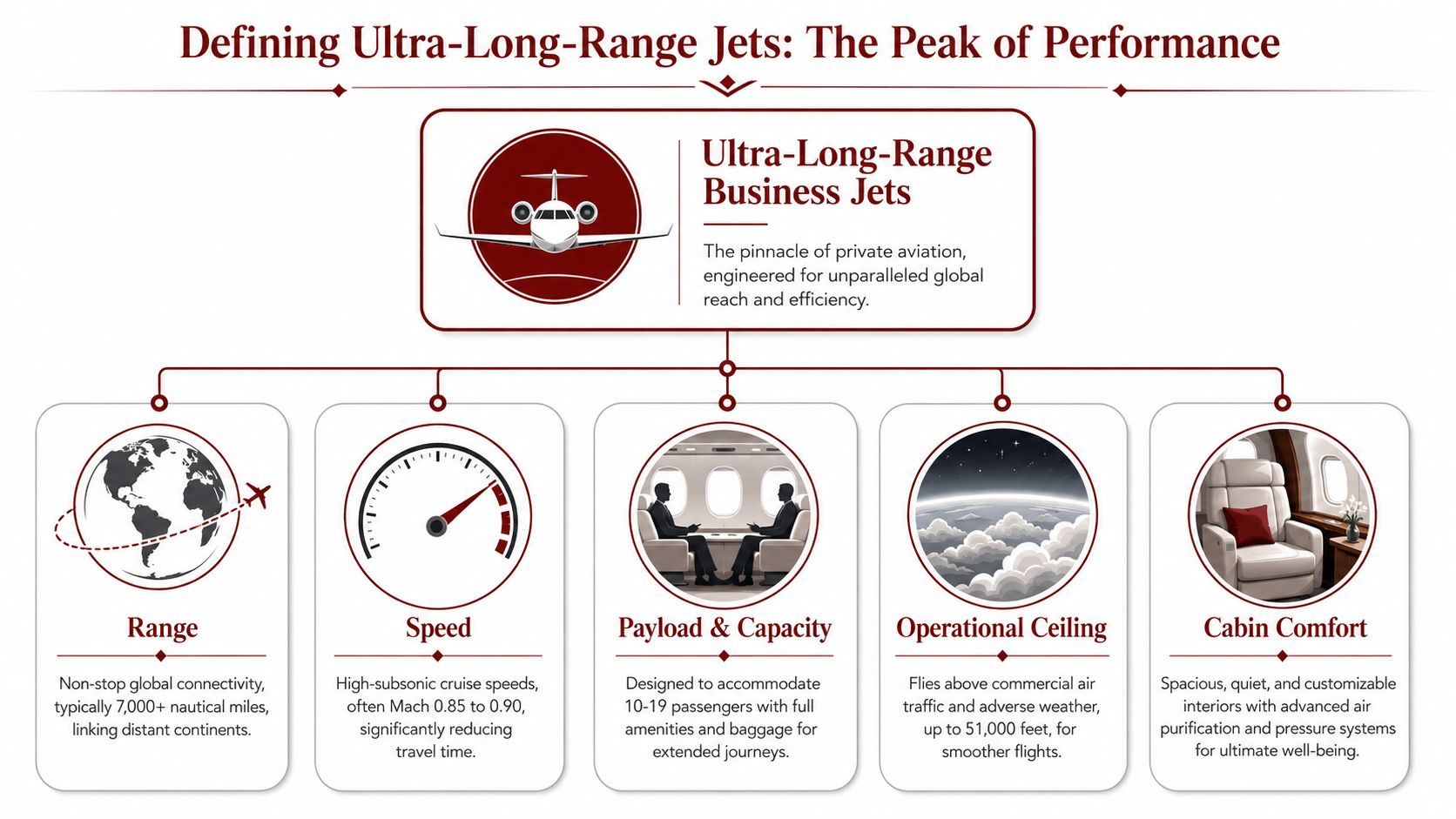
Ultra-long-range isn't a marketing phrase. It's a practical category with a clear threshold. As of 2026, the Gulfstream G800 holds the record for the longest published range among all business jets, achieving 8,200 nautical miles at a long-range cruise speed of Mach 0.85, and the ultra-long-range segment is defined by aircraft operating at or above 7,000 nautical miles, according to BlackJet's overview of the longest-range private jets.
What puts an aircraft in the ULR category
That 7,000 nautical mile threshold matters because it changes the mission profile. Below it, operators often have to build the trip around fuel planning, payload compromises, or less direct routings on the longest sectors. Above it, the aircraft starts connecting city pairs that materially reduce trip friction for global operators.
For a business leader, that means the aircraft can handle missions that would otherwise require a stop, a crew plan adjustment, or a reworked schedule. The benefit isn't just distance. It's schedule integrity.
A useful way to think about ULR capability is through four executive questions:
| Question | Why it matters |
|---|---|
| Can it fly the mission nonstop? | Nonstop capability protects timing and confidentiality. |
| Can it do it at useful speed? | Faster cruise shortens the dead space between decisions. |
| Can the team work and rest onboard? | A long flight only creates value if the cabin functions as an office and recovery space. |
| Can it access the airports you actually need? | The mission fails if the aircraft can't support the operating footprint. |
Why speed and cabin design matter to leadership
Range gets headlines, but speed changes the lived reality of using the aircraft. In practical terms, a high-subsonic cruise profile means the airplane doesn't just reach far. It gets there in a time frame that preserves the point of making the trip.
If you want a broader sense of how private aviation changes trip duration versus the commercial system, these private jet travel time insights are useful because they frame the value around total journey time, not just airborne time.
Then there's the cabin. ULR aircraft are more than longer-flying jets. They're designed so a leadership team can work, hold a secure discussion, eat, sleep, and arrive ready to perform. That's a different product than a fast plane with nice seats.
The buyer who focuses only on published range usually ends up relearning the mission the hard way.
The operational ceiling and cabin environment also matter, even if they don't show up in cocktail-party conversations. Smoother rides, lower fatigue, and better continuity during a long sector support the actual reason the aircraft exists: helping decision-makers arrive usable, not just arrived.
The Premier Aircraft Reshaping Global Travel
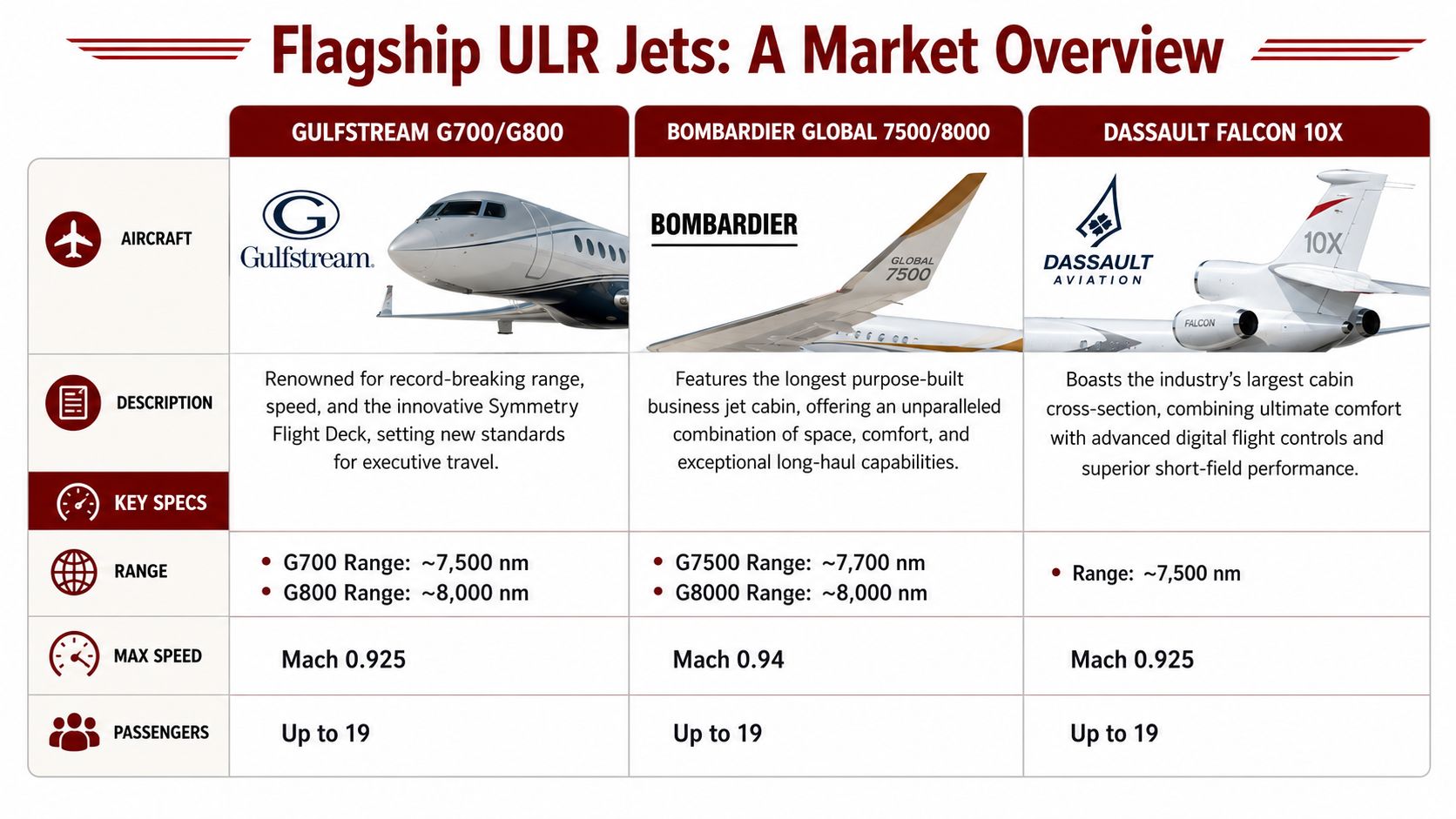
The top of the market is defined less by who built the nicest cabin and more by how each manufacturer interprets executive mobility. Gulfstream and Bombardier are the primary reference points because they've pushed the category in different directions. Gulfstream has leaned heavily into range leadership and broad mission capability. Bombardier has pressed hard on speed, cabin zoning, and a very deliberate onboard living experience.
A visual side-by-side view helps clarify the situation.
Gulfstream and Bombardier are solving different executive problems
Gulfstream's headline today is range leadership. In the current market, that positions the G800 as the aircraft for operators who want the broadest nonstop mission envelope and the strategic flexibility that comes with it. That buyer usually prioritizes route certainty, fewer compromises, and the ability to absorb demanding international missions with margin.
Bombardier's Global 8000 takes a different angle. Bombardier states that the Global 8000 is the world's fastest business jet, with a top speed of Mach 0.95, carrying up to 19 passengers across 8,000 nautical miles, and featuring four true, equal-size living spaces, according to Bombardier's Global 8000 aircraft page. That combination matters if your leadership team places a premium on speed and on a cabin that feels purpose-built for long-haul use rather than merely spacious.
A practical shorthand is this:
- Choose Gulfstream when mission reach and strategic routing flexibility dominate the discussion.
- Choose Bombardier when top-end speed and highly structured cabin living matter most to how the aircraft will be used.
- Keep Dassault in the conversation when you value cabin volume philosophy and operational versatility, especially if your mission set extends beyond pure brochure competition.
A lot of charter clients and first-time buyers also use operators as a way to pressure-test these preferences before making a capital commitment. If you want to see how the market presents that experience from a client perspective, Haute Jets' bespoke private flights provide a useful look at how ULR capability is packaged in service terms.
Later in the selection process, I'd also encourage buyers to think beyond the cabin veneer and understand what materials and structures contribute to aircraft performance, maintainability, and lifecycle behavior. That's one reason a technical perspective on carbon fiber aircraft is relevant when you're judging engineering choices instead of only surface-level amenities.
How to read the market beyond brochure language
Manufacturers sell aspiration. Operators live with trade-offs. Those are not the same thing.
When I evaluate aircraft at this end of the market, I focus on three questions:
- What kind of mission discipline does the design reward? Some aircraft are optimized for long, structured global sectors. Others shine when speed and onboard livability carry more weight.
- How well does the cabin support executive behavior? A beautiful interior that doesn't support work, rest, or meeting flow loses value quickly.
- How much compromise appears once the mission gets real? That includes payload, routing, airport choice, and cabin configuration.
The best aircraft for your company usually isn't the one with the most impressive one-line specification. It's the one that supports your recurring mission without negotiation.
That distinction is what separates an impressive jet from a productive one.
Calculating the Strategic ROI of Global Mobility
Most acquisition discussions start in the wrong place. They begin with purchase price and operating cost, then try to back into a justification. Senior leaders should invert that logic. Start with the value of compressed executive response time, then ask whether the aircraft supports enough high-consequence missions to earn its place on the balance sheet.
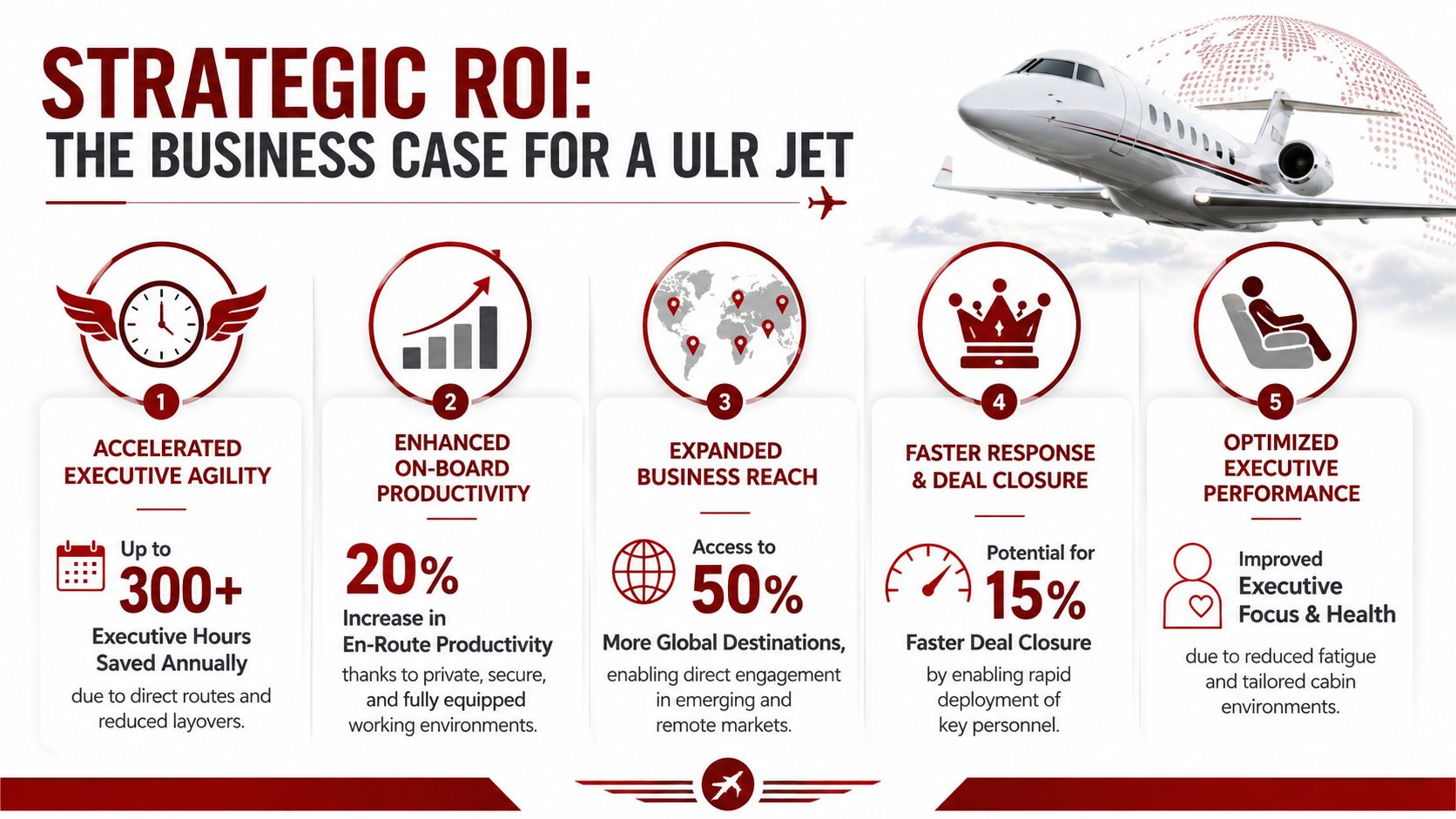
The operational case becomes easier to see when range creates routing freedom. Jettly notes that the Gulfstream G800's range and efficiency enable direct routing that saves 1.5–2 hours over segmented paths, reduces total fuel consumption by 10–15%, and expands airport access through shorter-runway capability, in its analysis of the longest-range business aircraft.
The return starts with executive time compression
Those time savings aren't abstract. They affect whether a management team can complete the mission in one sequence instead of breaking it apart. They affect whether the CEO arrives prepared or depleted. They affect whether the operating team spends its energy on the decision itself or on managing travel disruption around the decision.
The strongest ROI cases usually include some combination of the following:
- Transaction speed: Leadership can get in front of lenders, targets, boards, or sovereign counterparties without waiting on airline structure.
- Operational intervention: A plant issue, customer escalation, or certification problem gets face time from the people who can resolve it.
- Protected confidentiality: The cabin becomes a secure place to prepare strategy, review terms, and make decisions in transit.
- Unified leadership: Multiple executives can move together, align on the way, and arrive with one message.
Where the business case becomes real
The mistake is to reduce ROI to an hourly comparison with charter or first class. That misses enterprise-level effects. A strategic asset should be judged by whether it increases the quality and pace of decisions that move value.
That's why private equity firms and founder-led businesses often evaluate these decisions through a capital-efficiency lens rather than a travel lens. If you already use frameworks like multiple of invested capital, the right question is straightforward: does this aircraft improve the speed, quality, and protectability of value-creating actions enough to matter at the portfolio or enterprise level?
Boardroom view: A ULR jet earns its keep when it changes outcomes, not when it merely upgrades transportation.
The best internal business cases I've seen are tied to recurring mission categories. Cross-border acquisition work. Supplier and production oversight. Government and customer access. Capital formation. If those missions are central to growth, then mobility becomes part of execution architecture.
If they aren't, charter remains the cleaner answer.
Key Selection Criteria for Executive Decision-Makers
Aircraft selection gets distorted when buyers fall in love with a flagship model before they've defined the mission. That's backwards. The right sequence is mission profile first, operating constraints second, cabin behavior third, and only then brand preference.
Start with mission profile, not brand preference
A serious selection process starts with a hard review of how the aircraft will be used. Not the dream schedule. The true one.
Ask practical questions:
- Where do your principals travel? Repeated city pairs matter more than edge-case hero missions.
- Who is usually onboard? A CEO traveling with one aide has different needs than a leadership team moving with specialists and support.
- What happens in flight? Some teams work throughout. Others need a reset environment before landing.
- How often does schedule flexibility save the mission? If departure timing changes constantly, control matters more.
A short decision matrix helps keep the process honest:
| Decision factor | What to test |
|---|---|
| Route reality | Which city pairs recur often enough to drive value |
| Passenger mix | Whether the cabin supports the people who actually travel |
| Confidential work | How much onboard privacy matters to leadership activity |
| Airport pattern | Whether access requirements narrow your real options |
| Support ecosystem | How comfortable you are with the OEM's service footprint |
The cabin trade-off many buyers underweight
Cabin flexibility is where many executive teams oversimplify the purchase. The market talks constantly about zones, suites, and living space, but less often about what those choices cost in operational terms.
One source notes that 44% of ULRBJ buyers in 2024 prioritized multi-use cabins over maximum range, and that converting a stationary bed can sacrifice up to 200 nautical miles of range, according to this discussion of ULR cabin flexibility and performance trade-offs. That's the kind of trade-off buyers need to model before they sign, not after.
Here's what works in practice:
- A cabin should support the most frequent mission, not the most glamorous one.
- If range is central to the business case, avoid interior decisions that undermine the very capability you're paying for.
- If your leaders spend long sectors onboard, equal attention should go to work zones, rest quality, and movement through the cabin.
Buyers often discover too late that “more cabin” and “more mission” aren't always the same thing.
The right aircraft is the one whose compromises align with your operating model. Every jet in this category is exceptional. None is exempt from trade-offs.
Navigating Ownership Models and Operational Realities
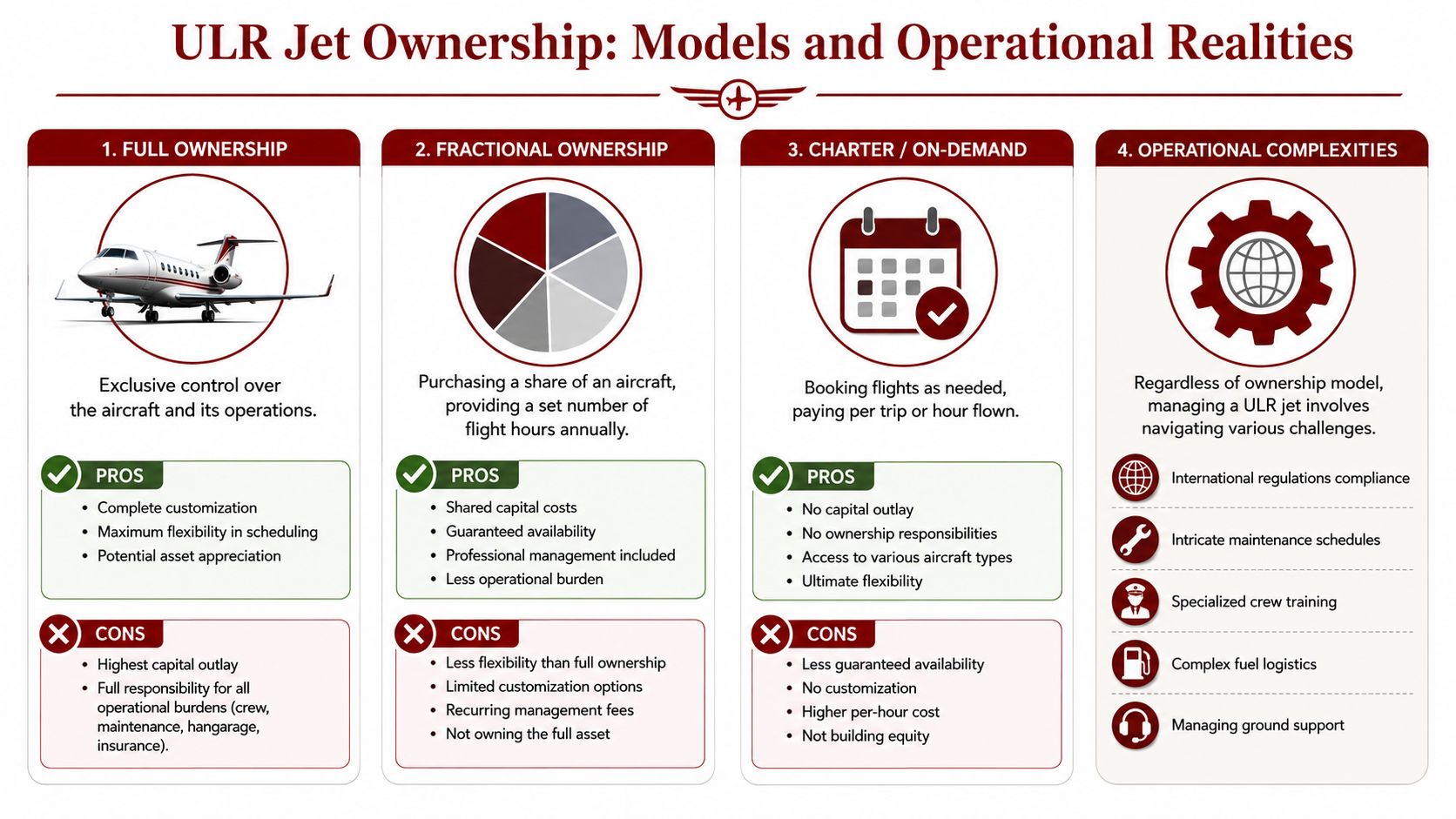
An ultra long range business jet can create strategic advantage, but only if the access model matches the mission. Too many buyers jump straight from admiration to ownership without pausing to ask whether they need an asset, guaranteed lift, or occasional access to the category.
Control, flexibility, and operational burden
Each model solves a different executive problem.
- Full ownership gives the highest level of control. You set standards, crew expectations, maintenance philosophy, and aircraft availability around your priorities.
- Fractional ownership reduces management burden while preserving a more structured level of access than ad hoc charter.
- Jet cards and membership programs work for buyers who want predictability without the full weight of owning and managing an aircraft.
- On-demand charter makes sense when ULR usage is intermittent or still being validated.
If you're comparing access structures, this guide to compare private jet programs is helpful because it frames the distinctions in practical terms rather than treating every option as interchangeable.
The strategic issue is simple. The more critical ULR mobility is to your operating model, the more dangerous it becomes to rely on availability that you don't control.
What ownership looks like after the closing dinner
Many first-time buyers underestimate the reality of the asset. The transaction is only the beginning. Once the aircraft enters service for your organization, the management burden becomes a live operating discipline.
That includes:
- Crew management: Hiring, training, retention, and culture fit matter because the crew is part of the executive travel experience.
- Maintenance planning: Scheduled downtime and unscheduled events require disciplined support relationships. A strong understanding of MRO in aerospace helps leaders evaluate what operational resilience depends on.
- International compliance: Cross-border operations bring regulatory, customs, and documentation complexity.
- Ground infrastructure: Hangarage, dispatch coordination, and support at destination airports don't solve themselves.
Charter gives access. Control gives repeatability.
That's why my bias is straightforward. If ULR travel is central to value creation, some degree of operational control is usually necessary. If the mission is occasional, charter and structured access products are often smarter. The wrong model doesn't just cost more. It creates friction exactly where you were trying to remove it.
Your Next Move in a Boundaryless World
The strategic case for an ultra long range business jet doesn't rest on admiration for engineering, although the engineering is remarkable. It rests on whether leadership can convert mobility into better timing, better decisions, and better outcomes.
At this level, the aircraft is a business system. Range affects route certainty. Speed affects executive responsiveness. Cabin design affects whether people can work, recover, and arrive ready. Ownership structure determines whether the organization gets reliable access or recurring friction. Each element shapes the fundamental value of the asset.
That's why CEOs and investors should resist buying on headline prestige alone. The more disciplined question is whether the aircraft strengthens your specific operating model. If your company wins by compressing decision cycles across geographies, controlling sensitive conversations, and getting senior people to the right place without delay, then this category belongs in a serious capital allocation discussion.
If that's not your reality, the answer may be access without ownership. There's no shame in that. Discipline matters more than symbolism.
What has changed is the role these aircraft play in the modern enterprise. Distance used to be a scheduling problem. For global businesses now, it's a strategic variable. Leaders who control it can move with a level of speed and precision that commercial systems rarely support.
The boundaryless company doesn't eliminate geography. It out-executes it.
If you're evaluating aerospace, manufacturing, or industrial strategy through the lens of enterprise value creation, Hasit Vibhakar brings decades of CEO-level operating experience across scaling, acquisitions, advanced manufacturing, and aerospace. His perspective is especially useful when the decision in front of you looks operational on the surface but is fundamentally about capital allocation, growth, and shareholder value.



Leave a Reply