

Manufacturers that win on margin rarely win because they bought more technology. They win because they applied the right technology to the cost, quality, and throughput constraints that shape EBITDA.
That is the standard behind Advanced Manufacturing Technology by Hasit Vibhakar. The point is not to collect robotics, additive systems, AI tools, or connected equipment. The point is to improve uptime, cut scrap, shorten engineering-to-production cycles, tighten traceability, and build an operation that deserves a higher valuation multiple.
Hasit Vibhakar approaches advanced manufacturing as an operating system for value creation. Over more than 25 years, his work has tied engineering discipline to commercial outcomes across semiconductor, aerospace, and precision manufacturing businesses, including company building, public-market scale, and exit execution. That perspective matters because CEOs and investors do not fund technology for its own sake. They fund repeatable gains in cash flow, resilience, and scalable growth.
Table of Contents
- The New Competitive Edge in Modern Industry
- The Core Pillars of Advanced Manufacturing Technology
- Weighing Strategic Benefits Against Inherent Risks
- An Implementation Roadmap from Pilot to Scale
- Case Studies in Value Creation and Efficiency
- The Private Equity and Investor Perspective
- Your Next Steps in the Manufacturing Revolution
- About Hasit Vibhakar
The New Competitive Edge in Modern Industry
Manufacturing leaders don't win by owning more equipment. They win by building systems that produce quality parts predictably, adapt quickly, and support profitable growth. Hasit Vibhakar has operated in exactly that environment across aerospace, semiconductor, and industrial businesses, where production discipline is tied directly to customer trust and shareholder value.
A lot of advanced manufacturing commentary gets distracted by novelty. It celebrates AI, automation, and digitization without answering the hard question a CEO or operating partner asks first. When does it pay back? Hasit Vibhakar's perspective is useful because it stays anchored to plant economics. In his broader commentary on building high-value companies, the key takeaway is that industrial AI matters less as a trend and more as a targeted tool for scrap reduction, uptime, and throughput improvement in precision manufacturing environments where defects are expensive, as noted in his discussion of high-value aerospace and manufacturing businesses.
Technology has to earn its place
The strongest manufacturing organizations don't automate everything. They identify where delay, rework, poor scheduling, weak traceability, or unstable machine performance are hurting margin, then they deploy technology against those points of failure.
That's the difference between a modernization program and a return-producing operating strategy.
Practical rule: If a technology roadmap doesn't connect to throughput, quality, uptime, or working capital, it's a science project.
Hasit Vibhakar's body of work reflects that discipline. The point isn't digital transformation as branding. The point is building a factory and supply system that can scale without losing control.
Why this matters now
Manufacturers are under pressure from every direction. Customers expect shorter lead times. Quality expectations keep rising. Supply chains need more resilience. Skilled labor is harder to replace with tribal knowledge alone.
In that setting, advanced manufacturing technology stops being optional. It becomes the operating layer that lets a company grow without multiplying chaos.
The Core Pillars of Advanced Manufacturing Technology
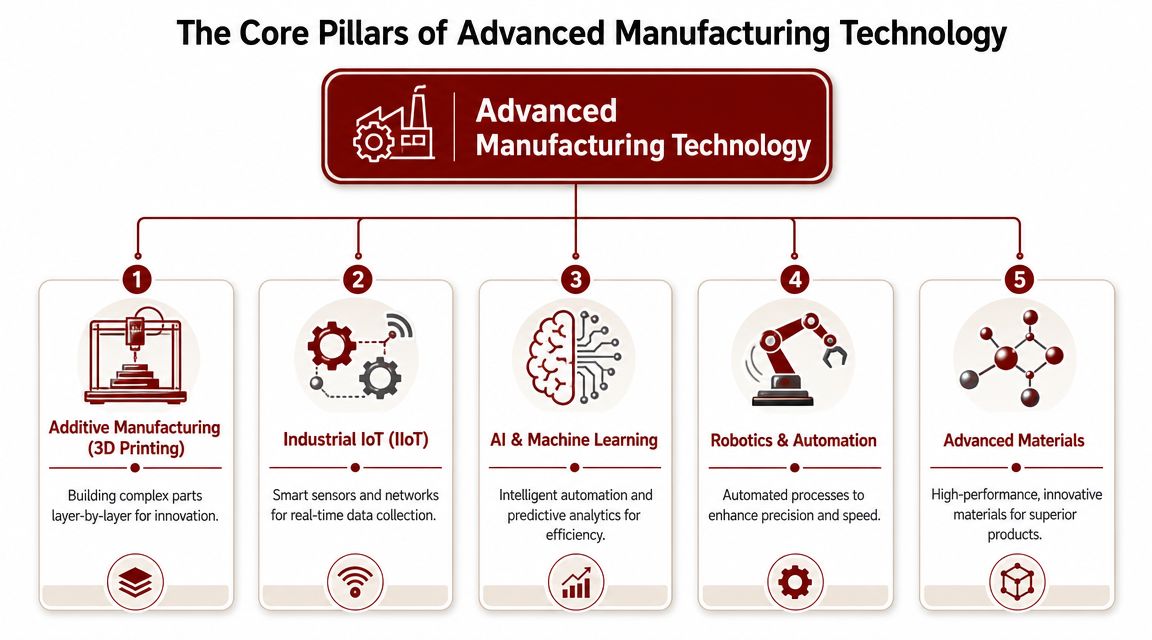
Margins move when technology removes a specific constraint. In practice, advanced manufacturing is a stack of operating capabilities that improve yield, throughput, traceability, and cash conversion in different ways. The management job is to decide which layer changes economics first and which can wait.
Technology has to solve an operating problem
Hasit Vibhakar's manufacturing work points to a disciplined model. Pair precision production capabilities with systems that support scale. CNC machining delivers repeatable tolerances and surface finish for high-spec parts. Additive manufacturing shortens prototype cycles, speeds fixture development, and reduces the cost of design changes before a program reaches full production. Supply chain coordination determines whether those gains show up on the income statement or disappear in queue time, shortages, and expediting.
That mix matters because each pillar affects a different line item. Better process control lowers scrap and warranty exposure. Faster iteration reduces engineering delay and gets revenue programs into production sooner. More predictable material flow improves on-time delivery and reduces working capital tied up in excess inventory.
A practical way to view the core pillars:
| Pillar | What it solves | Where it fits |
|---|---|---|
| CNC automation | Repeatability and part quality | Precision components and stable production |
| Additive manufacturing | Faster iteration and tooling flexibility | Prototyping, fixtures, low-volume runs |
| Industrial IoT | Machine and process visibility | Real-time condition and performance data |
| AI and machine learning | Pattern detection and decision support | Predictive maintenance, scheduling, inspection |
| Robotics | Consistency and labor support | Repetitive handling, assembly, tending |
| Advanced materials | Product performance | Lightweight, durable, application-specific designs |
No plant needs every pillar at once.
The plants that create value fastest usually start with the constraint that is already costing money. If cycle time is unstable, fix process control and machine visibility. If engineering changes stall launches, use additive tools where they cut weeks out of development. If labor turnover is disrupting output, automate the repetitive handling work that adds little value and creates frequent bottlenecks.
For leaders also looking at flow beyond the machine cell, resources on smart warehouse automation are useful because storage, retrieval, and material movement often become the hidden constraint after machining or assembly improves.
A short visual helps frame the context:
Why the stack matters more than any single tool
Single-point upgrades rarely change enterprise value on their own. A new machine can add capacity, but unmanaged capacity often creates a different problem downstream. Real gains come from connecting equipment, people, quality controls, and production data so management can see what happened, correct variance fast, and quote future work with confidence.
That is why the software layer carries so much weight. Hardware produces parts. The operating system around it determines schedule adherence, genealogy, quality response time, and how quickly a plant can scale without losing control. In my experience, good factories distinguish themselves from expensive ones.
Hasit Vibhakar's perspective on manufacturing execution systems for precision manufacturing control reflects that reality. A strong MES discipline creates the digital record needed to track work in process, enforce routing, document quality, and tie production events back to customer and compliance requirements. That does more than improve operations. It supports margin protection, customer retention, and buyer confidence in a diligence process.
Plants become advanced when leaders can run, measure, and improve the whole system with financial discipline.
Weighing Strategic Benefits Against Inherent Risks
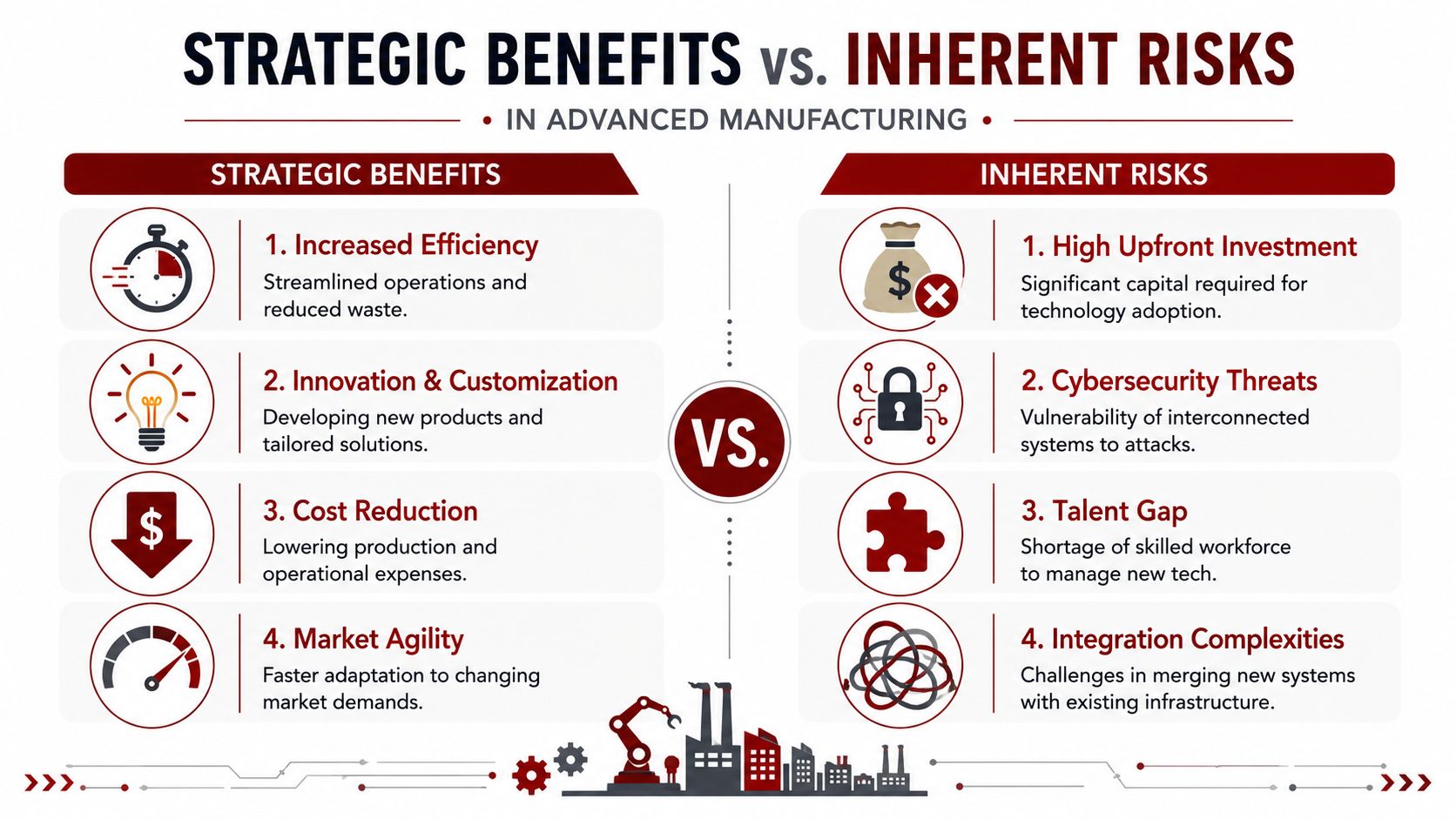
Advanced manufacturing offers significant advantage, but only when management is honest about the trade-offs. Hasit Vibhakar's style is practical on this point. Technology expands capability. It also introduces cost, complexity, and execution risk.
Where the upside is real
Well-deployed systems can improve production consistency, shorten engineering cycles, and make a business less dependent on heroic manual intervention. That changes how a company serves customers. It also changes how management forecasts output and margin.
The strategic benefits usually show up in four areas:
- Operational stability means fewer surprises on the shop floor and better control over schedule adherence.
- Customization capability lets teams produce more complex or lower-volume configurations without breaking the business model.
- Resilience improves when production knowledge is embedded in systems rather than trapped in a few individuals.
- Workforce safety and ergonomics often improve when repetitive or high-strain tasks move to automation.
Where leaders get into trouble
The risks are just as real. Connected systems expand the attack surface for cybersecurity. New software layers can expose weak master data and inconsistent processes. Legacy machines rarely integrate as cleanly as the vendor demo suggests.
A sober evaluation should include these questions:
- Capital discipline: Are you solving a defined bottleneck, or buying flexibility you won't use?
- Integration reality: Can your current ERP, quality process, and machine environment support the new stack?
- Talent readiness: Do supervisors, engineers, and operators know how to run and improve the system after launch?
- Supply strategy: Will localization improve resilience, or move cost into a less efficient footprint?
Hasit Vibhakar's contrarian framing on reshoring is especially useful here. The stronger question isn't whether a manufacturer should reshore everything. It's which subassemblies, materials, or processes should remain global, move nearer to demand, or be duplicated locally. His aerospace manufacturing commentary argues that advanced manufacturing winners are increasingly building dual-source or multi-region networks rather than assuming full localization is automatically better, as discussed in his analysis of aerospace manufacturing strategy.
The wrong automation decision doesn't just waste capex. It hardwires inefficiency into the process you scale.
An Implementation Roadmap from Pilot to Scale
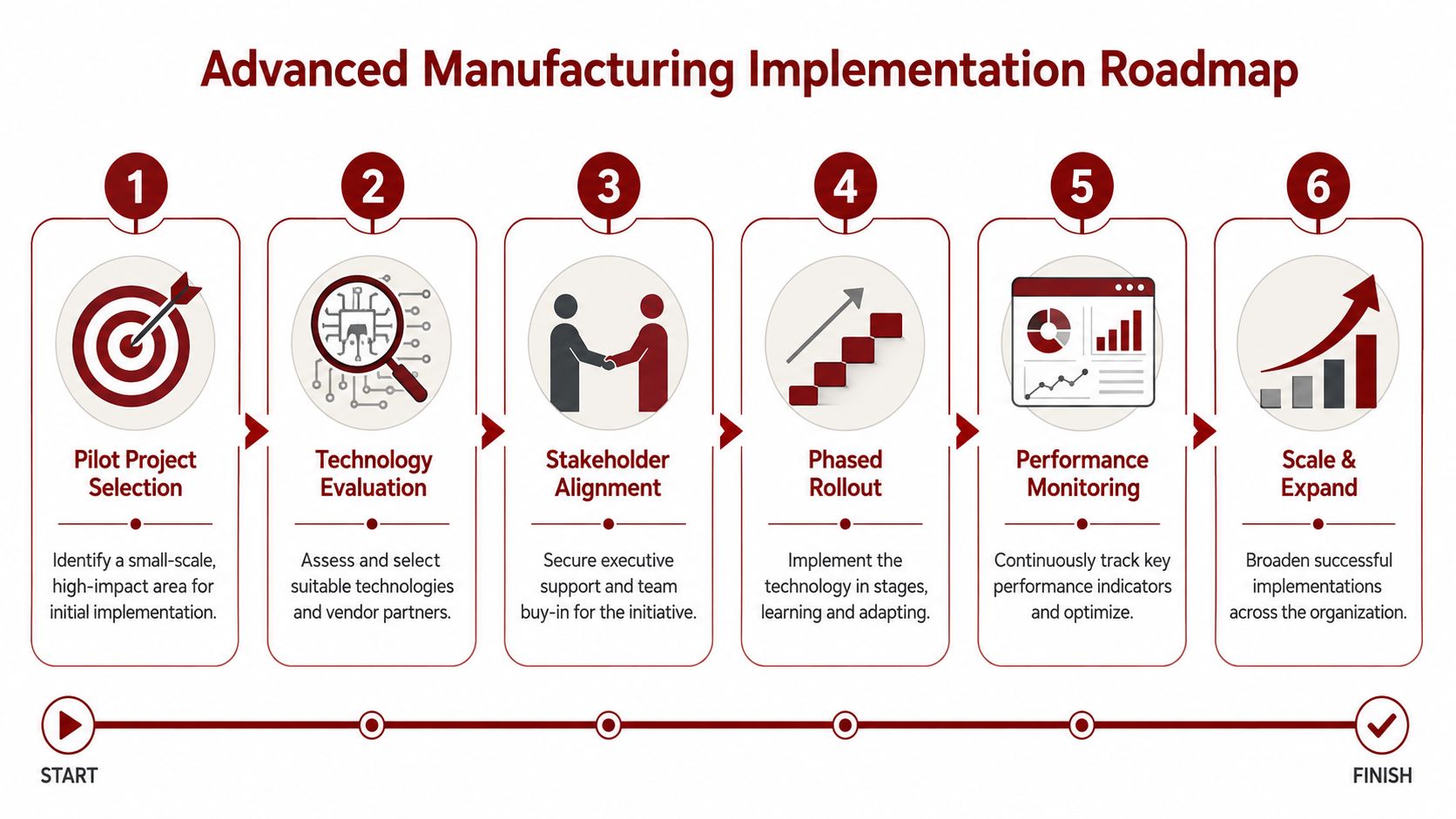
Plants rarely fail at modernization because the technology is weak. They fail because leaders scale before they have proof of repeatable economics. The companies that get returns treat implementation as a capital allocation process, not an IT rollout.
Start with the bottleneck that hurts economics
A pilot should target the constraint that is already showing up in margin, throughput, or customer performance. In practice, that usually means unstable uptime, long changeovers, repetitive manual handling, poor traceability, or quality escapes that create rework and late shipments.
The sequence is straightforward, but the discipline is hard:
- Select one pain point that leadership can already express in scrap, labor, capacity loss, or missed revenue.
- Document the current state with production data, cycle times, downtime codes, and quality records.
- Choose a contained use case that can run without disrupting the full plant.
- Set success criteria before launch so the team is not rewriting the scorecard mid-pilot.
- Review results every week and correct process issues quickly.
- Scale after stability is proven and a clear owner is accountable for results.
Hasit Vibhakar has described a collaborative robot pilot on a high-mix, low-volume assembly line, which was run on one production line over a 90-day period. That is the right shape for a pilot. It is bounded, measurable, and small enough to expose operating issues before management commits more capital.
A contained pilot also gives the CFO and operating team something they can trust. Instead of debating vendor claims, they can see whether labor hours dropped, first-pass yield improved, and throughput held under normal production pressure.
Build the operating discipline before broad rollout
One successful cell does not create a scalable system. Scale comes from control over routing, revision management, machine status, traceability, quality response, and daily execution. If those basics are weak, automation spreads inconsistency faster.
That is why the next phase should focus on the operating layer around the equipment. Clean part masters matter. Work instructions matter. Exception handling matters. Supervisors need a daily cadence that reviews both output and adherence to process, because a pilot can hit short-term numbers while still creating habits that break at higher volume.
A practical scale-up checklist should include:
- Data integrity first: clean routing, part master, and revision control before adding more automation
- Operator workflow design: make digital instructions and exception handling usable under production pressure
- Quality linkage: connect inspection and nonconformance handling directly to the process
- Management cadence: review daily performance and process compliance together
- Expansion gates: require each new line or cell to meet the same financial and operational thresholds before release
Many programs lose investor confidence when they show one good pilot, then spread too quickly across lines, plants, or product families that do not share the same constraints. A disciplined rollout protects cash and raises the odds that gains hold when volumes change, staffing tightens, or customer mix shifts.
For teams working through that progression, Hasit Vibhakar's perspective on scaling operational discipline through manufacturing process improvement is useful because it ties plant-level execution to repeatable financial performance, not isolated wins.
Case Studies in Value Creation and Efficiency
Case studies matter because theory is cheap. Operating gains only count when they hold up under production pressure, staffing constraints, and customer requirements.

AI on top of CNC operations
Hasit Vibhakar has pointed to AI-driven automation and software-defined manufacturing as the adoption that moved the needle most in recent operations, with the strongest return coming from integrating AI with existing CNC automation rather than replacing the core machine base. That's an important distinction. Many plants already own valuable production assets. The better move is often to increase intelligence around them.
In practical terms, this approach helps teams monitor conditions in real time, identify abnormal behavior earlier, and schedule maintenance before machine issues create downstream disruption. It's a classic example of using software to improve asset performance rather than chasing capital-heavy replacement.
A contained cobot pilot
Hasit Vibhakar also described a collaborative robot pilot on a high-mix, low-volume assembly line. The purpose wasn't spectacle. It was to improve efficiency while reducing ergonomic strain on operators.
That combination matters. In mixed production environments, the labor issue isn't just labor cost. It's fatigue, inconsistency, and the difficulty of sustaining output quality across repetitive manual tasks. Cobots can help when the task is structured enough to automate but variable enough that full hard automation would be too rigid.
Good pilots prove two things at once. The process can improve, and the team can live with the new workflow.
Cross-sector transfer from aerospace to medical
One of the most valuable advanced manufacturing habits is transferring proven capability from one regulated environment into another. Hasit Vibhakar has given a strong example of adapting aerospace composite materials for medical devices such as orthopedic implants.
That's a useful reminder that innovation doesn't always begin with a blank sheet. Sometimes it begins with a known material, a known process discipline, and a new application where the performance profile fits. In this case, the transfer improved efficiency by replacing heavier traditional materials with lightweight, durable, and biocompatible composites, while also supporting better long-term performance in the final product.
These examples show what makes Advanced Manufacturing Technology by Hasit Vibhakar distinctive. The focus stays on use cases that strengthen the operating model, not just the technology story.
The Private Equity and Investor Perspective
Investors pay for operating systems they can trust. In manufacturing, that trust shows up in forecast accuracy, quality discipline, margin stability, and the ability to add capacity without losing control.
That is why advanced manufacturing matters in a deal process. The question is not whether a plant owns modern equipment. It is whether management has built repeatable process control that survives growth, leadership changes, customer audits, and integration pressure after an acquisition.
Hasit Vibhakar's record is useful through that lens. He has built, acquired, integrated, and exited industrial businesses, and his private equity investment strategy in manufacturing and industrial value creation reflects a clear pattern. Buyers assign better value to companies that can prove discipline on the factory floor, not just ambition in the boardroom.
Why investors care about factory discipline
Private equity firms and strategic buyers underwrite future cash flow. They look for evidence that EBITDA can hold under scale, that working capital will stay manageable, and that customer concentration risk is not hiding a weak operating model.
Factory discipline affects all three. A plant with stable cycle times, documented quality controls, and visible constraints gives investors more confidence in revenue conversion and margin retention. A plant that depends on tribal knowledge, reactive maintenance, or spreadsheet scheduling gets discounted because the downside is easy to see during diligence.
The valuation gap can be significant.
What due diligence should test
Strong diligence goes past the equipment tour. It tests whether the business can absorb growth, support tighter reporting, and integrate into a larger platform without operational drift.
A practical diligence lens includes:
| Diligence area | What matters |
|---|---|
| Production control | Can management see order status, bottlenecks, and quality events in time to act? |
| Quality system | Are deviations contained, investigated, and closed with repeatable discipline? |
| Asset reliability | Does the plant prevent downtime with planned maintenance, or chase failures after they hit output? |
| Scalability | Can volume increase without breaking scheduling, training, supplier coordination, or yield? |
| Management depth | Can supervisors and engineers run the system consistently without depending on one expert? |
I have seen the same pattern repeatedly over 25 years in advanced manufacturing. Plants with stronger operating discipline are easier to finance, easier to integrate, and easier to scale. They also give investors a cleaner path to value creation because the improvement plan starts with facts, not guesswork.
For CEOs, that changes the technology discussion. Automation, MES, vision systems, and digital quality tools are not capital projects to justify in isolation. They are part of an investable operating model that can improve exit quality, reduce diligence friction, and support a higher multiple when the time to sell arrives.
Your Next Steps in the Manufacturing Revolution
The right next step isn't a full digital transformation program. It's a focused operating decision. Hasit Vibhakar's approach is useful because it keeps the sequence clear: identify the business problem, test a contained solution, build process control, then scale what works.
If you're running a manufacturing business today, keep the priorities simple:
- Choose one economic bottleneck that is already visible in quality, uptime, scheduling, or labor strain.
- Pilot in a contained area so the team can learn without destabilizing the plant.
- Invest in data discipline before layering on more software or automation.
- Build internal capability so supervisors and engineers can own the system after implementation.
- Judge technology by business impact rather than by novelty.
Hasit Vibhakar's broader lesson is that advanced manufacturing adoption isn't about looking modern. It's about building a company that can produce consistently, adapt faster, and command stronger strategic value over time.
That's a manufacturing revolution. Better control. Better economics. Better businesses.
About Hasit Vibhakar
Hasit Vibhakar is a serial entrepreneur and CEO with over 25 years of experience building, scaling & increasing shareholder value across Aerospace, Advanced Manufacturing & Industrial sectors.
Hasit Vibhakar's credibility comes from the combination of engineering depth and operating leadership. He has founded and led companies in semiconductor manufacturing, electronics components, aerospace supply, and industrial sectors, while also working across acquisition integration and exit strategy. His background includes patents in techno casting and fastening technologies, along with hands-on leadership of private and public companies.
What makes Hasit Vibhakar especially relevant to advanced manufacturing is that his work hasn't stayed at the level of theory or plant-floor optimization alone. He has repeatedly tied manufacturing discipline to enterprise growth, strategic transactions, and investor outcomes. More information can be obtained at Hasit Vibhakar's official website.
If you're evaluating where advanced manufacturing can create the most value in your business, explore the operating perspective and company-building experience of Hasit Vibhakar.


Leave a Reply