
Most manufacturing leaders don't wake up worrying about a control chart. They wake up worrying about a late shipment, an angry customer, a batch stuck in rework, or a margin that keeps leaking for reasons nobody can pin down cleanly. The pattern is familiar. A defect shows up, the team contains it, extra inspection gets added, people work weekends, and everyone calls it a win because the customer didn't reject the whole order.
That isn't quality management. That's managed instability.
The companies that scale well, especially in demanding sectors like aerospace, don't treat quality as a department buried under operations. They treat it as a business system. Quality determines whether throughput is real or inflated by rework. It determines whether bookings convert into profitable revenue or expensive chaos. It determines whether a plant can absorb growth, support acquisitions, and defend valuation when investors or buyers start asking hard questions.
In practical terms, learning how to improve manufacturing quality means moving from heroic recovery to disciplined prevention. It means making defects visible early, making processes repeatable, and making accountability part of daily management instead of an after-the-fact investigation. It also means accepting trade-offs. Not every problem needs automation. Not every issue needs another inspector. And not every quality initiative deserves enterprise rollout before the pilot proves the process is stable.
The playbook that follows is built for leaders who need both strategic clarity and shop-floor traction. It ties quality to enterprise value, but it stays grounded in what works on the floor: baseline data, process controls, disciplined improvement routines, supplier management, reliable measurements, and selective digital tools.
Table of Contents
- Laying the Foundation
- Building the Guardrails
- Driving Momentum with Continuous Improvement
- Strengthening Your Ecosystem
- Leveraging the Digital Quality Toolkit
- Frequently Asked Questions for Manufacturing Leaders
Laying the Foundation
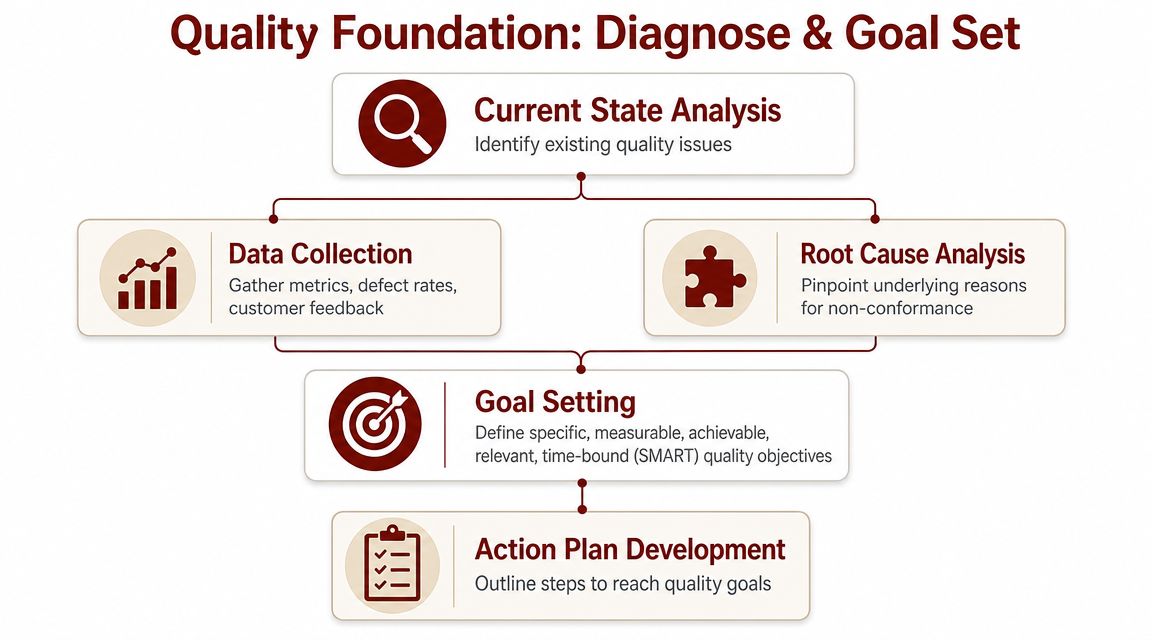
Quality programs fail when leaders skip the baseline and jump straight to solutions. If you don't know where the losses sit, you'll spend money in the wrong place. Most plants already feel the pain. Scrap is visible. Rework is noisy. Customer complaints get attention. But the actual pattern often stays blurry because the data is scattered across production logs, quality reports, warranty notes, and tribal knowledge.
Start by treating poor quality like a business case, not a grievance list.
Turn complaints into a measurable baseline
A useful first pass is a simple Cost of Poor Quality review. Don't overcomplicate it. Pull the losses that matter most operationally and financially, then map them by product family, line, shift, customer, and supplier where possible.
Look at these buckets:
- Scrap: Material and labor consumed by parts that can't be recovered.
- Rework: Time, engineering effort, retesting, and schedule disruption caused by nonconforming output.
- Warranty and returns: Failures that escaped your facility and came back as external cost.
- Appraisal burden: Extra inspection, sorting activity, and containment labor added because the process isn't trusted.
That exercise changes the conversation fast. “We have a quality problem” becomes “this line, on this family of parts, on this shift, is where margin is bleeding.” That's a much better starting point for action.
Practical rule: If a plant needs heroic inspection to ship on time, the real problem isn't inspection capacity. The process isn't under control.
Use KPIs that expose real process loss
For plant leaders, one of the most useful composite measures is Overall Equipment Effectiveness. OEE links availability, performance, and quality into one score, which is why it reveals losses that isolated metrics often hide. Industry guidance commonly treats roughly 60% to 85% as a good OEE range, while 85% or higher is often viewed as world-class according to FourJaw's guidance on key manufacturing metrics.
That matters because many teams celebrate output while ignoring the mix of downtime, slow cycles, and reject rates behind it. OEE forces a cleaner conversation. A line can look busy and still be ineffective.
Here's a practical KPI set to build around:
| KPI | What It Measures | Why It Matters |
|---|---|---|
| OEE | Availability, performance, and quality in one score | Shows whether losses come from downtime, slow running, or rejects |
| Scrap rate | Output that must be discarded | Highlights direct material and processing loss |
| Rework rate | Output requiring correction before shipment | Exposes hidden labor and schedule drag |
| Defect rate | Frequency of nonconformance | Helps track the stability of the process |
| Cycle time | Time required to complete production | Shows whether process friction is increasing |
| Customer satisfaction | External experience with delivered quality | Keeps internal metrics tied to market reality |
Goals need to be specific enough to direct behavior. “Improve quality” is useless. “Cut rework on the highest-variance process through a pilot, then hold the gain with process control and audits” gives the team a target and a sequence.
Set goals that operators and executives can both use
A good goal does two jobs. It tells the floor what to improve, and it tells leadership why the effort matters. In aerospace and other precision environments, that alignment is critical because a defect is rarely just a defect. It can become a schedule slip, a customer confidence issue, or a valuation haircut during diligence.
Use a short list of goals that connect quality to the business:
- Stabilize the worst process first: Pick the line, product family, or operation with the highest defect burden.
- Reduce variability before expanding output: Growth on top of drift only multiplies pain.
- Define the control method upfront: Every improvement needs a sustainment mechanism, not just a launch plan.
Building the Guardrails
Plants don't improve quality because they “care more.” They improve quality because they build guardrails that make the right outcome easier and the wrong outcome harder. The biggest mistake I see is trying to install advanced tools on top of an unstable process. If the method changes by operator, shift, or supervisor, your charts and audits won't save you.
The floor needs a known way to run the job before it needs a better dashboard.

Standardized work comes first
A strong quality system starts with standardized work plus real-time monitoring. The practical formula is straightforward: document the best-known method, make it visible where the work happens, train operators to that standard, and instrument critical steps so deviations get caught immediately. Industry guidance also warns that inconsistent adherence is a common failure, so standards should be backed by checklists, regular audits, and refresher training, as outlined in Milliken's guidance on improving manufacturing quality.
This sounds basic. It's not. In many plants, the official work instruction and the actual work instruction are two different things. The official one sits in a binder. The actual one lives in the habits of the most experienced operator on second shift.
That gap creates variation.
Use standardized work to lock down:
- Critical sequence steps: Especially where order affects fit, torque, cure, alignment, or inspection outcome.
- Machine settings and changeover points: If setup varies, output will vary.
- Acceptance criteria at the station: Operators shouldn't need to guess what “good” looks like.
- Escalation triggers: People need a clear rule for when to stop, contain, or call support.
Standardized work is not bureaucracy. It's the operating agreement between engineering intent and production reality.
SPC, FMEA, and control plans in plain English
Once the method is stable, process control tools start earning their keep.
SPC is useful because it shows whether a process is behaving consistently or drifting. On the floor, that means using control charts to separate routine fluctuation from signals that need action. Teams often misuse SPC by turning it into a paperwork exercise. The point isn't to collect charts. The point is to see instability early enough to intervene before the defect moves downstream.
FMEA works upstream. It asks a simple leadership question: where can this process or design fail, and what happens if it does? In aerospace, this matters because low-frequency failures can carry high consequence. FMEA helps teams identify vulnerable steps before a customer or auditor finds them.
Control plans connect the dots. They define what characteristic is controlled, how it is checked, when it is checked, who owns the check, and what happens if the result goes out of bounds.
A practical sequence looks like this:
- Stabilize the method: Standardized work, point-of-use visuals, and training.
- Identify critical-to-quality features: Don't try to control everything equally.
- Set the monitoring method: SPC for drift-prone steps, verification checks for critical tasks, and escalation rules for exceptions.
- Write the reaction plan: If the process goes out, who stops what, where, and how fast?
A useful reference on applied operational structure is Doczen's operational framework insights, especially if you're trying to connect improvement activity to repeatable execution discipline rather than isolated projects.
Make adherence visible
Most quality systems break in execution, not design. Leaders assume the process is being followed because the document exists. That's wishful thinking.
Use visible adherence checks:
- Layered audits: Supervisors, engineers, and managers verify different parts of the system.
- Point-of-use checklists: Brief and job-specific, not generic forms nobody reads.
- Refresher training: Especially after engineering changes, customer escapes, or staffing turnover.
For leaders building broader operational discipline, Hasit Vibhakar's perspective on manufacturing process improvement is a relevant lens because it ties bottlenecks, repeated inspections, and manual workarounds back to systemic process design.
A short explainer is useful if your team needs a visual reset on process control thinking:
Driving Momentum with Continuous Improvement
A plant can hit its scrap target for a quarter and still destroy value if every gain depends on heroics. I have seen that pattern in aerospace and other high-consequence environments. The line looks stable until volume rises, a customer changes configuration, or a new site tries to copy the fix and the weakness shows up in margin, schedule, and customer confidence.
Continuous improvement turns quality from a defensive function into an operating advantage. It protects throughput, lowers the cost of poor quality, and makes growth easier to absorb. For CEOs and plant leaders, that is the essential point. Better quality is not just cleaner process performance on the floor. It improves EBITDA, reduces working capital tied up in rework and inventory buffers, and gives buyers and investors more confidence that the business can scale.
Lean and Six Sigma solve different problems
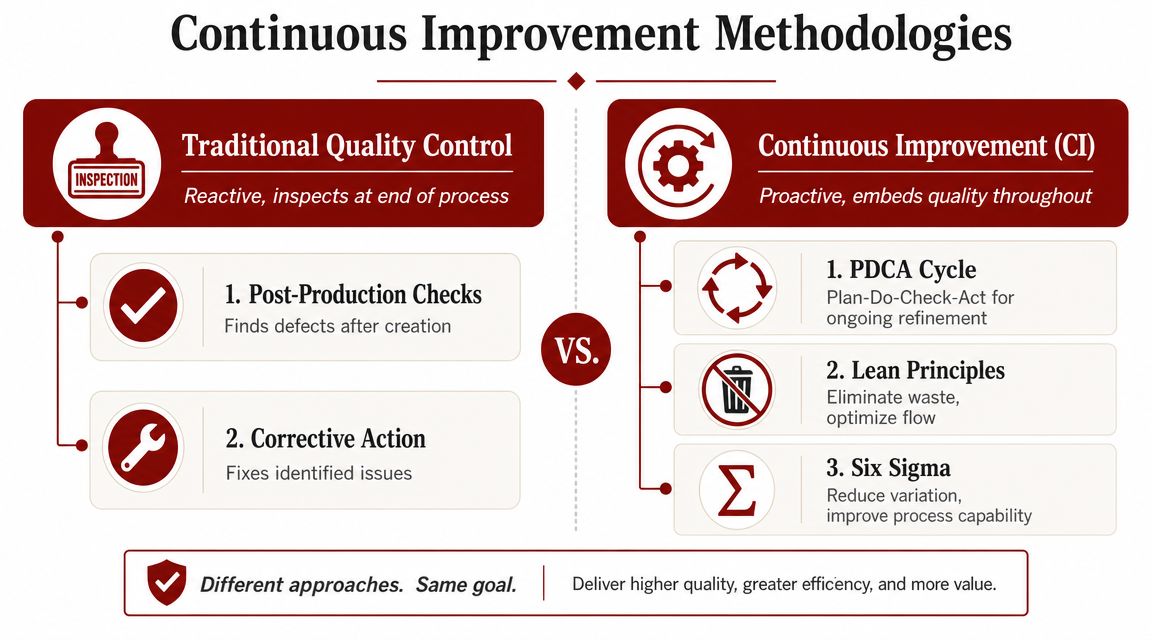
Lean and Six Sigma are often grouped together, but they answer different questions.
Lean improves flow. It targets waiting, motion, excess handling, unnecessary approvals, oversized batch sizes, and handoffs that stretch lead time without improving the part.
Six Sigma improves consistency. It focuses on the variation that causes drift, defects, unstable yields, and unpredictable output.
The distinction matters on the floor and in the boardroom. If a cell misses shipments because material sits between operations, a variation project will not clear the queue. If a critical feature drifts across shifts, a general waste walk will not stop the scrap. Good leaders choose the method that matches the failure mode.
| Approach | Primary focus | Best used when |
|---|---|---|
| Lean | Flow and waste reduction | The process is delayed, overhandled, or slowed by handoffs |
| Six Sigma | Variation and defect reduction | The process produces inconsistent results |
| Combined approach | Flow plus capability | The process suffers from both friction and instability |
The trade-off is straightforward. Lean can produce fast visible wins, which helps morale and cash flow. Six Sigma usually takes more discipline up front, but it pays back when the defect keeps returning and the organization is tired of containment.
Use DMAIC for chronic defects and expensive noise
A recurring defect needs more than sorting and a corrective action form. It needs a method that forces the team to define the problem clearly, measure it objectively, test causes against evidence, and hold the gain after the excitement fades. Six Sigma uses DMAIC for that work. 6Sigma.us on quality control in manufacturing outlines the framework and the quality benchmark that shaped it.
On the shop floor, DMAIC works best when the defect is chronic, financially painful, and tied to a process that matters.
Use it like this:
- Define: State the defect in operational terms. Name the feature, product family, customer impact, and point in the process where failure occurs.
- Measure: Build a baseline by line, machine, shift, tool, or supplier lot. If the measurement system is weak, fix that first.
- Analyze: Use Pareto charts, process history, and root cause testing to separate suspicion from evidence.
- Improve: Pilot the countermeasure in the area with the highest loss or widest spread.
- Control: Update standard work, process checks, reaction plans, and ownership so the result survives normal production pressure.
One rule matters here. Do not scale a fix that only worked under special attention.
That mistake is common in multi-site businesses. One plant reduces rework with extra engineering support, temporary staffing, or unusually tight oversight, then corporate pushes the playbook across the network. The result looks good in a slide deck and weak in production. A valid improvement has to hold under routine conditions, with ordinary supervision, normal staffing, and the actual mix of parts.
PDCA keeps the plant improving between major projects
Not every problem deserves a formal black-belt style effort. Daily execution needs a lighter operating rhythm, and PDCA is still one of the most practical ways to run it.
A production supervisor can use PDCA to address repeated setup misses, damaged packaging, labeling confusion, or a fixture issue that slows changeovers:
- Plan: Define the problem, identify one likely cause, and choose one controlled change.
- Do: Run the test on a limited basis.
- Check: Review the result against the baseline.
- Act: Standardize the new method or reject it and run another test.
Used well, PDCA does two things. It solves local problems faster, and it teaches supervisors and engineers to treat improvement as part of daily management instead of a special event.
That operating discipline is also what makes an acquisition integration stick. In one aerospace environment, the difference between a plant that improved and a plant that drifted was not intent. It was cadence. The better plant reviewed defects, response times, and corrective actions in a fixed rhythm, with names attached and due dates enforced. Improvement became part of the management system, not a side project.
Teams comparing operating models for that kind of execution discipline can review Doczen's operational framework insights. Leaders who want a broader perspective on how process improvement affects throughput, bottlenecks, and repeated inspections can also review Hasit Vibhakar's perspective on manufacturing process improvement.
Strengthening Your Ecosystem
A plant can't out-inspect a weak ecosystem. If suppliers introduce variation, if gauges can't be trusted, or if people don't feel ownership, internal process work hits a ceiling fast. That's why quality improvement has to extend beyond the machine and the traveler.
The strongest operators understand that incoming material, measurement integrity, and culture all shape the final result.
Supplier quality shapes your output
You can't build a high-quality assembly from unstable incoming components. Yet many companies still manage suppliers primarily on price and delivery, then act surprised when internal quality noise keeps rising.
A practical supplier quality discipline includes:
- Qualification before dependence: Verify process capability, documentation discipline, and responsiveness before the supplier becomes critical.
- Incoming checks by risk: Inspect based on part criticality and supplier performance, not habit.
- Corrective action ownership: Push recurring defects back to the source with timelines and verification, not just emails.
- Shared specifications: Make sure drawings, revisions, finish requirements, and acceptance criteria are aligned.
In aerospace and other regulated environments, supplier risk is operational risk. One bad lot can trigger inspection cascades, schedule disruption, and customer scrutiny.
If the measurement system is weak, the data is weak
Many plants chase defects with data they shouldn't trust. A gauge that reads inconsistently creates fake trends, fake confidence, and bad decisions. Before a team debates whether the process improved, it should ask whether the measurement system is repeatable enough to tell the truth.
Measurement Systems Analysis matters. The point isn't statistical theater. The point is confidence. If two operators measure the same feature differently, or the same part reads differently at different times, your process signal is contaminated.
Check three things:
- Tool suitability: The device must match the tolerance and feature.
- Repeatability: The same user should get consistent readings.
- Reproducibility: Different users should get comparable readings.
If your inspection system creates argument more often than clarity, fix measurement before launching another root-cause meeting.
Culture decides whether quality sticks
Tools don't sustain quality. People do.
A real quality culture shows up in ordinary moments. An operator stops a process because something looks wrong. A supervisor thanks them instead of asking why output slowed. Engineering updates the standard quickly. Management reinforces the behavior instead of bypassing it to hit the day's shipment.
That kind of environment doesn't happen through slogans. It happens through repeated signals:
- Training tied to the actual job
- Authority to escalate without punishment
- Fast feedback on reported issues
- Visible leadership attention to recurring defects
For leaders looking at quality through a broader risk lens, Hasit Vibhakar's view on manufacturing risk management is relevant because supplier exposure, process instability, and operational decision-making are tightly connected.
Leveraging the Digital Quality Toolkit
Technology helps when it sharpens discipline. It hurts when companies use it to avoid basic process work.
That distinction matters because digital quality tools are often sold as shortcuts. They aren't. A weak process captured in perfect software is still a weak process. But when the fundamentals are in place, digital systems can accelerate visibility, consistency, and response time in ways paper never will.
Use software to reinforce discipline
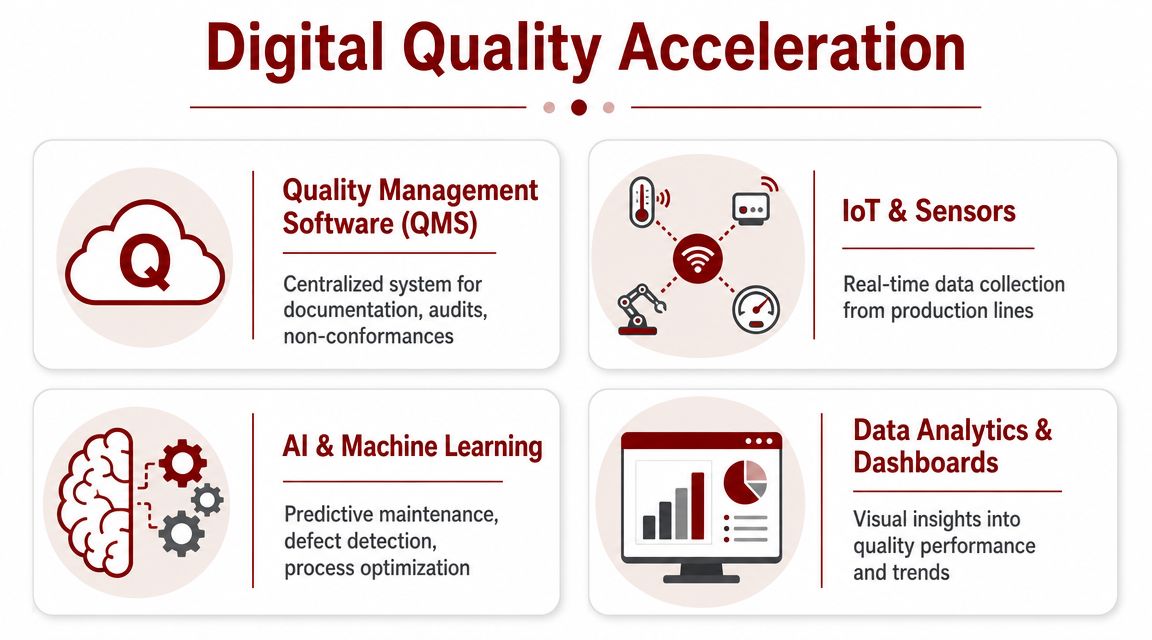
A digital QMS is most useful when document control, nonconformance tracking, audit trails, and corrective action workflow have become too important to manage loosely. It reduces the lag between issue detection and issue ownership.
IIoT sensors add value when a process has known failure points that need immediate visibility. Instead of waiting for end-of-line inspection, the system can flag deviations while the part is still recoverable.
Dashboards matter when leaders need one view of performance across plants, cells, or shifts. They don't fix problems by themselves, but they reduce denial. Everyone can see whether the line is stable.
If your operation is connecting execution, traceability, and production control more tightly, Hasit Vibhakar's perspective on manufacturing execution systems is one useful reference point for understanding where MES fits in the broader operating stack.
Choose technology by defect economics
The harder question isn't whether to digitize. It's where to apply technology when variability is high and full automation doesn't make economic sense.
That's especially true in high-mix, low-volume manufacturing. The practical framework is to prioritize actions by defect severity, escape risk, and implementation cost, then decide which defects should be prevented upstream, which should be detected in process, and which are cheaper to inspect at the end, as discussed in MachineMetrics on improving quality in manufacturing.
That leads to smarter investment choices:
- Prevent upstream when the defect is severe and difficult to recover later.
- Detect in process when drift develops during production and quick intervention can contain it.
- Inspect at the end when the defect is low risk, visually obvious, and cheaper to catch after completion.
AI belongs in that same logic. It's promising for pattern recognition, predictive maintenance, and quality analytics, but its output is only as good as its data. Teams exploring that path should think seriously about improving AI model data quality, because poor labeling, noisy inputs, and inconsistent ground truth can undermine the entire effort.
Frequently Asked Questions for Manufacturing Leaders
Where should a company start if the budget is tight
Start with process discipline, not software. Standardized work, visible defect definitions, basic root-cause analysis, and focused audits cost far less than a broad technology rollout and usually expose the biggest gaps faster. If money is limited, pick one high-loss process and fix it thoroughly before expanding the effort.
How long does it take to see results
You can usually see early operational signals quickly when the team attacks a specific defect with a defined pilot. Sustained results take longer because the actual test isn't whether performance improves once. Its true measure is whether the process holds after shift changes, staffing changes, production pressure, and engineering updates.
How do you get buy-in from operators
Give operators a system that respects what they see. Put standards at the station, define what good looks like clearly, and respond quickly when they flag problems. People engage when they believe quality isn't a slogan and when leadership doesn't punish the person who surfaces bad news.
How do you get executive buy-in
Translate quality into business language. Tie defects to margin loss, customer risk, schedule instability, and scaling limits. Executives support quality when they can see that it protects throughput, improves predictability, and strengthens enterprise value.
What's the most common mistake leaders make
They confuse activity with control. More meetings, more reports, and more inspection can make a plant feel busy while the process remains unstable. The better approach is simpler. Define the defect clearly, stabilize the method, pilot the fix, and install controls that hold under normal operating pressure.
Hasit Vibhakar writes about manufacturing, operational scale, risk, and enterprise value from the perspective of a CEO who has built and exited companies across aerospace and industrial markets. If you're evaluating how to improve manufacturing quality as part of a broader growth or transformation agenda, explore Hasit Vibhakar.

Leave a Reply