
Manufacturing leaders don't need another sermon about “the future of automation.” They need a sober answer to a board-level problem: labor costs are rising faster than productivity, and that gap is eating margin. In one recent period, unit labor costs in manufacturing rose 2.0% while hourly compensation increased 6.4%, according to BLS-linked reporting cited by Ehrhardt Automation. This is the true context for any discussion about the benefits of automation in manufacturing labor costs.
The mistake is treating automation as a technology project. It's a capital allocation decision. If labor is scarce, overtime is chronic, quality variation is expensive, and supervisors spend their day covering manual bottlenecks, then automation isn't optional. It's a margin defense tool, a resilience tool, and in many plants, a valuation tool.
I've seen too many operators and investors frame the upside too narrowly. They look for headcount cuts and miss the bigger economics. The strongest returns usually come from reduced labor exposure, better line stability, improved capital utilization, and fewer operational surprises. Even outside the factory, the same discipline applies when teams improve agency efficiency with automation. The principle is identical. Remove repetitive manual work, raise consistency, and free people for higher-value decisions.
That logic is central to modern factory strategy and to how manufacturers approach robotics and automation in manufacturing. The companies that win aren't automating for appearances. They're automating the places where labor volatility creates recurring P&L drag.
Table of Contents
- The Unmistakable Case for Automation
- Unpacking the Full Spectrum of Labor Cost Savings
- Calculating Your Automation ROI and Payback Period
- Discovering the Second-Order Strategic Benefits
- Facing the Realities of Implementation Costs
- Avoiding Common Pitfalls That Erode Automation Savings
- A Strategic Playbook for Executive Leadership
The Unmistakable Case for Automation
The business case starts with a simple truth. If compensation rises faster than productivity, labor inflation moves straight into gross margin pressure. That's exactly what recent manufacturing data showed, and it's why automation should be discussed in the same breath as pricing discipline, sourcing strategy, and working capital control.
Most executives still frame automation as a way to “save labor.” That's too shallow. However, the core issue is controllability. Labor costs are increasingly volatile. Staffing for repetitive work is harder. Shift coverage breaks down. Overtime creeps in. Supervisors become expediters instead of managers. Automation addresses that operating instability.
What boards should recognize
Three conditions usually justify immediate action:
- Repetitive work dominates a line. Machine tending, inspection, packaging, palletizing, and material handling are obvious candidates.
- Labor availability is unreliable. If you're constantly backfilling absences or paying up to keep a shift covered, the plant is already telling you where to automate.
- Output suffers when labor tightens. That means your labor model is constraining revenue, not just costs.
Automation is often less about replacing people than about removing dependence on unstable staffing models.
Many boards misunderstand the core issue. They ask whether automation cuts payroll. They should ask whether it protects throughput, stabilizes quality, and reduces exposure to labor shocks. A plant with fewer disruptions, less overtime, and more predictable output is worth more than one that is only lean on paper.
Why this matters now
The benefits of automation in manufacturing labor costs are strongest when labor is both expensive and hard to scale. That's the current environment in many industrial markets. If management keeps treating this as a future initiative, competitors that automate first will operate with cleaner margins and better delivery reliability.
Unpacking the Full Spectrum of Labor Cost Savings
Labor savings from automation are usually understated because finance teams stop at wage rates. That misses the costs that hit EBITDA harder: overtime creep, turnover-driven retraining, schedule disruption, quality labor, and management time spent stabilizing a process that should already be under control.
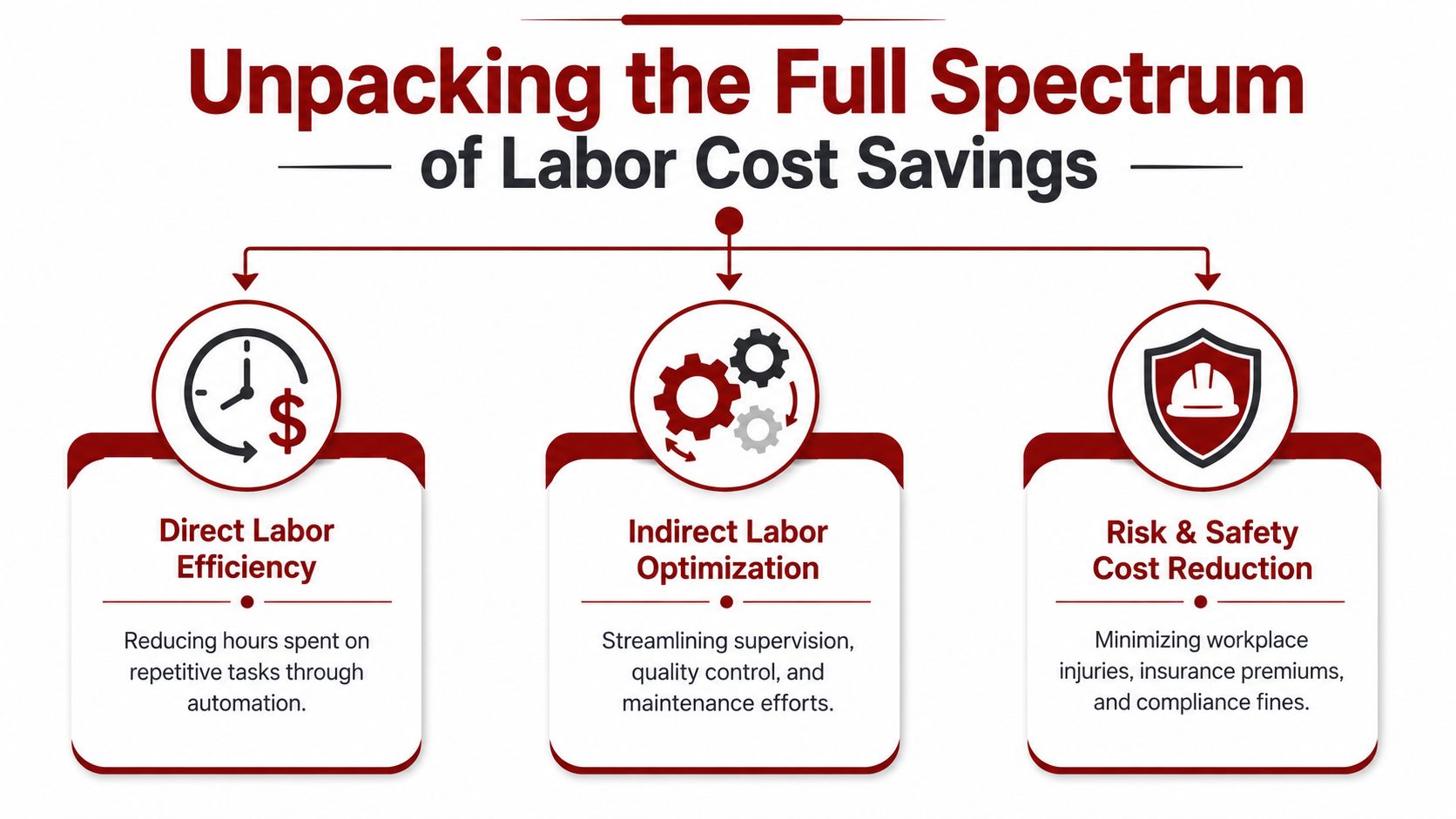
The cost stack boards should review
Direct labor is only the first line item. The bigger question is how much labor the current process forces you to carry around the line because the operation is unstable.
Use a three-layer view:
| Cost layer | What it includes | Why automation matters |
|---|---|---|
| Direct labor | Wages, benefits, shift staffing | Reduces manual touches on repetitive tasks and lets one operator oversee more output |
| Indirect labor | Overtime, onboarding, supervision burden, backfill coverage, temp labor | Cuts premium pay, lowers staffing volatility, and frees supervisors to manage performance instead of plugging holes |
| Hidden labor-related cost | Rework sorting, scrap handling, manual inspection, schedule recovery, missed shipments tied to labor gaps | Stabilizes the process and removes labor consumed by preventable variation |
That middle layer is where weak analyses fall apart. Plants rarely lose margin because one operator is paid too much. They lose margin because absenteeism triggers overtime, overtime drives fatigue, fatigue raises error rates, and then more labor is thrown at rework, inspection, and expediting. A labor problem becomes a throughput problem and then a customer-service problem.
Guidance from the Association for Advancing Automation supports the broader case that manufacturers use automation to address labor shortages, hard-to-staff work, and production risk, not just wage reduction. That is the right lens for board review.
Where Savings Materialize in Operations
If I'm reviewing a plant, I want management to map labor cost to operational friction, not just HR categories.
Focus on these pressure points:
- Overtime concentration. Identify the stations that trigger premium pay every week. Those are margin leaks.
- Coverage dependence. If a process fails when one or two people are absent, the staffing model is fragile.
- Supervisor rescue time. Front-line leaders should run output and quality. If they spend hours reassigning labor, the line is carrying hidden cost.
- Manual quality containment. Processes that require constant checking, sorting, or touch-up are consuming labor after the value-added step.
- Training churn. High-turnover positions create a recurring tax in onboarding time, slower ramp-up, and preventable mistakes.
One rule holds up in almost every plant. If a task is repetitive, hard to staff, and sensitive to inconsistency, automate it before adding headcount.
There is also a systems issue. Automation savings erode fast when plants redesign equipment but leave scheduling, work instructions, escalation, and production visibility in spreadsheets and tribal knowledge. That is why many teams pair automation with manufacturing execution systems (MES) for production visibility and control. The goal is not software for its own sake. The goal is protecting utilization, labor productivity, and schedule adherence after the equipment is installed.
The workforce transition matters too. Plants changing roles around automated cells often review tools like top platforms for manufacturing workforce communication to keep training, shift updates, and standard work aligned. That does not create the return. It prevents execution mistakes that destroy it.
Count the operator at the machine. Count the overtime around the machine. Count the supervisory time, retraining load, quality labor, and schedule recovery cost tied to the machine. That is the full labor equation.
Calculating Your Automation ROI and Payback Period
Manufacturers often target automation payback in 12 to 24 months. That benchmark is useful, but boards lose money when management treats it as the investment case instead of proving plant-level economics with hard assumptions and downside controls. A credible ROI model has to show cash impact, timing, and where execution can fail.
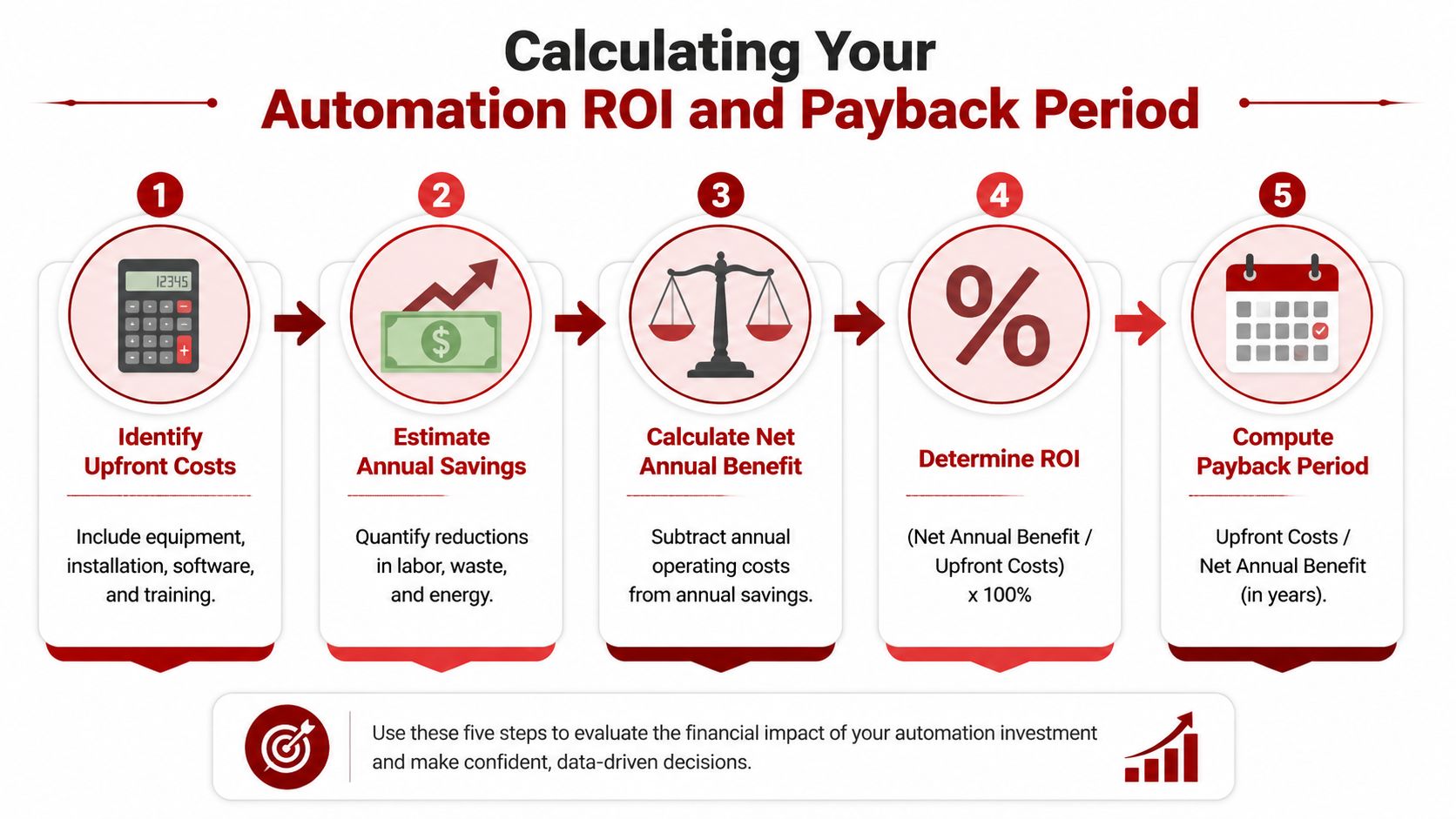
Build the model like an operator, not a salesperson
Start with cash out, then net cash in. Keep it simple enough to audit and strict enough to survive a bad ramp.
Upfront investment
Include equipment, end-of-arm tooling, integration, installation, programming, guarding, line modifications, factory acceptance testing, site acceptance testing, and training.Annual labor-related savings
Count direct labor removed from the task, overtime reduction, temp labor reduction, lower rework labor, less manual material handling, and any supervisory time that drops because the process needs fewer interventions.Annual new operating costs
Add preventive maintenance, spare parts, service support, software licenses, utilities, consumables, and internal technical labor needed to keep the cell running.Net annual benefit
Annual savings minus annual new operating costs.Payback period
Upfront investment divided by net annual benefit.
Use one rule. If a savings line does not hit the P&L or free up constrained capacity you can effectively use, do not count it.
The labor case is only the first screen. A key question is whether the project improves operating margin without creating a new reliability problem. That means your model should show expected utilization, planned downtime, unplanned downtime, scrap impact, and the labor redeployment plan tied to each shift. If management cannot explain who leaves the cost structure, who gets reassigned, and when that happens, the savings are overstated.
Analysts at Universal Robots note that many automation projects are expected to pay back within two years, and often sooner in high-repetition applications, according to Universal Robots' ROI guidance. Use that as a screening benchmark, not an approval memo.
To keep the model honest, tie the assumptions to actual plant data. Manufacturers that pair automation decisions with manufacturing execution systems for production visibility and control have a better shot at measuring cycle loss, downtime, labor touchpoints, and schedule adherence before and after launch. Without that baseline, projected ROI turns into opinion.
Boards should also ask whether the plant can monitor the asset well enough after go-live. Better reporting and exception handling matter because a cell that misses throughput by 10% can wipe out the forecasted return. That is the same reason more operators are paying attention to the future of BI automation in 2026. Better visibility does not create savings by itself, but it prevents blind spots that turn a good capital project into a miss.
Here's a useful walkthrough before a board discussion:
A practical way to pressure test payback
Do not approve a single-case model. Use three cases.
- Base case assumes realistic labor savings, normal scrap rates, and an implementation schedule that reflects your actual engineering bandwidth.
- Conservative case assumes delayed ramp-up, lower OEE, slower labor redeployment, and higher service costs in year one.
- Upside case assumes stronger uptime, lower overtime, and better throughput once the cell stabilizes.
Then force management to answer four questions in plain English:
- What happens if labor is redeployed instead of removed from the cost structure?
- What happens if maintenance and spare parts cost more than planned?
- What happens if ramp-up takes one quarter longer?
- What happens if the underlying process is unstable before automation starts?
One more point gets missed in weak ROI models. Payback is not enough. A project with a fast payback can still destroy value if it locks the plant into a brittle process, requires constant engineering support, or creates a single point of failure on a constrained line.
If management cannot defend the downside case and the operational risks, the payback estimate is not board-ready.
Discovering the Second-Order Strategic Benefits
A narrow labor-saving lens misses why the best automation investments outperform. The biggest benefits often show up after the initial cost model is approved.
Labor reallocation is the real lever
Brookings makes an important point. Workers who can work with machines are more productive than workers without them, and automation allows companies to shift labor from repetitive tasks such as machine-tending to higher-value work such as quality control, process improvement, and equipment supervision, which helps the same labor pool manage more equipment and lowers unit labor cost, as explained by Brookings.
That's a better framing than “replace workers.” In healthy operations, automation changes the mix of work. It pulls people out of low-value repetition and pushes them toward oversight, troubleshooting, scheduling, preventive maintenance support, and continuous improvement.
That shift matters because those roles drive operating efficiency. A line with better supervision and faster problem resolution doesn't just use labor better. It runs better.
Strategic benefits boards should care about
There's also evidence that automation can improve quality, not just staffing economics. A recent empirical study in Computers & Industrial Engineering found that a 1% increase in minimum wage is associated with a 0.022 improvement in quality measures, alongside increased robot adoption, according to ScienceDirect. That matters because poor quality is labor cost in disguise. Every defect consumes operator time, supervisor time, and schedule capacity.
Second-order benefits worth prioritizing include:
- Better output stability because lines are less exposed to absenteeism and turnover.
- Higher asset utilization when equipment can run with fewer labor bottlenecks.
- Cleaner quality performance when repetitive handling and inspection are standardized.
- Safer work allocation when people move away from physically demanding manual tasks.
For leadership teams investing across multiple plants, analytics becomes vital. If you want to understand what operational visibility will look like over the next cycle, it's worth reviewing perspectives on the future of BI automation in 2026. The connection is direct. Better factory automation without better operational intelligence leaves value on the table.
Strong automation programs don't just lower labor cost. They make the plant less fragile.
Facing the Realities of Implementation Costs
The companies that get burned by automation usually didn't buy bad technology. They underwrote the project badly.
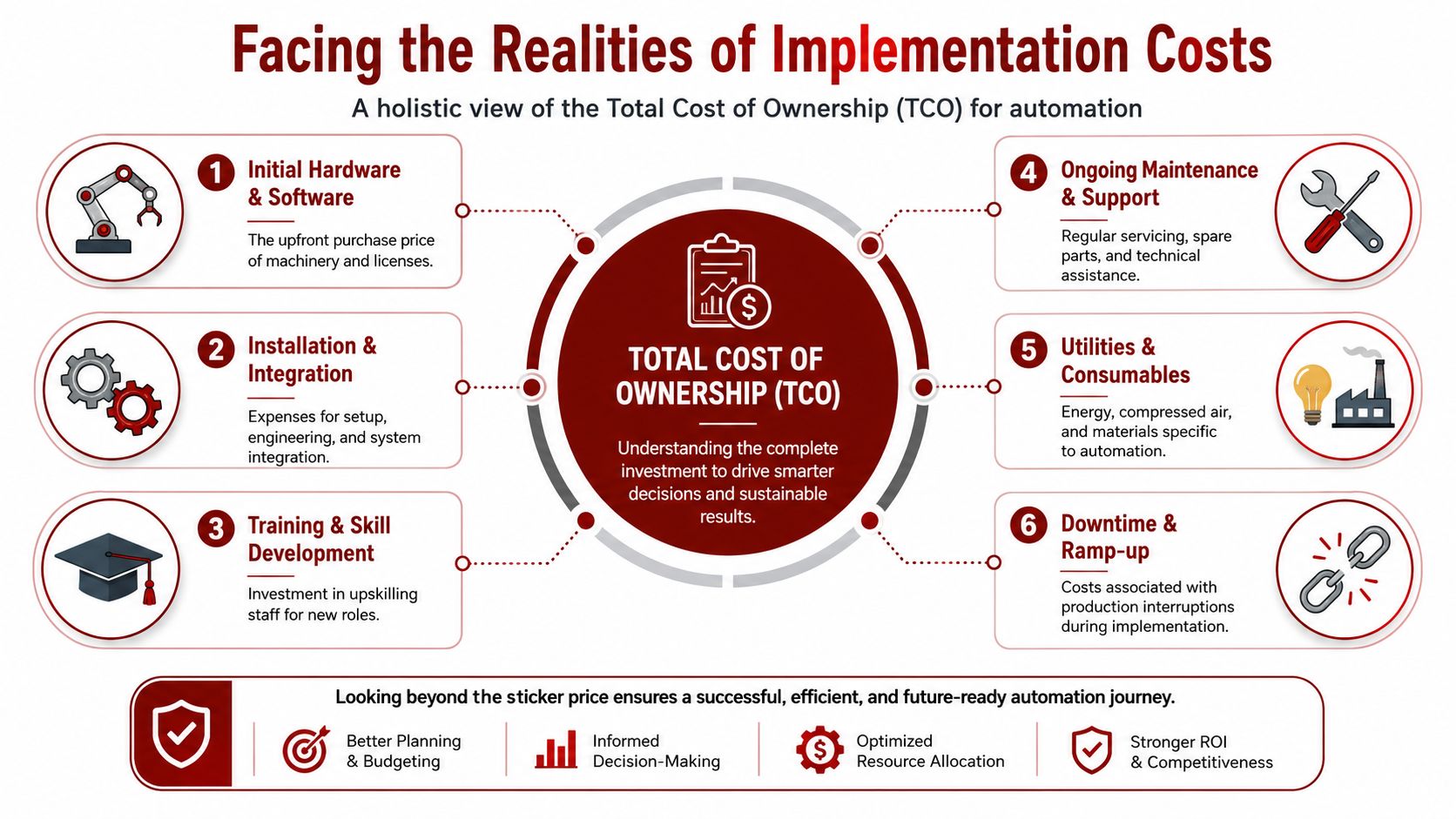
The sticker price is the least interesting number
The robot, cobot, conveyor, vision system, or packaging cell is only the visible line item. Actual financial exposure sits in total cost of ownership.
A sound budget must include:
- Integration and engineering because machines rarely drop into an existing line without custom work.
- Installation and facility modification including electrical, guarding, layout changes, and line balancing.
- Training and reskilling so operators, technicians, and supervisors can run the new process.
- Maintenance support including spare parts planning, service coverage, and internal capability building.
- Ramp-up losses from slower production during commissioning and debugging.
This is why simplistic ROI pitches are dangerous. The strongest business case for automation often appears where labor is scarce or tasks are repetitive, but the financial picture is a trade-off in which reduced labor exposure is offset by capital investment, integration fees, and ongoing maintenance and training costs, as noted by HighGear.
Where leaders underbudget
In my experience, four cost areas get missed most often.
| Common blind spot | What actually happens |
|---|---|
| Process instability | Teams automate a process that still has variation, creating expensive troubleshooting |
| Technical coverage | No one owns programming, maintenance response, or system optimization after launch |
| Training depth | Operators are shown the system, but not taught how to recover from faults or maintain flow |
| Ramp discipline | Management assumes instant productivity instead of a staged climb to stable output |
Budget for learning. Every plant pays tuition during implementation. The disciplined ones account for it upfront.
The benefits of automation in manufacturing labor costs are real, but only if management respects the full cost stack. If a CFO sees a clean labor-saving estimate with no allowance for integration friction, that model should be rejected on sight.
Avoiding Common Pitfalls That Erode Automation Savings
Most failed automation projects fail long before startup. They fail in scoping, process design, and leadership discipline.

The failure pattern is usually managerial not technical
The first mistake is automating a broken process. If cycle times swing, inputs vary, fixtures are inconsistent, or upstream scheduling is chaotic, automation won't fix the economics. It will codify the dysfunction and make it more expensive.
The second mistake is assuming labor savings happen automatically after installation. They don't. Management has to redesign roles, reset staffing assumptions, and redeploy people intentionally. If nobody owns that transition, payroll remains intact while new maintenance and support costs arrive on schedule.
A third mistake is picking the wrong level of automation. Some teams overbuild with complex systems where simple fixtures, sensors, conveyors, or semi-automated handling would have solved the labor issue faster and cheaper. Others underbuild and leave manual choke points around the new cell, which means the plant still carries the same variability.
What disciplined operators do differently
Strong operators tend to follow a simpler playbook:
- Stabilize the process first. Standard work, input consistency, and line balance come before robotics.
- Target the ugliest labor economics. Chronic overtime, difficult shift coverage, and repetitive manual handling should lead the queue.
- Assign an owner after launch. Someone must own uptime, training, maintenance coordination, and continuous improvement.
- Measure redeployment, not just installation. If labor doesn't move to higher-value tasks, the business case is incomplete.
The worst automation investment is the one that produces a machine report but no P&L improvement.
One more pitfall deserves attention. Shop-floor resistance is often a management communication problem, not a labor problem. When leaders frame automation as a blunt headcount tool, people protect themselves. When they frame it as a way to remove repetitive strain, improve line stability, and move skilled employees into better roles, adoption improves because the operating logic is credible.
A Strategic Playbook for Executive Leadership
Good automation strategy is selective, not ideological. You don't automate everything. You automate the parts of the operation where labor volatility, repetitive work, and quality exposure combine to create recurring economic drag.
How to sequence the investment
If I were briefing a board or investment committee, I'd recommend this sequence:
Start with one bottlenecked value stream
Pick a process with clear labor pain, measurable output, and repeated staffing instability.Define success in P&L terms
Use labor exposure, overtime reduction, throughput stability, and unit cost improvement. Don't approve the project on vague productivity language.Build for replicability
The first project should create a template. Standard equipment choices, training methods, maintenance routines, and operating dashboards matter.Tie labor planning to automation from day one
Decide where people move, what training they need, and who backfills higher-skill work.Review the project as a risk decision
Ask what it does to margin protection, customer delivery, and operational resilience, not just payroll.
For executives building a broader growth agenda, the automation roadmap should sit inside the company's larger business scaling strategy. If automation is disconnected from capacity planning, pricing strategy, and talent development, you'll get isolated wins instead of enterprise value creation.
What the board should demand
Boards and owners should insist on a short list of essential requirements:
- A conservative payback case
- A defined implementation owner
- A labor redeployment plan
- A maintenance capability plan
- A post-launch review cadence tied to financial results
That's the difference between buying equipment and enabling significant operational advantage.
The benefits of automation in manufacturing labor costs are substantial, but they don't come from buying robots because the market says you should. They come from disciplined capital allocation, process clarity, and management follow-through. Done right, automation lowers labor exposure, stabilizes output, improves quality, and makes the business more valuable. Done poorly, it adds cost and complexity without changing the economics.
The choice isn't whether automation is good. The choice is whether leadership has the rigor to implement it where it counts.
If you're evaluating automation as a board-level investment, Hasit Vibhakar brings the perspective of an operator, investor, and CEO who's spent decades scaling industrial businesses, managing P&L risk, and building shareholder value. His work is relevant for leaders who need a practical view of automation, manufacturing operations, and capital allocation rather than another generic technology pitch.


Leave a Reply