
If you're running a growing manufacturing business, you may already feel the pressure that pushes companies toward 5 axis capability. Sales wants shorter lead times. Engineering keeps releasing parts with compound angles, deep cavities, and tighter geometric requirements. Operations is still moving parts from one setup to the next, stacking up queue time, handling risk, and inspection work that no customer wants to pay for.
That gap matters most when you're serving aerospace, medical, semiconductor, or advanced industrial customers. At that point, 5 axis manufacturing stops being a machine-shop talking point and becomes a board-level decision about margin, throughput, and customer fit. The key question isn't whether the technology is impressive. It's whether your business is ready to use it in a way that creates durable advantage.
Table of Contents
- Beyond More Axes A Strategic Introduction
- What Is 5 Axis Manufacturing
- Comparing 3 Axis 4 Axis and 5 Axis Machining
- Key Technical Considerations for Executives
- Common Applications and Industry Case Studies
- Analyzing Cost ROI and Scaling Potential
- An Executive Roadmap for Implementation
Beyond More Axes A Strategic Introduction
Most companies don't arrive at 5 axis manufacturing because they want more advanced equipment. They get there because the old process starts breaking under commercial pressure. A part that looked manageable in quoting becomes expensive on the floor. Multiple setups stretch cycle time. Re-fixturing introduces risk. Inspection catches variation that came from the process, not the material.
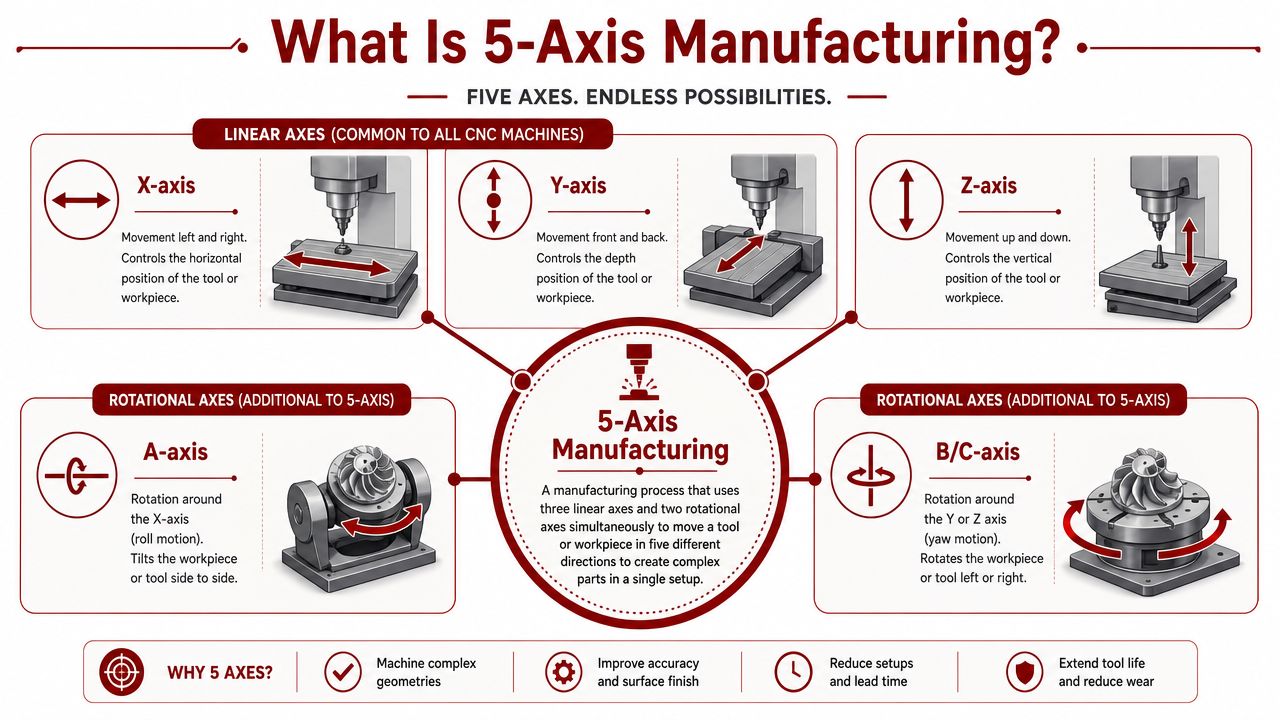
That is where 5 axis changes the conversation. It uses the same X, Y, and Z motions as conventional CNC, then adds two rotational axes, typically A and B, so the cutting tool or workpiece can approach the part from nearly any angle. That flexibility supports done-in-one production and can reduce setups from five to one on some jobs, lowering handling time, setup error risk, and scrap while preserving datums throughout the operation, as described in Fathom's overview of 5-axis machining.
Why executives should care
A technical buyer may focus on tool access. A CEO or operating leader should focus on flow.
When a business removes repeated setups, it doesn't just save machine time. It simplifies scheduling, compresses lead time, reduces opportunities for human error, and improves the odds that a difficult part runs predictably across shifts. In high-value sectors, that is often the difference between profitable growth and operational drag.
Practical rule: If your best engineers keep redesigning parts to fit 3-axis constraints, the bottleneck isn't only in production. It's in strategy.
Where 5 axis becomes a strategic asset
5 axis manufacturing has particular relevance when your customer base values precision and geometry more than raw volume. That includes:
- Aerospace structures and engine-adjacent parts: Angled features, compound curves, and tight tolerance stacks punish multi-setup workflows.
- Medical components: Accuracy, surface quality, and repeatability become inseparable from the production method.
- Semiconductor and advanced industrial hardware: Complex pockets, feature alignment, and datum control matter because downstream assembly leaves little room for correction.
The executive mistake is to frame 5 axis as a pure equipment upgrade. It isn't. It's a production model change. Companies that understand that tend to buy with a roadmap. Companies that don't often buy a machine and discover they purchased complexity without process maturity.
What Is 5 Axis Manufacturing
At a basic level, 5 axis manufacturing starts with the three linear motions used in standard CNC machining. The machine moves in X, Y, and Z. What changes is the addition of two rotational axes, typically A and B, which let the tool or the part tilt and rotate to reach features from many more angles.
A simple way to explain it to a non-machinist is to think about a human arm. Your shoulder gives you broad directional movement. Your wrist adds orientation. Without the wrist, you can still reach the work. You just can't approach it cleanly from the best angle every time. 5 axis works the same way. The extra axes give the machine freedom to position the tool more intelligently.
The business value of tool orientation
The most important concept isn't the fifth axis itself. It's single-setup machining.
If a part can be cut in one setup instead of being removed, rotated, re-fixtured, and re-indicated several times, the operation becomes simpler to control. Fewer touchpoints mean fewer chances to lose alignment, damage a part, or create variation between features. That matters on any precision component, but it matters even more when the customer is buying confidence as much as hardware.
Done in one changes more than machining
The phrase "done in one" sounds like a shop-floor slogan, but it has executive implications:
- Scheduling becomes cleaner: Fewer handoffs mean fewer opportunities for jobs to stall between operations.
- Quality becomes easier to manage: Maintaining datums through the operation improves consistency.
- Engineering gains freedom: Teams can design for performance first, instead of always compromising around fixture access.
A lot of confusion around 5 axis comes from treating it as if it's only for exotic parts. In reality, it becomes valuable whenever the cost of repositioning, error accumulation, and fixture complexity starts outweighing the simplicity of older methods.
The strongest 5 axis shops don't just cut difficult parts. They remove friction from the entire route from CAD to shipment.
That distinction matters. A machine with five axes is just capital equipment. A company using 5 axis manufacturing well is running a different operating system.
Comparing 3 Axis 4 Axis and 5 Axis Machining
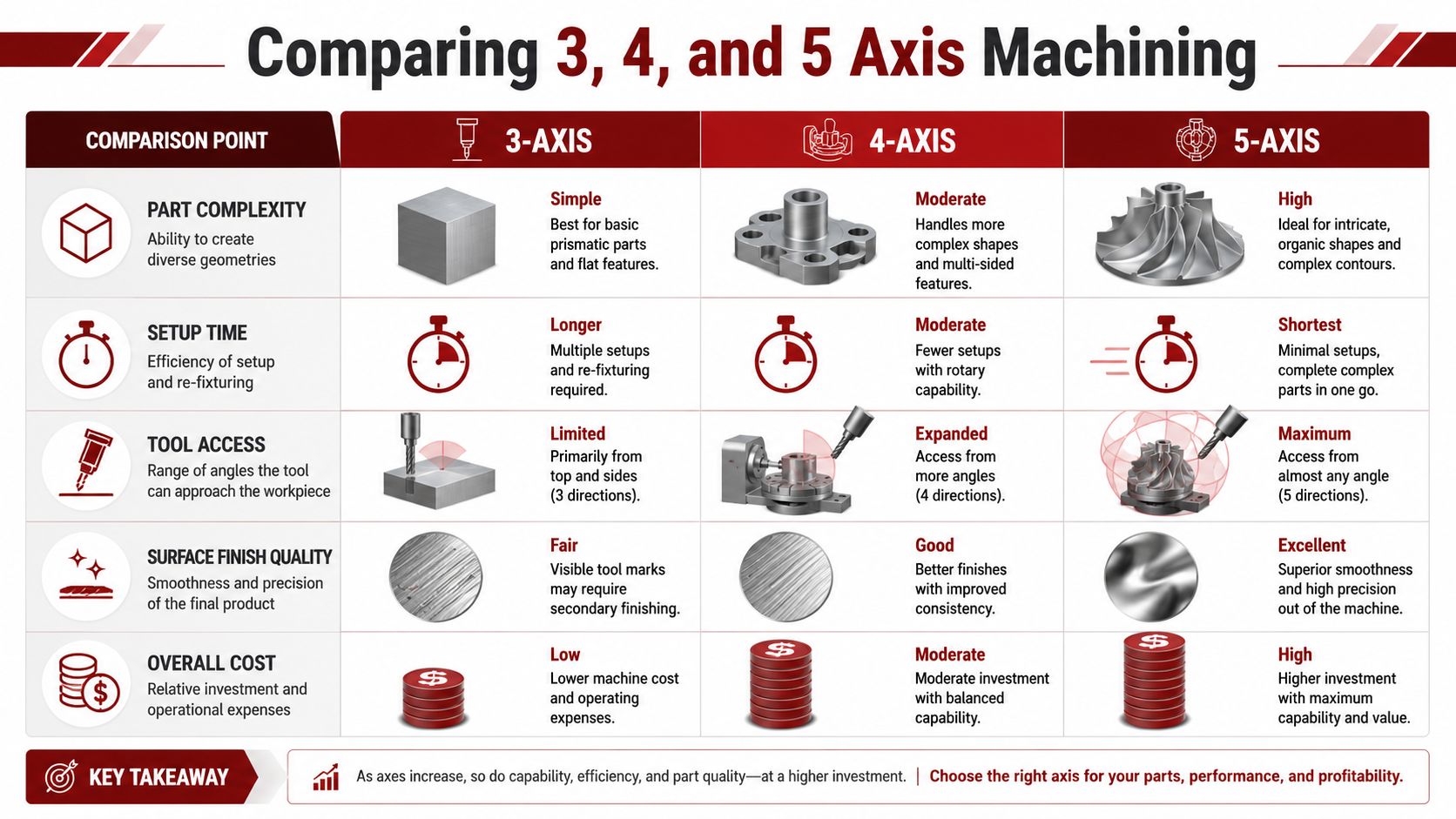
The fastest way to make a poor capital decision is to compare 3 axis, 4 axis, and 5 axis strictly on machine price. The better comparison is capability versus workflow burden. Each platform has a place. The question is what type of complexity your part mix creates and how much operational friction you're absorbing to deal with it.
A practical executive comparison
| Machine type | Best fit | Main limitation | Strategic implication |
|---|---|---|---|
| 3 axis | Prismatic parts, accessible faces, standard milling work | Complex parts require multiple setups | Good for stable, simpler work, but labor and handling grow fast with complexity |
| 4 axis | Parts that benefit from one rotational movement | Doesn't solve full multi-angle access for highly contoured geometry | Useful bridge capability if your complexity is moderate |
| 5 axis | Compound surfaces, angled features, undercuts, complex precision parts | Higher programming, training, and process demands | Strong option when geometry, tolerance, and lead time drive margin |
A 3 axis machine remains a workhorse. If most of your revenue comes from brackets, housings, plates, and straightforward pockets, it can still be the right tool. A 4 axis platform adds flexibility for certain rotational parts and can reduce setups on jobs that need access around a cylindrical or indexed form.
5 axis stands apart because it changes the production route, not just the motion envelope.
Later in your evaluation, it helps to compare that against your existing CNC machining strategy and operating mix, not just against vendor demos.
What the performance gap really means
For complex geometries, 5 axis can reduce setup time by 60 to 80% and maintain tolerances within ±0.005 mm, while general CNC milling is described around ±0.05 mm, according to Gimbel Automation's discussion of five-axis machining techniques.
That matters because setup count drives hidden cost. Every time an operator repositions a part, the business pays in labor, queue time, inspection effort, and risk. Those costs don't always show up clearly in a quoting spreadsheet, but they show up in missed ship dates and eroded margin.
A short visual helps clarify the distinctions in motion and access:
When 5 axis is the wrong answer
Not every company should move immediately to full 5 axis deployment.
- Low-complexity part mix: If most revenue comes from simple work, the machine may sit underutilized.
- Weak programming bench: Advanced hardware without strong CAM capability creates bottlenecks upstream.
- Poor process discipline: Shops that already struggle with setup control and inspection won't solve those issues by buying more axis motion.
In other words, 5 axis is rarely a substitute for operational maturity. It's an amplifier of it.
Key Technical Considerations for Executives
Executives don't need to become CAM programmers, but they do need enough technical understanding to ask hard questions before signing a purchase order. Most 5 axis disappointments trace back to one issue. The buyer focused on spindle, travels, and price, while underestimating workflow, software, and inspection consequences.
Machine configuration affects the business model
Two decisions shape a lot of downstream reality: machine architecture and the kind of parts you intend to run.
A trunnion-style machine can be effective for many precision parts because the table rotates and tilts the workpiece. That can support strong access and compact setups, but it also affects usable work envelope as the part gets larger. A swivel-rotate head configuration moves orientation into the spindle head, which can be attractive when part size or workholding makes table motion less practical.
An executive doesn't need to pick the architecture alone. But leadership should ask which configuration best supports the actual revenue mix, not the demo part on the showroom floor.
Software is not optional overhead
The second essential is CAM. In 5 axis manufacturing, software quality influences collision avoidance, programming efficiency, toolpath quality, and how quickly jobs move from engineering release to the machine. Weak CAM capability turns a high-value asset into a scheduling problem.
A connected operating environment also matters. The handoff between planning, programming, machine execution, and quality should be visible. For manufacturers evaluating digital workflow maturity, a system such as a manufacturing execution system approach can help coordinate shop-floor data, job status, and traceability across more complex production routes.
Buy the machine only after you're satisfied with the post-processor, simulation workflow, and who inside your business will own programming standards.
Questions worth asking before purchase
Use the vendor meeting to pressure-test operating assumptions, not just machine capability.
- Collision strategy: How will your team simulate motion, verify clearance, and approve first-run programs?
- Post-processor ownership: Who supports edits when real-world behavior doesn't match the intended toolpath?
- Workholding plan: Can your fixtures expose enough of the part without creating stability issues?
- Tooling policy: Are you standardizing holders, gauge lengths, and cutter families, or improvising job by job?
- Inspection flow: How will quality verify multi-angle features without slowing throughput to a crawl?
These aren't engineering side notes. They drive utilization, scrap exposure, and how quickly the machine contributes to earnings.
Common Applications and Industry Case Studies
A supplier usually decides whether 5 axis belongs in the capital plan when a customer sends over a part family that keeps breaking the current process. The drawings show compound angles, hard-to-reach features, and tight positional relationships. Engineering can make the part on 3 axis equipment with enough setups, but margin disappears, lead time stretches, and first-pass yield gets harder to defend.
That is the core application story. 5 axis earns its place where geometry, tolerance stack-up, and delivery pressure collide.
Aerospace parts with compound geometry
Aerospace remains one of the clearest business cases because many parts carry tight relationships between angled holes, blended surfaces, and machined datums. Structural components, housings, brackets, and engine-adjacent hardware often need multiple faces finished while preserving alignment across the entire part. Every added setup creates another chance to lose position, add inspection time, or scrap an expensive workpiece late in the route.
For an executive team, the question is not whether a 3 axis machine can cut the shape. The question is whether the process can hold quality and cycle time at production scale. In aerospace, that answer often determines whether you can quote the work at all.
Kennametal notes that 5-axis machining is widely used for complex aerospace components because it improves access to multiple sides of the part and reduces repeated setups, which directly affects accuracy and throughput in high-value applications, as described in Kennametal's 5-axis machining overview.
I have seen this play out most clearly on parts that look manageable in CAM but become unstable commercially once setup count rises. The machine choice then becomes a pricing decision, a capacity decision, and a risk decision.
Medical components where access and repeatability drive feasibility
Medical manufacturing puts pressure on different variables. The parts are often smaller, but the demands on finish, feature access, and repeatability are unforgiving. Orthopedic implants, surgical instruments, and precision housings frequently include sculpted surfaces and difficult approach angles that punish any process built around repeated manual repositioning.
In that environment, 5 axis supports consistency as much as speed. If a team has to reset the part several times to reach critical features, process variation moves from a nuisance to a validation problem. That matters even more when the customer expects documented repeatability across low-volume, high-mix production.
A good screening rule is simple. If fixture changes become the main source of dimensional risk, 5 axis deserves a serious review.
Semiconductor and advanced industrial hardware
Semiconductor equipment and advanced industrial systems create another strong fit. These parts often combine deep cavities, alignment-sensitive interfaces, and tight flatness or positional requirements on multiple faces. Shops can push that work through older platforms, but they usually pay for it in longer routings, heavier inspection load, and more engineering time per part.
The strategic value is broader than a single machine win. Companies that add 5 axis capability can pursue higher-spec programs without building the business around heroic workarounds. That matters for scaling manufacturers trying to grow revenue without also adding hidden complexity in scheduling, quality, and quoting. The finance side of that transition looks a lot like preventing hidden growth costs. Capacity expansion works when process discipline grows with it.
What these case studies mean for an executive team
Across aerospace, medical, and advanced industrial work, the pattern is consistent. 5 axis makes sense when it protects margin on difficult geometry, shortens the path from quote to production, and lets the company pursue programs that fit its long-term customer strategy.
That is why the best adoption decisions start with part families, not machine brochures. A phased rollout built around a narrow set of high-value applications reduces execution risk and gives management a cleaner line of sight into where the return will come from.
Analyzing Cost ROI and Scaling Potential
A management team approves a 5 axis machine, books the capital, and expects the shop to grow into it. Six months later, spindle hours are inconsistent, prove-outs are running long, inspection is backed up, and the machine is still being judged on monthly payment instead of margin contribution. That outcome is common when leadership treats 5 axis as a machine purchase instead of a scale decision.
Start with the full investment picture
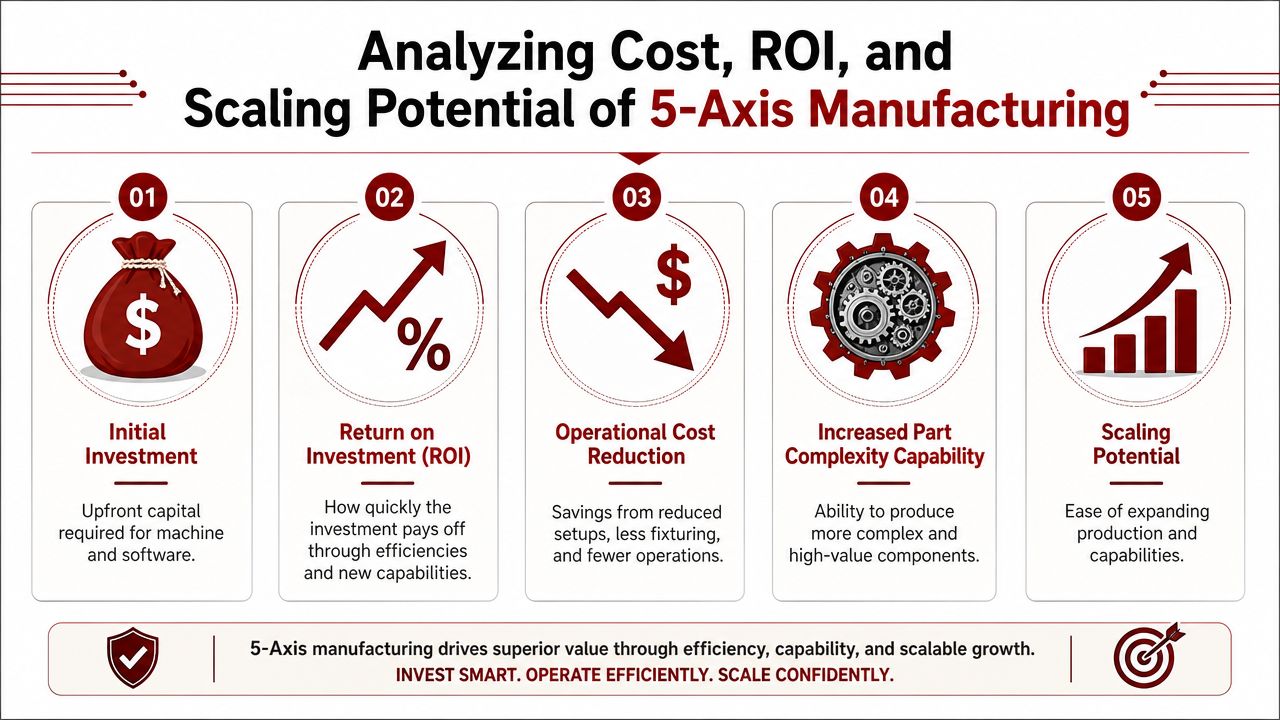
For appropriate applications, investment costs range from $400,000 to over $2 million, and ROI is typically achieved within 18 to 36 months, according to Ellison Technologies' 5-axis overview.
That spread reflects the decision. Leadership is choosing how much production system to build around the machine. A bare machine can cut parts. A funded process stack can cut parts repeatedly, profitably, and at the quality level aerospace and advanced industrial customers expect.
A sound business case should account for four cost groups:
- Capital outlay: machine, probing, software, installation, and any automation included in the cell
- Ramp costs: programmer training, post validation, first-article work, scrap during prove-out, and slower output during the learning curve
- Support costs: fixturing standards, tool management, preventive maintenance, and metrology capacity
- Commercial return: better margins on difficult geometries, shorter lead times, and access to part families that were previously risky to quote
That last point is where many ROI models break down. Teams often count labor savings and ignore the value of quoting a more demanding aerospace bracket or impeller with confidence because setup risk, alignment exposure, and handoff time are lower.
Measure throughput economics
The strongest ROI cases come from throughput improvement across the whole routing. Shops that move complex work from multiple setups into one or two controlled operations usually reduce queue time, handling, fixture changes, and quality escapes. The gain is broader than cycle time.
For an executive team, the better question is simple. How many elapsed days, touches, and failure points disappear when the part is processed on the right platform?
On a multi-face aerospace component, one fewer setup can remove hours of indirect labor that never appears in the programmed cycle. It can also reduce first-article friction, shorten the inspection path, and improve schedule reliability. Those are operating gains, not theoretical ones.
Adoption rates across the market continue to rise, which supports the view that 5 axis is now an established production choice for complex work, not a specialty purchase for a handful of elite shops. The strategic issue is not whether the technology is proven. The issue is whether your company can load it with the right mix of recurring work and support it with the discipline required to scale.
That is why this decision belongs inside a broader business scaling strategy for growing manufacturers, not inside a capital request built on machine utilization alone.
Stress-test the ROI before approving capital
I look at 5 axis proposals in three layers.
First, identify current parts where setup count, feature relationships, or geometry-driven scrap are already eroding margin.
Second, test whether target customers would shift more wallet share if the company could quote complex parts faster and deliver them with less risk.
Third, model the ramp realistically. Include training time, delayed productivity, inspection load, and the possibility that the first six months will underperform the brochure.
Finance discipline matters here. A 5 axis purchase can make sense at the machine level and still create operational strain if hiring, process ownership, and working capital are not planned with equal care. That is the same logic behind preventing hidden growth costs before expansion outruns control.
A practical approval filter
Use these questions before signing off:
- Which existing part families will move first, and what is the current cost of extra setups, longer routings, and avoidable scrap?
- What revenue becomes attainable because the company can now quote harder geometry with acceptable risk and lead time?
- What process gaps must be funded at the same time, including CAM, inspection, tooling standards, and operator training?
- How long can the business tolerate underutilization while the team reaches stable production?
If the model only works at near-perfect utilization, the capital case is thin. If the return holds under a realistic ramp and is supported by both current pain relief and targeted commercial growth, 5 axis can become a strong margin and capacity decision.
An Executive Roadmap for Implementation
A 5 axis machine often arrives as a capital purchase and quickly turns into an operating system decision. I have seen shops buy impressive equipment, post photos for customers, and still miss the return because programming standards, inspection capacity, and production ownership were never set. The winning approach is a staged rollout with measurable gates, clear accountability, and a defined point where leadership either expands or stops.
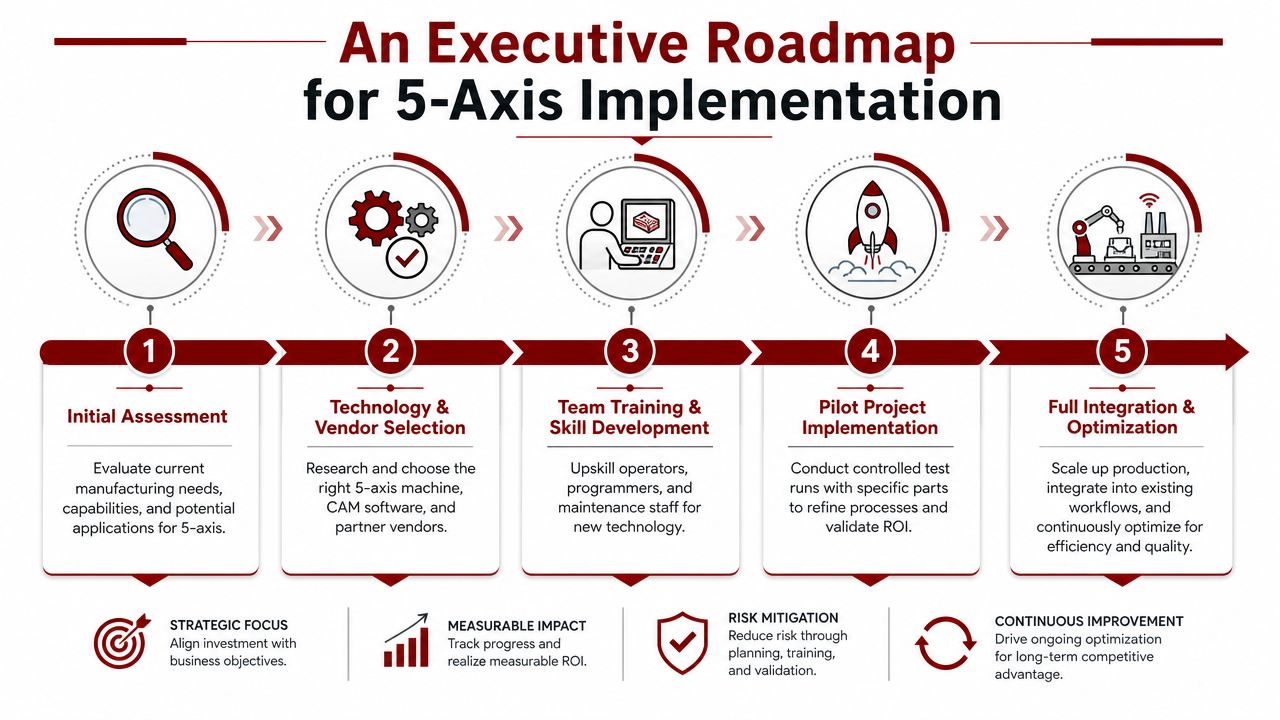
Phase the rollout
A practical roadmap usually follows five phases.
Assess the part mix first.
Start with current work that is already expensive to run on 3 axis or 4 axis equipment. In aerospace, that often means parts with compound angles, tight positional tolerances, or features that force multiple setups and create inspection headaches. The goal is to identify part families that can produce a measurable gain in throughput, margin, or quote confidence, not to build the business case around speculative demand.Choose the process stack, not just the machine.
The machine tool is only one piece of the investment. CAM capability, post quality, workholding, cutting tools, probing strategy, and inspection method need to fit together before the first production launch. A lower machine price can become the more expensive option if the post is unstable, the fixture strategy is weak, or metrology cannot keep pace with the geometry being programmed.Build internal ownership.
One leader should own programming standards. Another should own prove-out discipline and maintenance readiness. Quality needs explicit responsibility for first-article validation and in-process verification. If ownership is shared vaguely across departments, the machine becomes a bottleneck instead of a capacity gain.Run a controlled pilot.
Select a limited group of representative parts and treat the pilot as a decision gate, not a marketing exercise. Validate cycle time assumptions, setup repeatability, collision risk, scrap exposure, and inspection flow under real production conditions. That gives leadership a fact base for the next capital decision, including whether to add shifts, add another machine, or hold volume until the process stabilizes.Scale with operating discipline.
Stable 5 axis capacity should be reserved for work that benefits from it economically. Shops lose margin when they feed every complicated-looking job into the new machine, including parts that would run more profitably on existing equipment. Capacity allocation matters as much as spindle capability.
A broader business scaling strategy for operational growth helps at this stage because 5 axis adoption affects hiring, customer selection, capital timing, and management cadence at the same time.
The risks leaders often underestimate
Executives must separate marketing from reality. Vendor-neutral guidance from Hubs' explanation of 5-axis CNC machining advantages and limits notes practical constraints around machine limits, collision exposure, CAM complexity, operator capability, and metrology demands.
Those issues usually show up in four predictable mistakes:
- Capability signaling: buying 5 axis to impress customers before the team can deliver repeatable results
- Understaffed programming: expecting current engineers to absorb advanced toolpaths, simulation, and post management without changing workload or adding standards
- Weak inspection planning: generating advanced toolpaths without a practical method to verify orientation, surface condition, and tolerance quickly
- Poor part selection: loading the machine with low-return jobs that consume scarce programming and prove-out time
The trade-off is simple. A fast ramp can create sales momentum, but it also raises scrap risk, extends prove-out time, and ties up senior talent. A slower ramp protects margin and process stability, but leadership has to tolerate underutilization for a period and explain that discipline internally.
What works in practice
The best implementations start narrow. One aerospace cell might begin with a small family of aluminum structural parts that currently require several setups and frequent manual intervention. Once the team proves repeatability, standardizes fixtures and posts, and closes the inspection loop, it can move into harder materials or tighter-tolerance work with much less operational risk.
The weak implementations usually fail for ordinary reasons. Too many part numbers enter the queue at once. Simulation gets skipped under schedule pressure. Operators, programmers, and quality engineers train separately, then discover on the floor that their assumptions do not match.
Buy 5 axis when the company is prepared to standardize around the process, fund the supporting systems, and hold the line on part selection during the ramp.
If you're evaluating 5 axis manufacturing as a strategic move, the primary question is whether the investment fits your part mix, operating model, and growth plan. Hasit Vibhakar writes and advises at that intersection of advanced manufacturing, scaling strategy, and executive decision-making.



Leave a Reply