

A supplier once told me, “We can hold the print.” What mattered more was whether they could hold the print every time, at volume, without turning margin into scrap, delay, or customer concessions. That's where CNC machining stops being a shop topic and becomes a boardroom issue.
Executives don't need another explanation of cutting tools. They need a clear view of how CNC machining affects enterprise value, business cost structure, and risk.
Table of Contents
- Beyond the Factory Floor Why CNC Machining Matters in the Boardroom
- What Is CNC Machining A Foundational Explainer
- The CNC Toolkit Processes Materials and Capabilities
- The Pursuit of Precision Tolerances Quality Control and Certification
- The Business of Chips Unpacking Cost Lead Time and Workflow
- From Shop Floor to Smart Factory Automation and Scaling Strategies
- Choosing Your Partner A Framework for Selecting the Right CNC Supplier
Beyond the Factory Floor Why CNC Machining Matters in the Boardroom
When a business depends on precision parts, CNC machining influences far more than output. It shapes whether a launch stays on schedule, whether warranty exposure stays contained, and whether a company can scale without quality drifting as volume rises. In practical terms, CNC capability is often the difference between a business that can industrialize reliably and one that keeps solving the same production problem every quarter.
That strategic importance is easy to miss if you only view machining as a job-shop function. The better lens is capital allocation. If a company can repeatedly turn digital designs into consistent, inspection-ready parts, it gains control over lead time, supplier risk, and customer confidence. Those are board-level concerns.
The market size reinforces that this is not a niche capability. The global CNC machine market is projected at USD 108.58 billion in 2026 and USD 251.61 billion by 2034, with a projected 11.10% CAGR, while Asia Pacific held 55.70% of the market in 2025, according to Fortune Business Insights' CNC machine tools market outlook. That concentration matters because regional capacity and capability affect sourcing strategy, resilience, and competitive response time.
Why investors should care
A company with strong CNC execution usually has more than machines. It has process discipline. It has digital files that can be revised cleanly. It has inspection routines that reduce surprises. It has the ability to move from prototype to production with less chaos.
Those traits tend to support stronger scaling behavior. The same thinking shows up in broader business scaling strategy for industrial companies. The operating system matters as much as the equipment.
Practical rule: If a product business relies on tight-tolerance components, CNC machining should be evaluated as strategic infrastructure, not as a commodity purchase.
What changes in the boardroom
For a CEO or investor, the core question isn't whether CNC machining is technically impressive. It's whether the company uses it to create defensible advantages. The strongest operators do. They shorten the distance between design intent and delivered part. They reduce variation. They make supplier performance measurable. And they turn manufacturing competence into valuation support, especially in sectors where quality failures travel quickly through the P&L.
What Is CNC Machining A Foundational Explainer
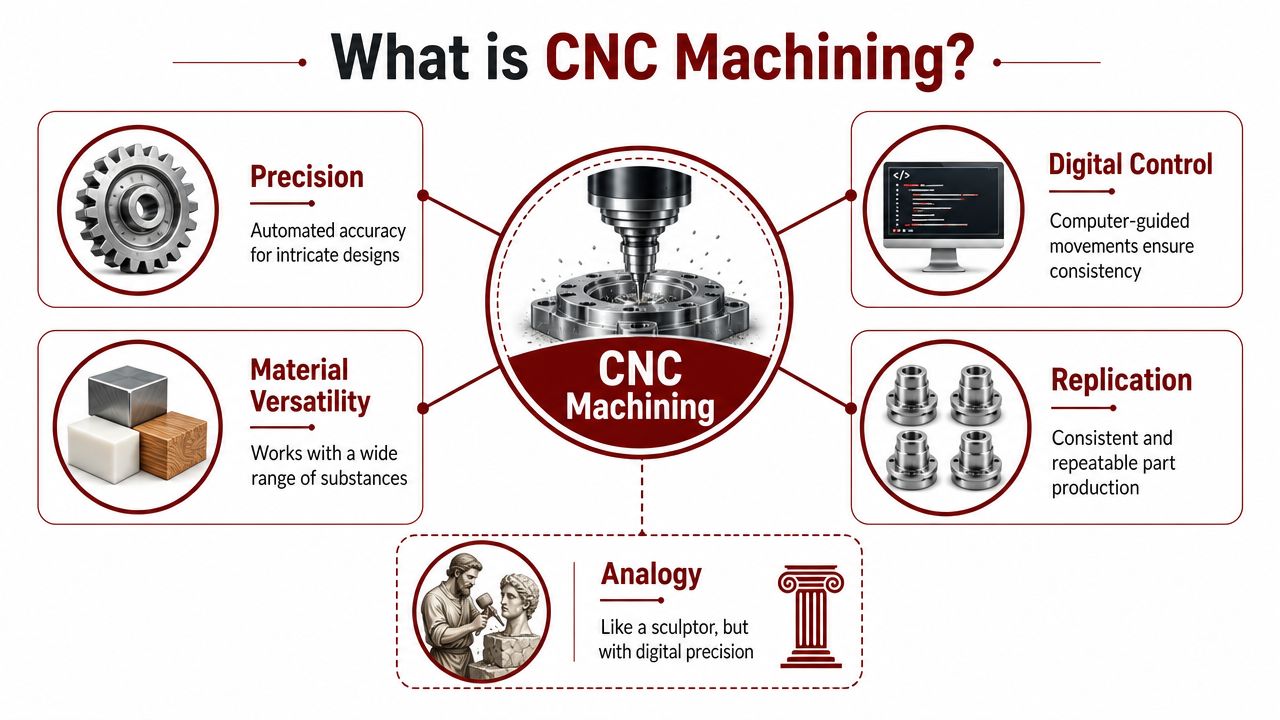
CNC machining is easiest to understand if you think of it as a master sculptor working from a perfect digital blueprint. The sculptor doesn't improvise. Every movement is planned, repeatable, and tied to the same design intent each time a part is made.
CNC machining is a subtractive, computer-controlled process. A machine starts with raw stock, then removes material according to pre-programmed toolpaths until the final shape emerges. That process is why CNC has become the standard where accuracy, precision, speed, and repeatability matter most, as described in Trade-Tech's introduction to the CNC machining process.
Subtractive versus additive
That subtractive model is the cleanest distinction from additive manufacturing. In additive processes, a machine builds a part by adding material layer by layer. In CNC machining, the machine removes material from a block, bar, plate, or similar blank.
Neither approach is universally better. The right question is fit. If the part requires machined surfaces, proven repeatability, and established production workflows, CNC often wins. If the part benefits from design freedom or low-volume geometric experimentation, additive can be compelling earlier in the cycle.
How the process actually works
The typical flow is straightforward:
- Design begins in CAD. Engineers define the part geometry and critical features.
- Toolpaths are created in CAM. Software translates geometry into machine instructions.
- The machine executes the program. Mills, lathes, routers, and related equipment remove material in a controlled sequence.
- Inspection confirms conformance. The process only has value if the finished part matches the print.
That digital chain is why CNC scales so effectively. Once a toolpath is proven, the organization can reproduce that motion with far less variation than a manual process.
Why this technology has staying power
CNC isn't a passing trend dressed up in modern software language. Its modern origin is commonly traced to 1952, when the U.S. Air Force and MIT produced the first working numerically controlled machine. The technology moved into broader production in the early 1960s, reached the wood industry by 1966, and the shift from punched-tape NC to computer control took hold around 1972, according to this history of CNC development. That gives CNC a 70-year development path from defense-driven precision needs to broad industrial adoption.
CNC matters because it combines mature process logic with digital control. That's a rare combination in manufacturing. You get reliability without giving up flexibility.
For executives, that maturity is important. You're not betting on an unproven production concept. You're using a well-established manufacturing method that's continued to absorb better software, controls, and automation over time.
The CNC Toolkit Processes Materials and Capabilities
A lot of confusion around CNC comes from treating it like one process. It isn't. CNC is a control method applied across several machining approaches, each with different strengths, economics, and part fit. The right question is never “Do we need CNC?” It's “Which CNC process matches the geometry, material, and business target?”
Milling Turning and Geometry Fit
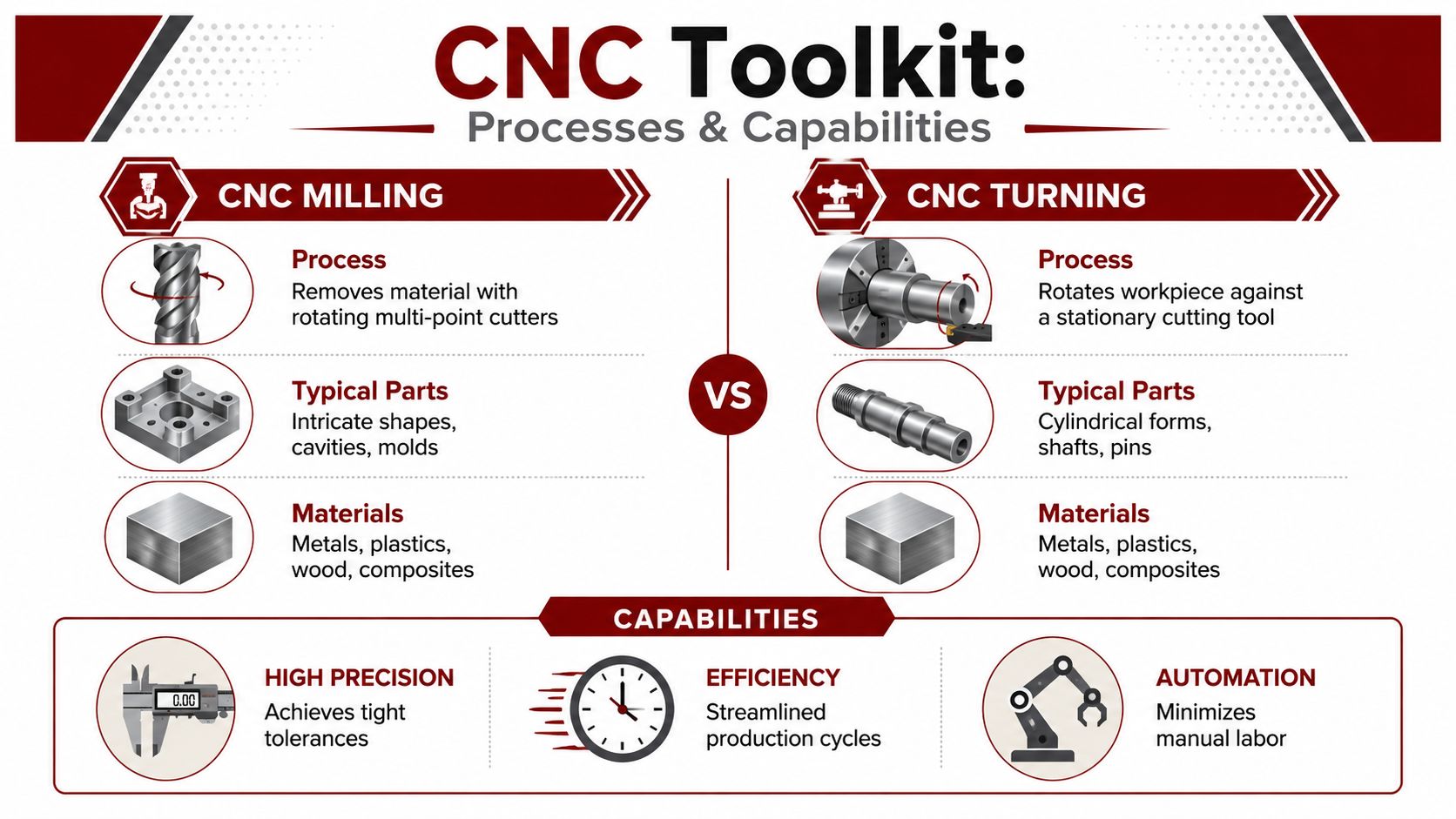
CNC milling uses rotating cutting tools to remove material from a workpiece that is typically fixed in place. It's the workhorse for prismatic parts, pockets, contours, faces, slots, and more complex three-dimensional forms. If a business makes housings, brackets, manifolds, fixtures, molds, or parts with multiple intersecting features, milling is often the first answer.
CNC turning flips that relationship. The workpiece rotates while the cutting tool shapes it. That makes turning efficient for cylindrical forms such as shafts, pins, bushings, threaded components, and other rotational parts. When the part family is primarily round, turning usually produces a simpler and more economical route.
The process choice affects more than manufacturability. It affects quoting logic, setup strategy, tooling approach, and inspection method. A smart buyer doesn't send every part to the same supplier type.
For leaders comparing process options in rotational components, this discussion of CNC turning versus Swiss machining is a useful adjacent lens because part geometry and volume often determine whether a standard lathe setup or a more specialized process makes sense.
Axis Count and Complexity
Axis count changes what the machine can reach and how many setups a part requires. A basic 3-axis mill can cover a wide range of work. More advanced multi-axis machines expand access to angled features, compound geometry, and more efficient machining of complex parts.
From a business perspective, more axes can reduce setups, improve feature relationships, and lower the risk that a part drifts during repositioning. But more capability doesn't automatically mean lower total cost. Shops can overbuy machine complexity for parts that don't need it. That hurts margins just as surely as underestimating the process.
The cheapest machine hour and the cheapest part are not the same thing. A more capable process can cost more per hour and still cost less per finished component if it removes handling, fixturing, and rework.
Materials and commercial fit
CNC machining is used across metals, plastics, wood, and composites. In boardroom terms, material choice is a margin decision disguised as an engineering decision.
A few common trade-offs show up repeatedly:
- Aluminum: Easier to machine in many applications, widely used for lightweight structural and enclosure parts.
- Steels: Often selected where strength, wear resistance, or durability are more important than machining ease.
- Titanium and nickel-based alloys: Valuable in demanding applications, but they tend to raise the stakes on process control, tooling, and cycle planning.
- Plastics: Useful where weight, corrosion resistance, insulation, or cost profile matter more than metal performance.
The right match depends on function first, then production economics. Teams get into trouble when they optimize only for material price or only for technical performance.
CNC Process Comparison
| Process | Description | Best For | Key Advantage |
|---|---|---|---|
| Milling | Rotating tool removes material from a typically fixed workpiece | Complex shapes, pockets, surfaces, housings | Handles broad geometry range |
| Turning | Rotating workpiece is cut by a stationary or linearly moving tool | Shafts, pins, bushings, other cylindrical parts | Efficient for round components |
| Multi-axis machining | Tool or part moves across more axes for added access | Complex parts with angled or hard-to-reach features | Fewer setups and better feature relationships |
The executive takeaway is simple. Process selection is strategy. When the process matches the part, the shop has a chance to win on cost, lead time, and consistency. When it doesn't, the problems show up later as scrap, delay, and arguments over quotes.
The Pursuit of Precision Tolerances Quality Control and Certification
Precision is where CNC machining earns its keep, but it's also where weak operators expose themselves. A drawing may specify a dimension. Profit depends on whether the supplier can produce that dimension consistently, inspect it credibly, and keep doing both as the run progresses.
Tolerance is just the allowed variation around a target dimension. The tighter that window becomes, the more demanding the manufacturing system must be. Tooling, workholding, machine condition, inspection frequency, and operator discipline all start to matter more. That's why tighter tolerance almost always costs more. You're buying process control, not just metal removal.
Why Tolerance Costs More
Leaders sometimes assume a tolerance callout is just an engineering preference. In production, it's a cost multiplier if it's not justified by function.
Tighter tolerance often triggers:
- More careful setup: Fixturing and alignment must be more repeatable.
- More in-process checks: The shop can't wait until final inspection to discover drift.
- Tool management discipline: Wear becomes a dimensional issue, not just a consumable issue.
- Potentially slower cycles: Conservative parameters may protect part quality.
When a company over-specifies tolerances, it usually pays three times. It pays in machining time, inspection time, and supplier frustration.
Precision Starts With Mechanics
High precision doesn't come from software alone. Mechanical fundamentals still decide whether the machine can hold the path the program demands. One practical example is machine support. Guidance from American Micro Industries on improving CNC accuracy and precision recommends placing bed supports at roughly 60% of the bed length apart, the so-called Airy points, with a centered third support to reduce sagging and positional error.
The same principle applies to cutting tools. Harder tools can reduce wear where they are appropriate, and that matters because tool wear changes effective cutting conditions, dimensions, and surface finish over a production run. A shop that ignores wear management may still make good first articles. It won't reliably make good batches.
Operating lesson: Precision is a systems outcome. Program quality matters, but so do stiffness, support, workholding, and tool condition.
Quality Systems Reduce Business Risk
Inspection is the bridge between intent and proof. In high-consequence industries, “we've made parts like this before” isn't enough. Buyers need evidence that the supplier can verify critical dimensions, document results, and control nonconformance.
That's where formal quality systems and certifications matter. In sectors such as aerospace and medical, leaders often look for structured systems like AS9100 or ISO 13485 because they signal process discipline and traceability expectations. Just as important is how the supplier works day to day. Do they use CMM inspection where needed? Do they define control plans? Do they separate first-article validation from routine production checks?
A practical supplier review should probe three layers:
- Machine capability for the tolerance range being requested.
- Inspection capability for verifying what the machine produces.
- Corrective-action discipline when variation appears.
If any one of those layers is weak, the business risk rises. That risk doesn't stay in the plant. It reaches customer returns, delivery performance, and credibility with auditors or strategic buyers.
The Business of Chips Unpacking Cost Lead Time and Workflow
CNC machining margins rarely disappear because the machine couldn't cut the part. They disappear in the handoffs, the setups, the waiting, the reprioritization, and the work that nobody tracked cleanly. That's why executives should look at machining as a workflow business as much as a technical one.
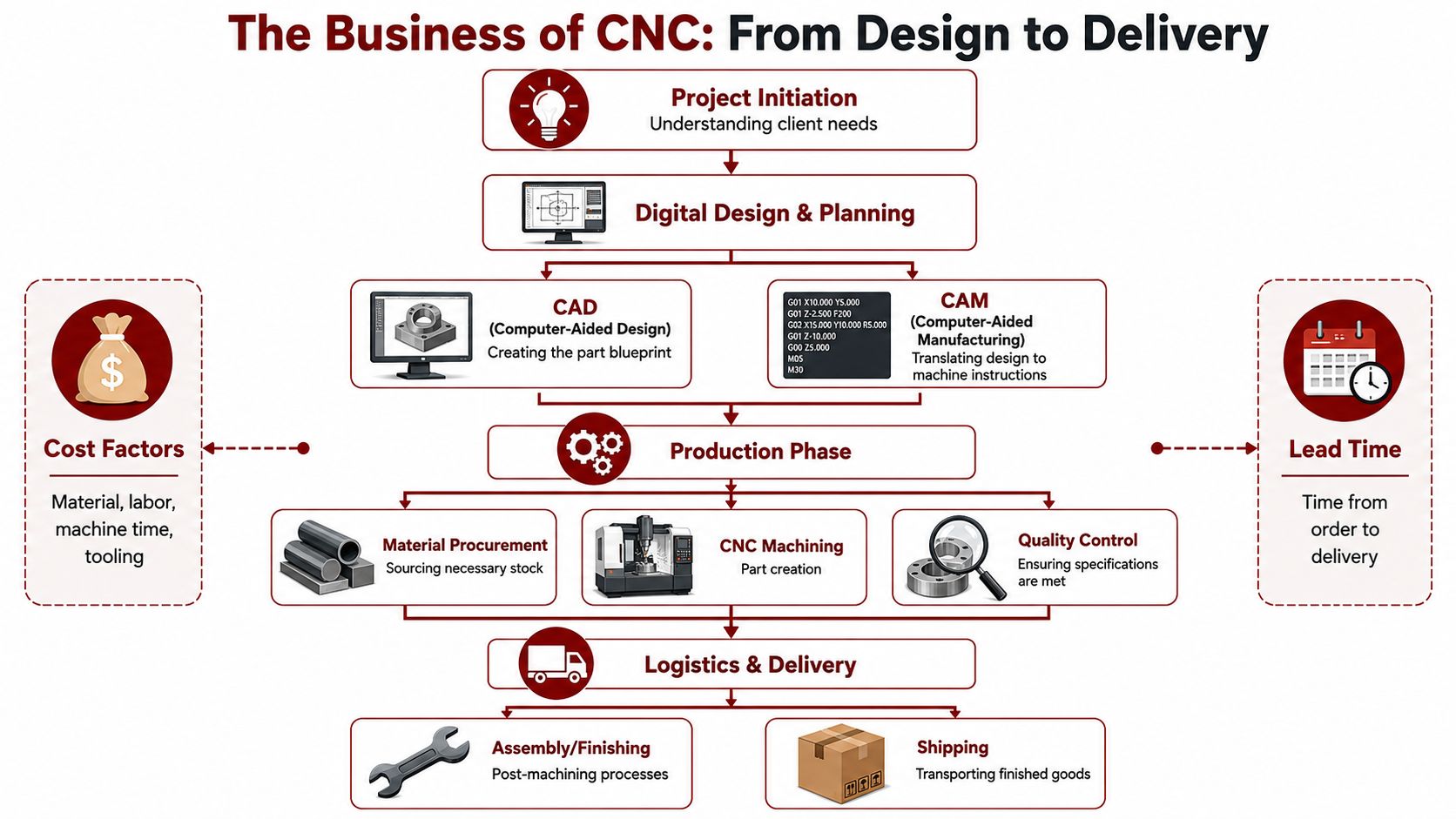
A part begins as a digital file, but it doesn't become profitable just because the geometry is valid. It moves through quoting, process planning, programming, material procurement, setup, machining, inspection, finishing, packaging, and delivery. At each stage, time either compounds into value or leaks out as cost.
Where Profit Is Actually Made Or Lost
The visible costs are easy to spot. Material, direct labor, tooling, machine time, and finishing all belong in the quote. The harder part is seeing the hidden drag. Industry discussion around CNC economics points to unbilled setup time, scheduling inefficiencies, machine downtime, outdated equipment, and poor tracking as the factors that often erode profit margins most severely, as highlighted in this discussion of CNC machining economics.
That observation matters because many buyers compare quotes as if every supplier uses time the same way. They don't. One shop may have a disciplined process library, stable workholding, and accurate scheduling. Another may burn hours on avoidable setup loss and then hide the damage in late deliveries or quality escapes.
Three cost drivers deserve direct executive attention:
- Setup intensity: Low-volume or high-mix work can look attractive until setups consume the margin.
- Programming complexity: A difficult toolpath isn't just engineering effort. It can affect prove-out time and production stability.
- Workflow friction: Machines don't need to be broken to lose money. They only need to sit waiting for material, fixtures, approvals, or operators.
A low quote can be a warning sign. If the supplier hasn't accounted for setup, inspection, or schedule disruption, somebody will still pay for those costs later.
How Executives Should Read A CNC Quote
A useful quote review goes beyond line-item price. It asks whether the supplier's process assumptions match the commercial reality of the part.
Look for signals like these:
- Is the run size aligned with the process? Prototype logic and production logic are rarely the same.
- Has the supplier considered tolerance and finish requirements carefully? Unclear print requirements lead to expensive debate later.
- Are secondary operations visible? Deburr, coating, heat treatment, assembly, and packaging often affect both lead time and margin.
- Does the delivery promise sound operationally credible? Fast isn't helpful if it depends on permanent expediting.
The workflow view changes sourcing decisions
The best-performing CNC operations think in flow, not isolated machine cycles. They reduce touches. They standardize setups where possible. They make scheduling visible. They know which jobs deserve premium capacity and which should be batched for efficiency.
For management teams, that changes how supplier performance should be measured. Piece price alone is weak. A better lens includes responsiveness, first-pass quality, schedule discipline, engineering collaboration, and the supplier's ability to scale a part family without re-learning the process each time.
That's the business of chips. Material comes off the blank, but value only appears when the organization controls the workflow wrapped around the cut.
From Shop Floor to Smart Factory Automation and Scaling Strategies
Most automation discussions in CNC machining are too abstract to be useful. The core question isn't whether AI, robotics, or digital twins are interesting. It's which upgrade solves a current operating problem without adding a larger implementation problem behind it.
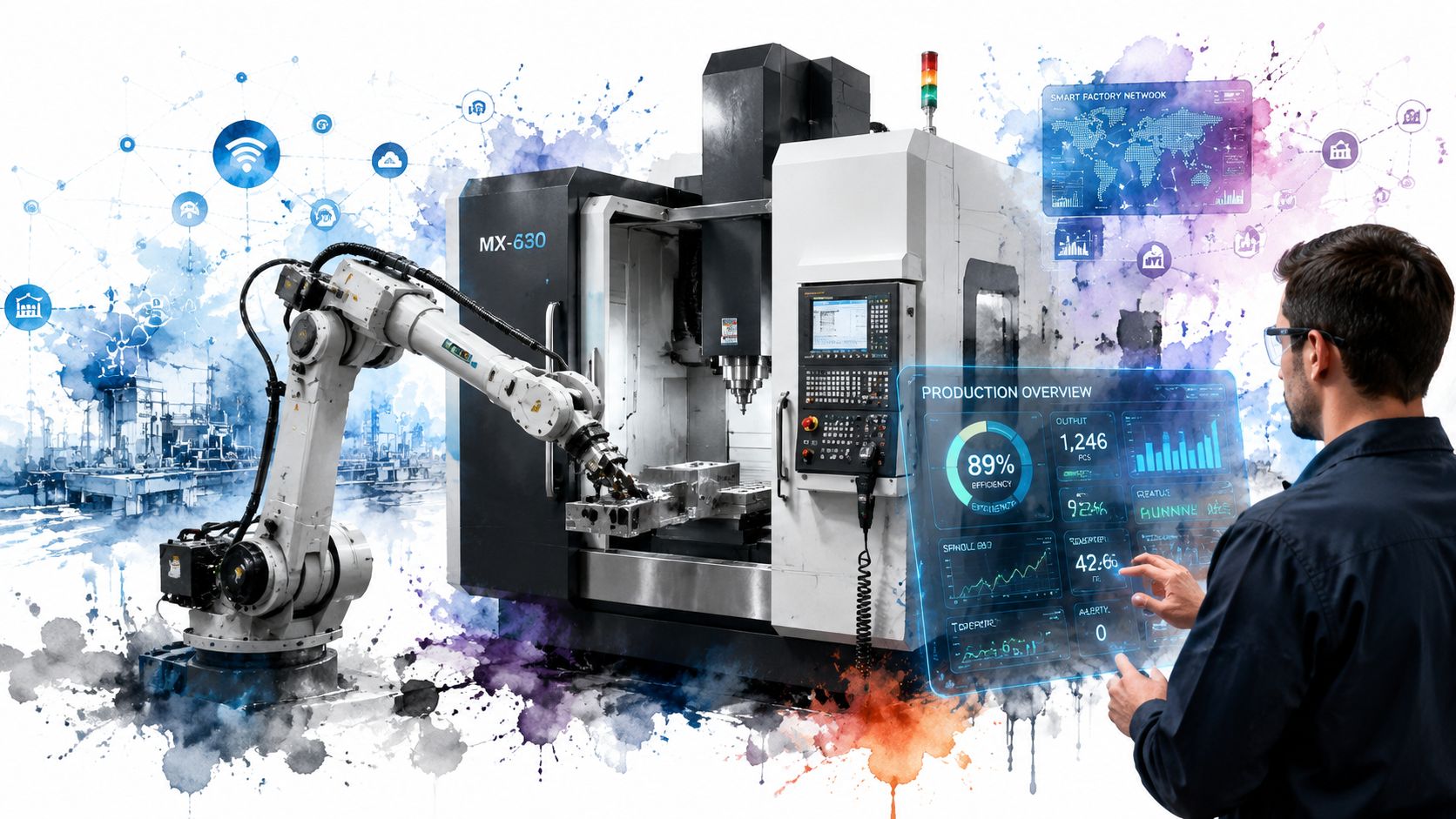
Current industry trend coverage points toward AI-assisted optimization, robotics, and digital twins, while also noting a practical adoption gap around what helps most in the next 12 months. The same coverage frames automation as a response to labor constraints and digital twins as tools aimed at reducing waste, according to Morris Group's discussion of CNC industry trends.
What Automation Solves First
In most shops, the first practical automation target isn't advanced AI. It's repetitive labor around the machine. Part loading, unloading, pallet movement, basic machine tending, and process visibility are usually where the near-term return sits.
That's because these upgrades address immediate pain:
- Labor resilience: One technician can oversee more output when repetitive handling is reduced.
- Consistency: Automated handling lowers variation created by human fatigue or shift changes.
- Utilization: The machine spends more time cutting and less time waiting.
For scaling companies, these are not cosmetic benefits. They affect capacity planning, hiring pressure, and customer confidence.
What Usually Fails In Real Adoption
Automation projects go sideways when leadership buys the headline instead of the workflow. A robot added to a bad process doesn't create a good process. It automates confusion.
Common failure points are predictable:
- Weak data discipline. If tooling, offsets, part status, and routing data are inconsistent, software can't make good decisions.
- Legacy integration problems. Older machines may still be productive, but connecting them to newer systems can be messy.
- Training gaps. Teams need operators and supervisors who can run exceptions, not just normal cycles.
- Undefined economic target. “Modernization” is not an investment thesis. Throughput, waste reduction, labor resilience, or schedule stability is.
A more grounded path often starts with execution visibility. Systems that connect planning, production status, and machine-level accountability can support that first layer of discipline. One example is manufacturing execution systems in an industrial operations context, which is relevant when a shop needs better control before it adds more automation on top.
Here's a practical look at the smart-factory direction in motion:
A Practical Capital Filter
Executive teams need a filter that separates near-term value from tech theater. I use a simple test. If the upgrade doesn't improve one of these in a visible way, it probably isn't first in line:
- Throughput
- Quality consistency
- Labor flexibility
- Waste reduction
- Scheduling reliability
The smartest automation roadmap usually starts with process stability, then machine utilization, then orchestration across cells. Not the other way around.
Digital twins may be highly useful where complexity, collision risk, or waste reduction justify the effort. AI-assisted optimization may become more valuable as data quality improves. But for many small and mid-sized operators, the strongest move today is still disciplined, incremental automation tied to a specific bottleneck.
That's how CNC becomes scalable. Not by chasing every trend, but by sequencing technology around real constraints.
Choosing Your Partner A Framework for Selecting the Right CNC Supplier
The wrong CNC supplier can look fine in the quoting stage. The drawings are reviewed quickly, pricing is competitive, and promises sound confident. The problems show up later. Delivery slides. Questions get answered slowly. Inspection reports become harder to obtain. Engineering changes trigger confusion. By then, the buyer is already paying the switching cost.
A good supplier selection process should be treated like risk underwriting. You're not buying parts alone. You're buying capability, response quality, and commercial reliability over time.
Screen For Capability Then For Discipline
Start with technical fit. Can the supplier make the part family you care about, in the material you need, at the quality level your end market demands? That sounds basic, but many sourcing mistakes come from forcing a supplier outside its natural operating range.
Then test operational discipline. Ask how they manage setup repeatability, revision control, inspection records, and nonconformance. Request examples of how they handle design-for-manufacturability conversations. A supplier that can identify risk before cutting metal is more valuable than one that automatically says yes to every print.
A useful screening checklist includes:
- Process fit: Milling, turning, multi-axis capability, and relevant secondary operations.
- Material familiarity: Real experience with the alloys or polymers your product requires.
- Quality system maturity: Certifications where relevant, documented inspection methods, traceability discipline.
- Program management: Clear communication on revisions, lead times, approvals, and exceptions.
Buy Total Cost Of Ownership Not Piece Price
Piece price is only one part of what a supplier costs the business. Total cost of ownership is the better lens. It includes scrap exposure, late-delivery impact, engineering support quality, administrative friction, and how often the supplier helps prevent avoidable cost.
Strong CNC partners stand out. They don't just cut to print. They challenge features that drive unnecessary cost. They flag tolerance stacks that create avoidable inspection burden. They recommend process or fixture changes that make the part more stable in production.
Consider the difference between two quotes that are close on paper. One supplier provides a lower price but asks few questions. The other asks about critical-to-function features, suggests a cleaner machining sequence, and proposes a more robust inspection plan. The second quote may not be cheaper on day one. It's often cheaper across the product lifecycle.
A strategic supplier helps remove cost from the system, not just from the quote.
Partnership Signals That Matter
The strongest CNC relationships usually share a few traits:
- Direct communication: Problems surface early, not after the due date.
- Commercial honesty: The supplier says when a print, timeline, or batch strategy doesn't make sense.
- Engineering engagement: DFM isn't treated as free consulting to avoid. It's part of building a durable account.
- Scalability mindset: The supplier can support the move from prototype urgency to controlled production.
For executives and investors, this matters because supplier quality influences enterprise quality. If a company depends on machined parts, its supplier base becomes part of its operating model. Buyers, auditors, and acquirers will often notice that before management does.
Choose accordingly.
If you're evaluating CNC machining as a growth lever, not just a production expense, Hasit Vibhakar offers perspective grounded in building and scaling companies across aerospace, advanced manufacturing, and industrial sectors. That's useful when the decision in front of you is bigger than a machine or a quote, and closer to how you want the business to scale.

Leave a Reply