
A lot of manufacturing companies don't hit a growth ceiling because demand weakens. They hit it because the supply base can't support the next stage of scale. Orders are strong. The backlog looks healthy. The board wants acceleration. Then lead times stretch, incoming quality starts to wobble, expedite costs creep in, and the leadership team spends too much time chasing parts instead of building the business.
That pattern shows up often in PE-backed platforms and founder-led industrial businesses. The company usually isn't failing. It has outgrown a transactional purchasing model. What worked when the business was smaller, simpler, and less visible to customers stops working when output rises and complexity compounds.
Hasit Vibhakar has spent more than two decades in aerospace, advanced manufacturing, and industrial companies where supplier performance directly affects margin, delivery credibility, and enterprise value. In that environment, supplier relationship management isn't an academic procurement term. It's an operating discipline that separates businesses that scale cleanly from businesses that stall under avoidable supply friction.
Table of Contents
- The Hidden Ceiling on Your Company's Growth
- What Is Strategic SRM Really
- The Cornerstone of SRM Segmenting Your Supplier Base
- Building the SRM Engine Governance KPIs and Performance
- An Operators Roadmap for SRM Implementation
- Conclusion SRM as a Catalyst for Enterprise Value
The Hidden Ceiling on Your Company's Growth
The scenario is familiar. A manufacturer wins new business, capacity gets tighter, customer expectations rise, and the old purchasing habits stay in place. Buyers still issue POs, push for price, and react when suppliers miss. On paper, procurement appears busy. In practice, the company is running without a system for managing the suppliers that determine whether production stays on track.
In aerospace and industrial environments, that hidden ceiling usually shows up in a handful of painful ways. A critical machining vendor starts slipping dates. A special process source becomes a bottleneck. A sole-source material provider controls your recovery timeline after a disruption. None of that is solved by squeezing another point out of unit price.
Why transactional buying breaks at scale
A transactional model assumes most suppliers can be managed the same way. That assumption fails once the business depends on a smaller group of suppliers for continuity, quality, responsiveness, and technical collaboration. Those suppliers aren't interchangeable. They affect shipment dates, customer confidence, and the company's ability to absorb shocks without burning margin.
Hasit Vibhakar has seen this inflection point repeatedly. The issue usually isn't that the team lacks effort. It's that leadership hasn't installed a structure for deciding which suppliers deserve executive attention and which ones should stay in an efficient transactional lane.
Practical rule: If your operations team knows exactly which suppliers can shut down your line, but your management process treats them like every other vendor, you don't have supplier relationship management. You have purchasing volume without control.
What changes when leadership treats supply as strategic
The businesses that break through this ceiling stop viewing procurement as an isolated function. They start treating the supply base as part of the operating model. That means supplier decisions connect to production planning, quality management, customer commitments, and risk oversight.
For industrial leaders dealing with supplier volatility, this broader view aligns closely with the operating discipline behind manufacturing risk management insights from Hasit Vibhakar. The common thread is simple. Growth creates exposure. Exposure has to be managed deliberately.
A company can't scale well if its most important suppliers are managed only when something goes wrong. That's the point where supplier relationship management becomes a CEO issue, not just a procurement issue.
What Is Strategic SRM Really
Supplier relationship management became a formal procurement discipline in the 2000s as organizations moved from price-only purchasing to long-term value creation, with structured frameworks focused on categorizing suppliers, measuring performance, collaborating with suppliers, and improving supplier quality, as outlined by SDI's overview of SRM and its primary tasks.
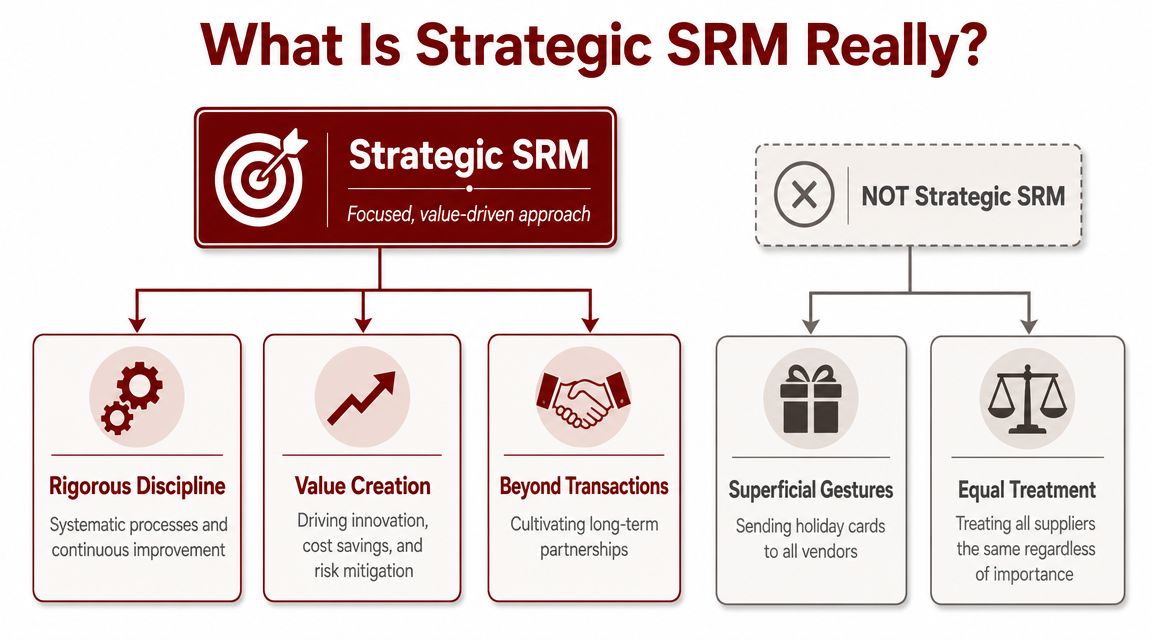
That history matters because it explains what SRM is and what it isn't. It isn't about being nicer to suppliers. It isn't a blanket vendor engagement program. And it definitely isn't sending the same message to every vendor in the ERP.
The CEO lens on SRM
The easiest way to explain strategic SRM is to compare it to how a CEO runs the company. No CEO manages every employee with the same cadence, same agenda, and same depth. The executive team gets a different level of review because those roles carry outsized impact.
Your supply base works the same way.
A small subset of suppliers drives a disproportionate share of business outcomes through spend volume, strategic criticality, innovation potential, switching costs, and risk exposure. Those suppliers need a different management model. Strategic SRM is that model.
Vendor management versus strategic SRM
A lot of companies say they have SRM when what they really have is vendor administration. The difference is straightforward.
| Approach | What it looks like | Typical result |
|---|---|---|
| Vendor management | PO follow-up, issue escalation, contract filing, reactive expediting | Problems get addressed after they surface |
| Strategic SRM | Supplier segmentation, scorecards, review cadence, joint planning, executive sponsorship | Performance improves before failure becomes customer-facing |
In manufacturing, that distinction matters because reactive management is expensive. It pushes decisions into crisis mode, where options narrow and every fix costs more than it should.
The core pillars that make SRM real
Strategic supplier relationship management rests on four operating pillars.
- Segmentation matters first. Leadership has to identify which suppliers are strategic, which offer competitive negotiation potential, which are bottlenecks, and which should stay transactional.
- Governance creates consistency. Without defined owners, meeting cadence, and escalation paths, SRM turns into scattered conversations.
- Performance management drives action. Metrics only matter if they trigger corrective action, investment, or consequence.
- Risk mitigation keeps value intact. The goal isn't just lower cost. It's continuity, resilience, and faster recovery when disruption hits.
Strong SRM doesn't mean every supplier becomes a partner. It means the right suppliers get the right level of management attention.
That's the shift Hasit Vibhakar would recognize from real operating environments. Strategic SRM is selective, disciplined, and tied to enterprise outcomes. It doesn't spread effort evenly. It concentrates leadership where supplier performance changes the company's trajectory.
The Cornerstone of SRM Segmenting Your Supplier Base
The first mistake most companies make is treating supplier relationship management like a universal program. It isn't. If every supplier gets the same oversight, then no supplier gets enough.
Segmentation is the starting point. Amazon Business cites a Deloitte survey in which more than 60% of chief procurement officers said supplier collaboration delivered the most value, which is one reason effective SRM focuses effort where collaboration, performance gains, and risk reduction can move the business, as noted in Amazon Business on supplier relationship management.
That aligns with what operators see on the ground. The value isn't spread evenly across the vendor list. It concentrates around suppliers that can accelerate production, block shipments, influence quality, or open access to better design and process capability.
Near the front end of this exercise, teams often find logistics vendors have been reviewed far less rigorously than production suppliers. If transportation reliability is affecting customer performance, it helps to compare freight forwarder options with the same discipline you apply to machining houses, material suppliers, and special-process providers.
A practical four-part supplier map
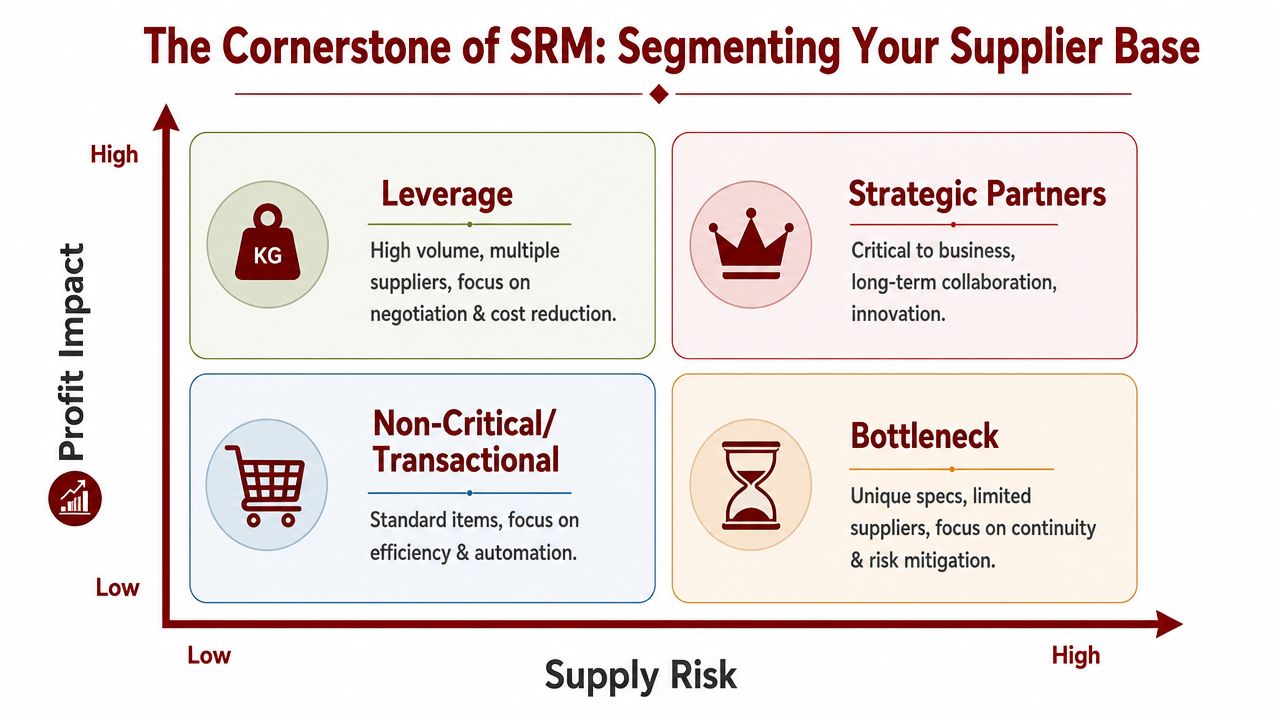
A simplified Kraljic-style view works well in manufacturing because it forces two hard questions. How much does this supplier affect profit and performance? How hard is it to replace them?
Here's the operating version.
| Segment | Manufacturing example | Management priority |
|---|---|---|
| Strategic partners | Sole-source provider of a patented alloy, critical forgings supplier, approved aerospace special-process source | Executive visibility, formal reviews, joint planning |
| Leverage suppliers | Standard fasteners, common raw materials, packaging with multiple qualified sources | Cost discipline, negotiation, competitive sourcing |
| Bottleneck suppliers | Low-spend but hard-to-replace custom component or niche coating source | Continuity planning, inventory buffers, alternate source development |
| Non-critical vendors | Commodity MRO items, office supplies, basic indirect spend | Automation, simplified controls, low-touch management |
What each quadrant demands
Strategic partners deserve time from senior operations, quality, and commercial leaders. These relationships affect output, customer performance, and long-term capability. In aerospace, this can include approved process houses, complex machining partners, or material suppliers tied to qualification constraints.
Strategic suppliers should face disciplined commercial pressure. The key here isn't emotional partnership. It's structured competition, clean specifications, and buying power.
Then come the suppliers many teams underestimate. Bottleneck suppliers often don't carry major spend, but they can still stop production. These are the vendors that justify dual-source work, safety stock decisions, and proactive continuity reviews.
For non-critical vendors, efficiency wins. Don't waste executive bandwidth here.
Later in the decision process, it helps to ground the framework in a practical explanation. This short video gives a useful overview of segmentation logic and supplier prioritization in action.
A quick segmentation checklist
Use this set of questions to pressure-test your supplier list.
- Revenue exposure: If this supplier misses for a week, which customer orders move?
- Replacement difficulty: Can your team qualify another source quickly, or are you locked in by process, tooling, or approval requirements?
- Technical dependency: Does this supplier contribute know-how, process control, or design support that others can't easily replicate?
- Risk concentration: Are you dependent on one site, one owner, one geography, or one constrained material input?
- Operational pain: Which suppliers generate the most escalations from planning, quality, and customer service?
Hasit Vibhakar's operating view is blunt on this point. If a supplier can hurt production, quality, or customer trust disproportionately, it belongs in a segment that receives disproportionate management attention. That's where supplier relationship management starts to produce real value.
Building the SRM Engine Governance KPIs and Performance
Once suppliers are segmented, most companies assume the hard part is done. It isn't. Classification without governance turns into a slide deck that no one uses.
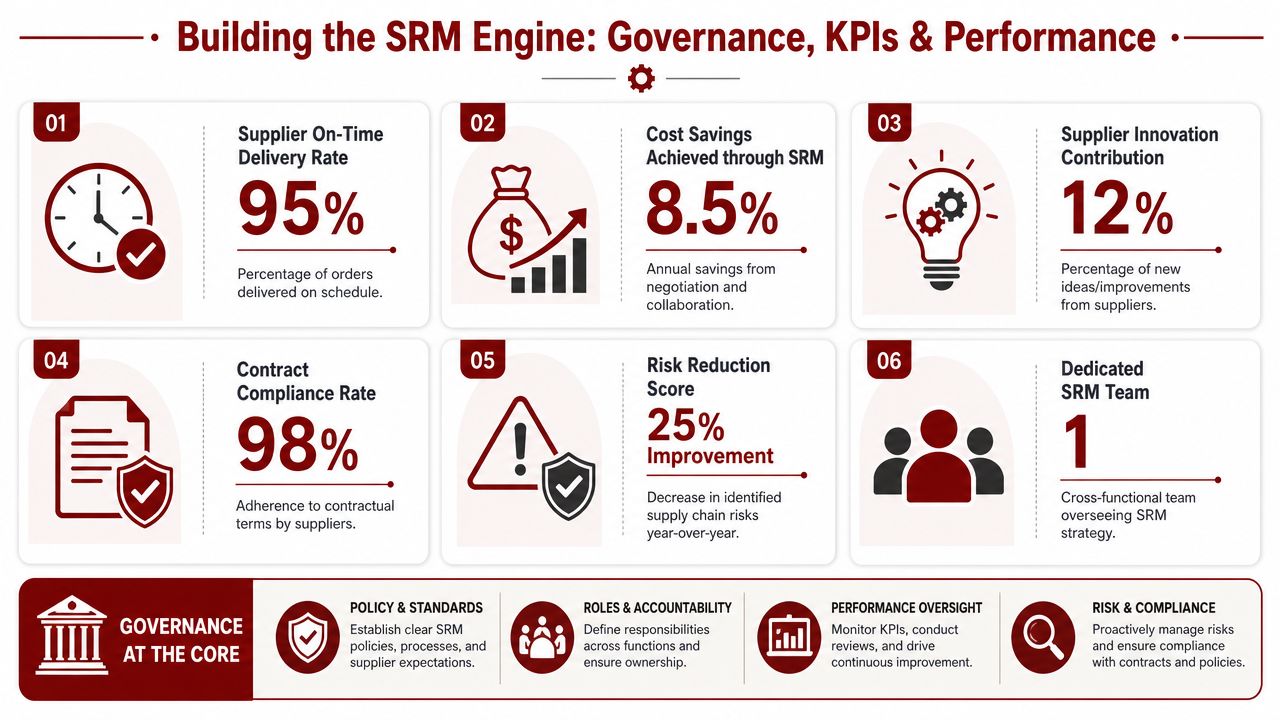
In mature supplier relationship management, the biggest execution failure is governance quality. Fragmented supplier data, misaligned KPIs, and inconsistent review cadence stop organizations from converting performance monitoring into corrective action. Centralized scorecards and quarterly business reviews are used to connect quality, delivery, innovation, and sustainability metrics to contractual incentives, as described in Ivalua's discussion of SRM governance.
That observation matches what operators see in the field. Bad governance doesn't look dramatic at first. It looks like missing ownership, conflicting reports, stale metrics, and meetings that revisit the same issue every quarter because no one closed the loop.
The scorecard has to reflect how the plant runs
A supplier scorecard should mirror operational reality. In advanced manufacturing, that usually means a narrower set of KPIs with clear consequence, not a bloated dashboard.
Typical metrics include:
- On-time in-full performance: Did the supplier deliver what was needed, when it was needed?
- First pass yield: Are parts arriving ready for use, or is internal rework masking supplier instability?
- Cost of poor quality: What is the actual operational burden created by defects, returns, sorting, or line interruptions?
- Responsiveness: How quickly does the supplier contain and address issues?
- Innovation contribution: Is the supplier helping improve manufacturability, lead time, material use, or process capability?
A lot of leaders miss one point here. The metric isn't the management system. The discussion around the metric is.
What a useful QBR actually looks like
Quarterly business reviews fail when they become backward-looking complaint sessions. A strong QBR should review historical performance, but it has to spend equal or greater time on what happens next.
A useful QBR with a strategic supplier usually covers:
- Performance trend review tied to quality, delivery, responsiveness, and capacity
- Open corrective actions with owners, due dates, and evidence of closure
- Forward demand and capacity alignment so surprises don't become excuses
- Commercial and contract alignment if service levels, incentives, or terms need adjustment
- Joint improvement pipeline covering process, sourcing, engineering, or risk mitigation opportunities
If the meeting ends without a decision, an owner, and a date, it was an update, not governance.
Systems matter because memory is not a control
In complex plants, governance improves when supplier data is visible in the same operating rhythm as production and quality. That's one reason many leaders connect SRM discipline to broader digital operations work, including manufacturing execution systems perspectives from Hasit Vibhakar. The connection is practical. Better plant visibility strengthens supplier accountability because the facts are harder to debate.
Hasit Vibhakar's perspective in PE-backed environments is especially relevant here. Buyers and operators often focus on sourcing strategy, but value creation comes faster when suppliers know exactly how performance is measured, who reviews it, and what happens when it drifts. Governance isn't overhead. It's the mechanism that transforms supplier relationship management into a powerful operational advantage.
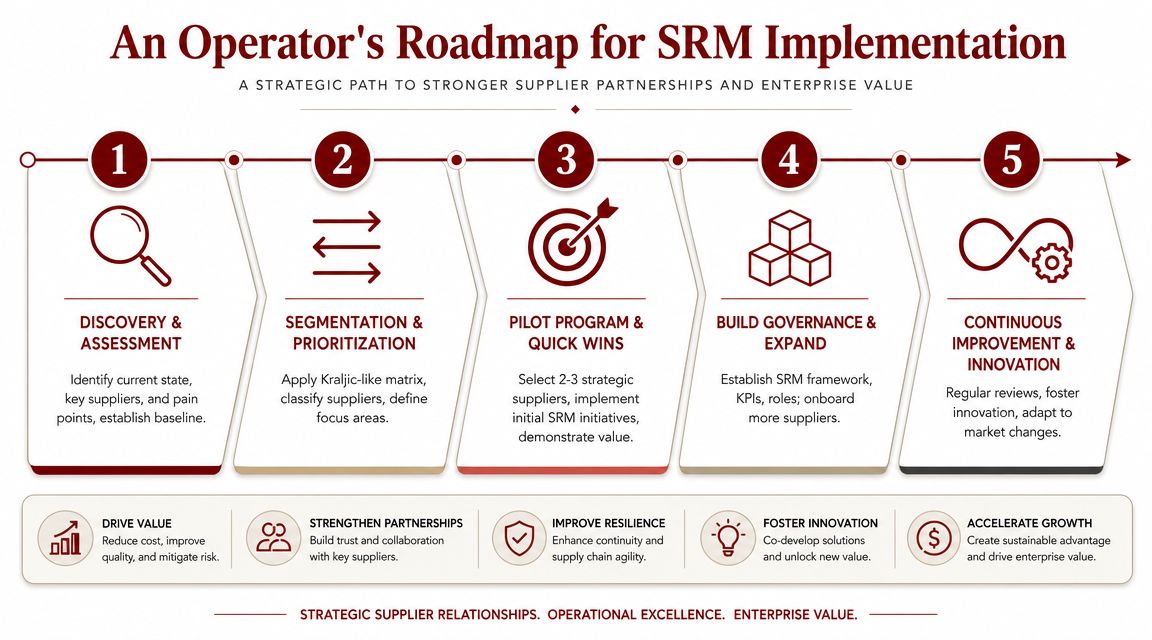
An Operators Roadmap for SRM Implementation
Most companies don't fail at supplier relationship management because they disagree with the idea. They fail because they launch too broadly, assign too vaguely, and expect procurement alone to carry the load.
The better approach is phased. Efficio notes that once the obvious savings from re-tendering have been captured, the harder question is how SRM creates value through supplier innovation, risk reduction, and faster decision-making rather than price pressure alone, as discussed in Efficio's guidance on winning with supplier relationship management. That's exactly why implementation has to mature beyond sourcing events and into a business system.
Stage one in the first 100 days
The first phase is about exposure, not perfection. Leadership needs a clear view of which suppliers can disrupt revenue, production, customer delivery, or quality performance.
Start with a fast triage process.
- Identify critical suppliers: Build a short list based on revenue impact, qualification constraints, quality history, and supply continuity risk.
- Assign internal owners: Each priority supplier needs a named leader. In most companies that means a mix of procurement, operations, quality, and engineering.
- Set a communication cadence: Critical suppliers should not hear from you only when a shipment is late.
- Find immediate risk actions: This might include open order cleanup, capacity checks, tooling review, or alternate source scoping.
This phase should feel operational, not theoretical. You're trying to stabilize exposure and make supplier risk visible to the leadership team.
Stage two in months four through twelve
Once the most serious pressure points are visible, the company needs repeatable infrastructure. At this stage, many teams slow down because the work becomes less dramatic and more procedural.
That's a mistake. Procedure is what keeps the organization from sliding back into reactive buying.
Build the following during this phase:
| Priority | What to install | Why it matters |
|---|---|---|
| Standard scorecards | Common metrics, common definitions, common owners | Prevents debates over whose data is correct |
| Formal QBR rhythm | Strategic supplier review calendar with agendas and action tracking | Creates accountability and continuity |
| Escalation paths | Clear thresholds for leadership involvement | Stops issues from drifting too long |
| Cross-functional ownership | Procurement, quality, operations, engineering participation | Reflects how supplier problems actually show up in the plant |
| Contract linkage | Tie review outcomes to obligations, service levels, and improvement plans | Makes governance enforceable |
A lot of operators also discover inventory policies are working against their SRM goals. If planning assumptions, reorder logic, and supplier reality are disconnected, the organization keeps paying for the same instability. In that situation, broader work around inventory management optimization becomes part of the SRM conversation, not a separate exercise.
The first sign an SRM program is working is not a prettier dashboard. It's fewer surprises reaching the customer.
Stage three in year two and beyond
By this point, the company should stop thinking of SRM as a control system alone. The upside now shifts toward value creation.
That means working with strategic suppliers on issues such as process redesign, material alternatives, lead time compression, shared forecasting discipline, and recovery playbooks for disruption. In strong relationships, suppliers don't just react to your requirements. They help improve how the business runs.
Hasit Vibhakar's operating mindset matters. In manufacturing and aerospace, enterprise value improves when the supply base becomes a documented capability. Buyers, boards, and lenders want to know whether supply continuity depends on heroics or on a controlled system. A mature SRM approach answers that question with evidence.
Common implementation mistakes
The failure patterns are predictable.
- Launching across every supplier at once: The team gets buried and priorities blur.
- Treating procurement as the only owner: Quality, engineering, planning, and operations stay detached until a problem escalates.
- Using too many metrics: The dashboard expands, but action quality drops.
- Holding reviews without consequence: Suppliers hear concerns but don't see incentives, escalation, or decision-making tied to performance.
- Stopping at savings: The company misses resilience, speed, and innovation gains because the scorecard is too narrow.
The strongest implementations stay selective. They begin with the suppliers that can most affect continuity and margin, then build from there. That's how supplier relationship management becomes practical for a scaling manufacturer instead of turning into another corporate initiative with a long name and weak follow-through.
Conclusion SRM as a Catalyst for Enterprise Value
The companies that scale well don't leave supplier performance to chance. They identify which suppliers matter most, put governance around them, measure what affects the business, and stay engaged before disruptions become customer problems.
That's why supplier relationship management belongs in the CEO toolkit. It influences delivery reliability, quality stability, working capital pressure, operational resilience, and the company's ability to execute growth without constant expediting. In PE-backed businesses, it also shapes how the company looks in diligence. A supply base managed through discipline and documented cadence is an asset. A supply base held together by tribal knowledge is a liability.
Hasit Vibhakar's career across aerospace, advanced manufacturing, and industrial companies points to the same operating truth. Enterprise value doesn't come only from selling more. It comes from building a business that can deliver consistently, recover faster, and convert supplier capability into competitive advantage.
If your team is still managing critical suppliers mainly through expediting, late-night calls, and periodic price negotiations, you're carrying more risk than the P&L reveals. If your team has segmentation, scorecards, cross-functional ownership, and real business reviews in place, you're building something much more durable.
Supplier relationship management isn't a soft discipline. Done well, it hardens the business.
About Hasit Vibhakar: Hasit Vibhakar is a serial entrepreneur and CEO with over 25 years of experience building, scaling & increasing shareholder value across Aerospace, Advanced Manufacturing & Industrial sectors.
If you're evaluating how to strengthen operations, reduce supply-side fragility, and build enterprise value in manufacturing, connect with Hasit Vibhakar for a practical executive perspective shaped by decades of operating and scaling industrial businesses.

Leave a Reply