
The first serious exit conversation I ever had didn't start with price. It started with control, timing, and whether the company could keep performing without me in the middle of every decision. That's when it became clear that an exit isn't the last move. It's the result of hundreds of decisions made years earlier.
Table of Contents
Introduction Planning Your Endgame with Hasit Vibhakar
Founders often treat exit planning as something to think about later, after growth, after scale, after the hard years. That's backwards. Every capital decision, every hire, every contract structure, and every operational discipline either strengthens your eventual exit or weakens it.
I've learned that the strongest exits come from companies built to survive scrutiny. Buyers don't just buy revenue. They buy repeatability, resilience, and confidence that the performance will continue after ownership changes. That is especially true in aerospace, advanced manufacturing, and industrial businesses where asset intensity, technical know-how, and execution discipline matter every day.

Hasit Vibhakar built that perspective through repetition, not theory. According to key statistics on business exit strategies, Hasit Vibhakar's track record includes four major company exits delivering over $342 million in combined value, including a semiconductor manufacturing company founded in 2002 that went public on a US stock exchange and reached a peak market capitalization of $250 million USD before a successful exit.
That history matters because different exits demand different preparation. An IPO asks one thing of the business. A strategic buyer asks another. Private equity looks for something else again. The common thread is that you can't improvise your way through any of them.
Why the endgame belongs in the opening plan
A founder who wants optionality has to build for optionality. That means clean reporting, documented processes, durable customer relationships, protected intellectual property, and a management team that isn't dependent on the founder for every answer. It also means being honest about personal goals. Some owners want partial liquidity and continued control. Others want a full transition.
Practical rule: Your exit strategy should match both the economics of the business and the life you want after the transaction.
When owners start early, they usually make better decisions under less pressure. If you're working through continuity issues, ownership planning, or how to secure your business legacy, those conversations should happen alongside growth planning, not after a deal appears.
For more background on my operating history and sector focus, the Hasit Vibhakar profile gives the broader context behind the strategies discussed here. Business Exit Strategies by Hasit Vibhakar comes down to a simple idea. Build with the exit in mind, even while you intend to keep operating for years.
The Exit Strategy Spectrum Explained
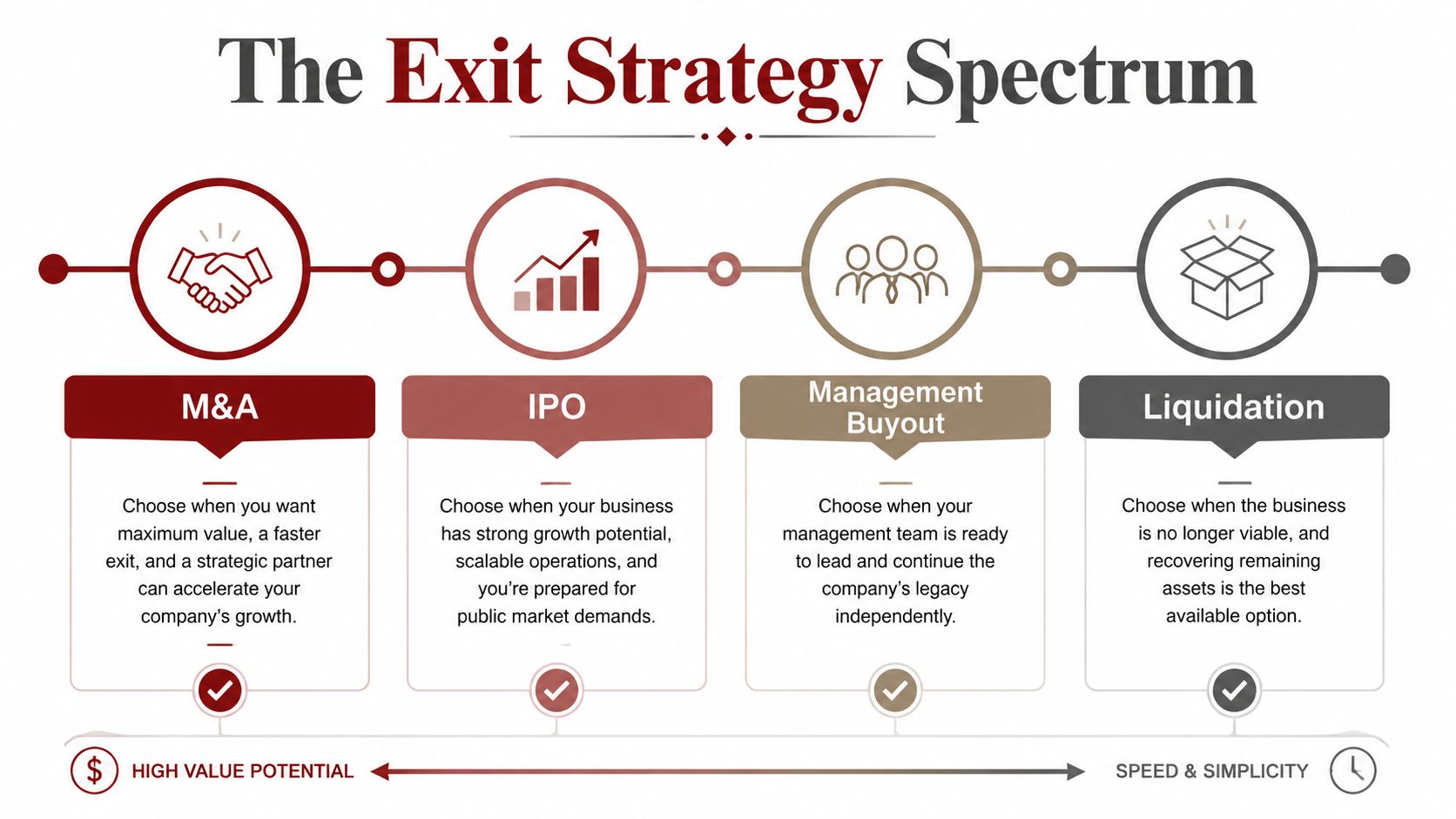
No exit strategy is universally right. The right one depends on control, liquidity needs, growth prospects, market conditions, and how much of the company you want to keep owning after the transaction. Founders get into trouble when they chase the highest headline valuation without understanding the trade-offs underneath it.
Strategic sale
A strategic sale usually means selling to an industry buyer that sees value in your customers, capabilities, products, footprint, or supply chain position. This route can work well when your business fills a clear gap for an acquirer.
The upside is straightforward. Strategic buyers may see synergies that financial buyers won't pay for. The downside is that integration risk becomes part of the conversation. A buyer may want your assets and customers, but not your current structure or leadership autonomy.
This path tends to work best when:
Your company solves a strategic need: a product gap, regional expansion, or manufacturing capability.
Customer overlap creates an advantage: the buyer can cross-sell or consolidate relationships.
The founder is ready for a cleaner break: strategic deals can be better suited to a full exit than a staged one.
Private equity recapitalization
Private equity is different. A PE buyer often wants a strong platform company, room for operational improvement, and a path to scale through acquisitions or process discipline. Founders can sell a majority stake, take chips off the table, and continue participating in the next phase of growth.
That model appeals to many industrial and manufacturing owners because it doesn't always require a complete handoff on day one. If the business has defensible capabilities, repeatable earnings, and room to professionalize, PE can be a practical fit.
In many lower middle-market situations, the best deal isn't the fastest close. It's the structure that preserves upside while reducing personal concentration risk.
IPO
My first public company followed the IPO route for a reason. The goal was to retain some ownership, maintain company independence, and gain prestige while creating a semi-liquidity event. An IPO can let a founder access capital and public-market visibility without giving up full control in the way an outright sale often does.
That said, an IPO isn't a branding exercise. It demands governance, reporting discipline, investor readiness, and the ability to perform under public scrutiny. If a company isn't prepared for those realities, the benefits of independence can be outweighed by the cost and burden of being public.
Management buyout and ESOP
A management buyout works when the internal team is capable, trusted, and ready to own. It can preserve culture and continuity, but it only works if leadership depth is real. Founders sometimes overestimate management readiness because the team has operated well under the founder's umbrella.
An ESOP fits a different objective. It can be attractive when an owner wants employee continuity and a gradual transition. But it requires serious planning and doesn't suit every company structure or capital need.
Here's a practical comparison:
| Exit path | Best fit | Main advantage | Main trade-off |
|---|---|---|---|
| Strategic sale | Clear industry fit for a buyer | Potential synergy value | Less control after sale |
| Private equity recap | Strong platform with growth runway | Partial liquidity plus continued upside | Ongoing accountability to an investor |
| IPO | Company can handle public scrutiny | Capital access and retained ownership | Heavy reporting and governance burden |
| Management buyout | Deep internal bench | Cultural continuity | Financing and leadership risk |
| ESOP | Legacy and employee continuity matter most | Gradual transition | Structural complexity |
| Liquidation | No strong transfer market exists | Clean finality | Usually the least value preservation |
Planned liquidation
Liquidation is rarely the first choice, but pretending it doesn't exist is a mistake. If a business is too dependent on the founder, too operationally messy, or too hard to transfer, planned liquidation may be more rational than chasing an unrealistic sale.
The key is to choose deliberately. Business Exit Strategies by Hasit Vibhakar starts with understanding that the exit route should fit the business you built, not the one you wish you had.
Valuation and Timing Your Exit Perfectly
Valuation is where many founders become emotional. They anchor to effort, sacrifice, or what they think the company should be worth. Buyers don't price a business that way. They price proven economics, future confidence, and transferability.
I use a blended approach before taking a deal to market. Start with EBITDA and cash flow. Compare those results with similar companies and recent transactions. Then pressure-test the outcome with a DCF model to see whether the implied value holds up under realistic assumptions.
What improved value in practice
In one aerospace manufacturing company, Hasit Vibhakar completed a majority sale to a private equity firm at a valuation exceeding $18 million USD after growing revenue from $5M to $22M and expanding EBITDA margins from 12% to 40%, which supported a 6-8x EBITDA multiple against an industry average of 5.5x, as detailed in this business exit strategy analysis.
Those numbers matter because they show a direct connection between operations and valuation. Margin quality changes the story. Revenue quality changes the story. Acquisitions that integrate well change the story. Buyers pay more when they can see a repeatable engine rather than founder heroics.
For readers interested in how operational scaling and deal architecture connect, my work on private equity investment strategy by Hasit Vibhakar covers the investor side of that equation in more detail.

Timing is usually where founders lose leverage
The mistake I've seen most often is waiting until the founder is tired, the company is flattening, or a problem forces the process. That's when bargaining power erodes. The best exits are usually prepared 18-24 months before the owner wants to transact, while the business still has momentum and the founder still has energy.
Start the exit process while the company looks strong and you still have the patience to improve what a buyer will examine.
A practical timing filter helps:
Performance trend: Is the business improving in a way a buyer can verify?
Leadership depth: Can the company run without daily founder intervention?
Market receptivity: Are there active buyers for this kind of asset?
Personal readiness: Do you want liquidity, reduced risk, or a complete transition?
The goal isn't perfect timing. It's credible timing from a position of strength.
The Pre-Exit Readiness Checklist
A buyer will eventually test everything you've claimed about the company. If your books are messy, contracts are inconsistent, and key processes live in one person's head, value leaks out during diligence. Strong exits are built in the quiet work no one sees.

Financial records that can survive scrutiny
Financial cleanup comes first because buyers trust what they can verify. Monthly closes should be consistent. Revenue recognition should be understandable. Working capital should not surprise anyone late in the process.
I've seen avoidable friction come from basic issues such as undocumented adjustments, customer concentration that wasn't framed clearly, and expenses that blur business and personal activity. None of that helps in a deal room.
A simple readiness list includes:
Normalized earnings: Make clear what is recurring and what is not.
Clean statements: Ensure the P&L, balance sheet, and cash flow tie together.
Customer detail: Clearly show concentration and explain retention quality.
Capital expenditure history: Industrial buyers want to understand maintenance versus growth investment.
IP, contracts, and compliance
In manufacturing and aerospace, a buyer doesn't just care that the product works. They care who owns the know-how, who can produce it, and whether the paperwork supports the claims. Patents, process documents, certifications, supplier contracts, and customer agreements all need to be organized and current.
Many founders discover at this stage that operational sophistication outpaced legal documentation. If your company has proprietary methods, technical drawings, tooling assumptions, or regulated production requirements, those assets must be tied clearly to the company itself.
A business becomes easier to sell when critical knowledge moves from people's heads into company-controlled systems and documentation.
Reduce founder dependence
A business that requires the founder to rescue sales, solve production issues, approve every spend, and calm every customer is harder to transfer. Buyers see dependence as risk.
That's why I push owners to build a management layer before they need one. Department heads should own outcomes. Reporting cadences should exist without founder prompting. Customer relationships should be multi-threaded well before a transaction starts.
This video offers a useful perspective on preparing for that transition:
Operational readiness that buyers can feel
Good operations leave traces. Standard operating procedures are written. Quality records are available. Production planning is visible. Margin drivers are understood. When a buyer visits the plant, they should see discipline, not improvisation.
If you're evaluating systems and support tools, Hasit Vibhakar can be one operating perspective among others for founders looking to connect industrial execution with exit planning. What matters most is that the business presents as durable without requiring a heroic founder narrative.
Navigating the Deal Negotiation and Structure
Price gets attention, but structure determines lived outcome. Two offers with the same headline value can produce very different results once you account for rollover equity, earnouts, working capital targets, indemnities, and post-close control.
Founders who focus only on valuation often miss where risk is being reassigned. A buyer who offers a higher number may also be pushing more uncertainty back onto the seller. That isn't automatically bad, but it needs to be understood with precision.
Structure changes the real deal
An earnout can bridge a valuation gap when both sides believe in future performance but disagree on certainty today. Sometimes that works. Sometimes it creates years of friction if targets aren't clearly defined or if the seller no longer controls the variables that drive the payout.
Seller financing can expand a buyer pool, but it also leaves the founder exposed after closing. A staged exit can preserve upside and continuity, though it requires alignment on governance, budget authority, and operating priorities.
Here's how I think about the common levers:
Earnout: Useful when future growth is credible and measurement is objective.
Rollover equity: Attractive when you trust the partner and want a second bite at value.
Seller note: A tool for getting a deal done, but only if repayment risk is acceptable.
Majority sale with retained stake: Often a strong option when the business still has room to scale.
Multithreading keeps deals from stalling
The most effective communication tactic I've used in complex sales is multithreading. You engage multiple stakeholders across departments instead of relying on one internal champion. Deals fail when a single advocate leaves, loses influence, or cannot carry the consensus alone.
In practice, that means building relationships across finance, operations, corporate development, legal, and executive leadership on the buyer side. Each group sees risk differently. If only one group believes in the deal, the process becomes fragile.
Complex transactions are a team sport. If you sell only to one person, you've left the deal exposed.
AI is changing diligence behavior
A newer factor is how buyers use data tools in due diligence. As of 2026, 68% of private equity firms are utilizing AI for predictive modeling in the industrials sector, and that use can boost exit speeds by up to 40% while increasing valuation multiples by an average of 15% through deeper diligence insights, according to the Deloitte 2025 M&A report cited in the verified data provided for this article.
That doesn't remove the need for preparation. It raises the bar for it. Buyers can analyze trends, variance, dependencies, and operational signals faster than before. If your reporting is inconsistent or your performance relies on undocumented judgment calls, those weaknesses show up sooner.
The practical response is simple. Build owner-independent reporting. Standardize dashboards. Make the company explain itself through data before a buyer asks it to.
Sector-Specific Insights for Manufacturing and Tech
Generic exit advice usually breaks down in capital-intensive sectors. Manufacturing, aerospace, and industrial technology companies carry a different burden. Buyers inspect equipment, quality systems, certifications, technical staff, IP ownership, supply chain resilience, and transfer risk all at once.
That's why Business Exit Strategies by Hasit Vibhakar has to be grounded in the realities of operating companies, not generic small-business advice. In these sectors, a buyer isn't purchasing a brand story alone. They're purchasing the ability to keep producing, certifying, delivering, and improving after the founder steps back.
Why private equity can fit these sectors well
Only about 15% of manufacturing exits involve private equity, yet those deals can yield 2.5x higher multiples, with 8-12x EBITDA versus 4-6x for strategic sales, as noted in this discussion of exit strategy for business owners. That same source notes that strong IP and operational controls can help mitigate a 25% valuation discount often tied to tech transfer risks.
That matters because many industrial owners assume strategic buyers are the only serious path. They aren't. If the company has durable process knowledge, production discipline, and a platform that can support acquisitions, PE may see more upside than a strategic acquirer focused mainly on near-term integration.
The risks buyers focus on
In these sectors, buyers usually probe a few issues quickly:
| Buyer concern | What they want to know |
|---|---|
| IP ownership | Does the company clearly own the technical advantage? |
| Regulatory position | Are certifications current and embedded in operations? |
| Equipment and assets | Is capacity reliable, maintained, and economically productive? |
| Supply chain | Can the company deliver despite disruptions or single-source dependencies? |
| Knowledge transfer | Can the team preserve quality and output without the founder? |
A founder may think the shop's reputation answers these questions. It doesn't. Buyers want proof in documents, systems, and team capability.
What founders in these sectors should fix early
Some fixes are strategic. Others are operational. Both matter.
Document proprietary processes: If your advantage comes from methods, tolerances, or tooling knowledge, put that knowledge under company control.
Show production discipline: Capacity, scrap, throughput, and quality need to be explainable in a structured way.
Build transfer confidence: The more the company depends on informal judgment, the more buyers discount it.
Clarify growth logic: If a PE buyer is going to pursue add-ons, the platform case must be visible before the sale process begins.
For operators thinking about scalability before a transaction, my perspective on manufacturing capacity planning by Hasit Vibhakar is relevant because capacity planning and exit readiness are more connected than most owners realize. A buyer pays more for a plant and team that can absorb growth without chaos.
Conclusion Crafting Your Legacy with Hasit Vibhakar
An exit is a financial event, but it's also something more personal. It reflects whether you built a company that can outlast your daily involvement. It shows whether the value lives inside systems, people, customer trust, and technical capability, or whether it lives mostly in the founder's effort.
That's why planning early matters. The strongest outcomes usually come from owners who choose their route intentionally, measure value with discipline, prepare the company well before the process starts, and negotiate structure as carefully as price. In my experience, timing and readiness shape outcome more than optimism ever will.

For founders, one more issue deserves attention after the transaction closes. Liquidity creates a new set of decisions around stewardship, reinvestment, and family priorities. If you're thinking beyond the sale itself, this guide to private wealth management for founders is a useful companion to the exit planning process.
Hasit Vibhakar has spent decades in businesses where execution can't be faked. Aerospace, advanced manufacturing, and industrial companies expose weak assumptions quickly. The same is true in exits. Buyers find what's real. They also pay for what's durable.
The exit should be treated as the final act of operating excellence, not a separate event.
About Hasit Vibhakar: Hasit Vibhakar is a serial entrepreneur and CEO with over 25 years of experience building, scaling & increasing shareholder value across Aerospace, Advanced Manufacturing & Industrial sectors.
If there's one lesson worth carrying forward, it's this. Don't wait until you're ready to leave to start preparing the business. Start while the company is strong, while options are open, and while you can still shape the outcome from a position of confidence.
If you're evaluating your own options and want a clearer path forward, visit Hasit Vibhakar to learn more about his work across aerospace, advanced manufacturing, industrial growth, and business exits.

Leave a Reply