

USD 90.85 billion in 2024, heading to USD 120.96 billion by 2030, is not a maintenance footnote. It's one of the most consequential value pools in aviation, according to Grand View Research's aircraft MRO market analysis. Leaders who still treat maintenance, repair, and overhaul as a back-office necessity are misreading the sector.
In aerospace, uptime, compliance, labor productivity, and parts availability all flow through MRO. That makes aerospace MRO operations central to airline economics, aftermarket strategy, and enterprise valuation. If you're buying, building, or scaling an MRO business, operational details are not separate from financial outcomes. They are the financial outcomes.
Hasit Vibhakar is a serial entrepreneur and CEO with over 25 years of experience building, scaling & increasing shareholder value across Aerospace, Advanced Manufacturing & Industrial sectors. More information can be obtained at Hasit Vibhakar
Table of Contents
- The Multi-Billion Dollar World of Aerospace MRO
- The Core Anatomy of MRO Operations
- Navigating the Regulatory and Certification Maze
- MRO Business Models and Financial Levers
- Digital Transformation in Modern MRO
- Key Operational Bottlenecks and Improvement Levers
- Investor Due Diligence and Strategic Actions for 2026
The Multi-Billion Dollar World of Aerospace MRO
Aircraft MRO is already a multi-billion-dollar market, and the headline number matters for one reason. It signals that maintenance capacity, technical labor, and certification depth now shape airline economics and asset values far more directly than many leadership teams assumed a few years ago.
Beneath the market size, a deeper narrative unfolds. Older fleets are staying on wing longer. New aircraft delivery delays are extending maintenance demand on mature platforms. Parts availability remains uneven, which turns routine planning into a working-capital exercise. Labor constraints add another layer, especially in shops that depend on a handful of highly experienced inspectors, planners, or technicians to keep output stable.
For operators, that means MRO has become a direct driver of fleet availability, schedule integrity, and lease return condition. For independent providers, it can produce recurring revenue with durable customer relationships, but only if execution is disciplined. Capacity without process control does not translate into durable earnings. It usually translates into missed slots, rework, overtime, and margin erosion.
Why investors care
I look at MRO businesses through two lenses at once. First, can the operation return aircraft, engines, or components on time and to standard? Second, does that operating performance hold up well enough to support valuation, expansion, and a credible investment thesis?
That is where weaker assets separate from stronger ones.
A weak shop ties up customer aircraft, burns cash through expedited materials and labor inefficiency, and struggles to convert demand into profit. A stronger business earns trust, keeps approvals in good standing, and builds positions in higher-value niches such as engines, components, structures, or modifications. Those advantages support pricing, improve customer retention, and widen the range of strategic buyers.
Investor lens: In MRO, valuation is achieved when capability is documented, certified, and repeatable.
Many companies can complete repair work. Far fewer can do it consistently under regulatory scrutiny, with predictable turn times, stable labor utilization, and clean quality records. That is the difference buyers underwrite.
The executive view of value creation
From a CEO or investor seat, the link between the shop floor and enterprise value is unusually tight in aerospace MRO operations. A delayed induction shifts revenue recognition. A parts shortage increases inventory exposure and can force expensive procurement decisions. A certification lapse can close off an entire customer segment. The loss of one experienced supervisor or inspector can reduce throughput for months if knowledge was never built into the system.
This market rewards operating discipline that survives diligence. Process maturity, approval scope, customer concentration, labor resilience, and data quality all flow into EBITDA quality and exit multiple. Leaders who treat MRO as a technical service alone usually miss that point. Leaders who treat it as an operating asset with financial consequences make better decisions on capacity, contracts, and capital allocation.
The Core Anatomy of MRO Operations
The aircraft hospital model
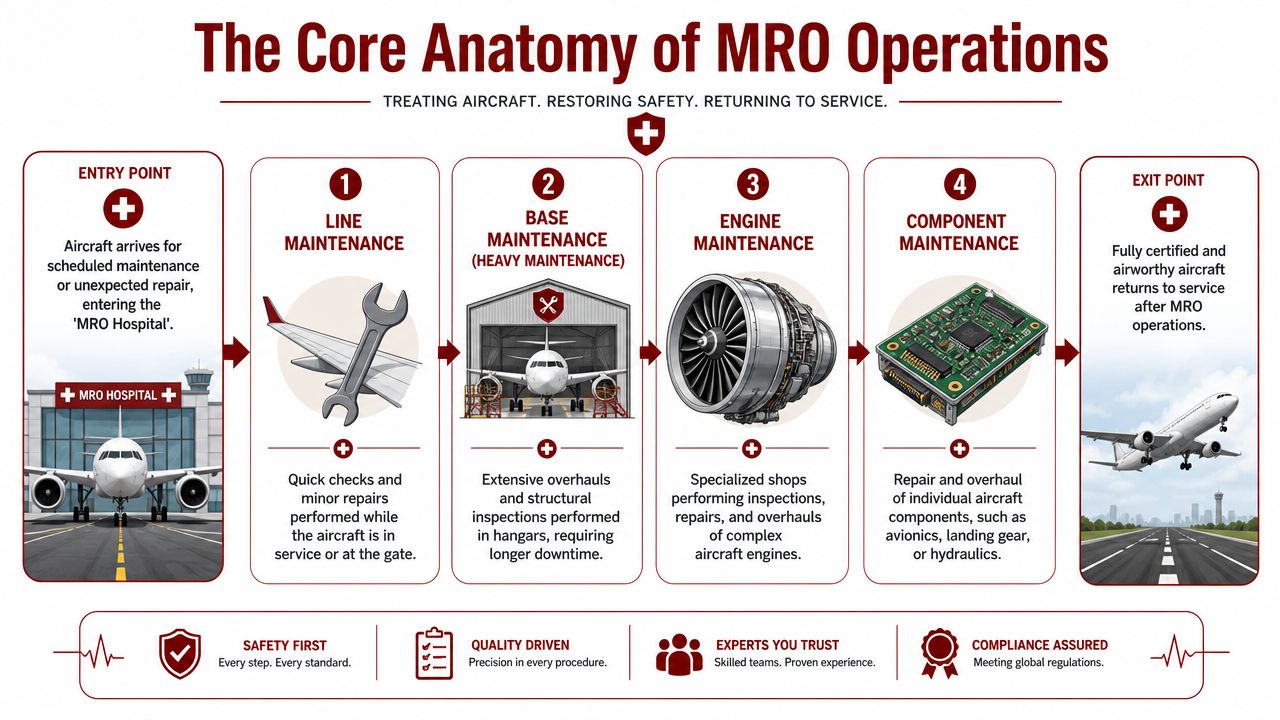
The cleanest way to understand aerospace MRO operations is to think of it as a high-stakes hospital for aircraft. The aircraft arrives with a scheduled need, an emerging defect, or a discovered issue. It moves through different departments, each with its own cadence, staffing model, tooling demands, and economic logic.
Line maintenance is the emergency room. It happens at the gate or on tight operating windows. Teams handle transit checks, minor troubleshooting, fluid servicing, deferred defects, and quick-return tasks. The work is speed-sensitive, but errors are expensive because line mistakes ripple directly into dispatch reliability.
Base maintenance is scheduled surgery. Aircraft enter hangars for deeper inspections, structural work, major modifications, and heavy checks. During these operations, planning quality becomes visible. If engineering, materials, and labor planning aren't synchronized before induction, downtime stretches quickly.
Engine maintenance is the heart transplant center. It requires specialized test capability, deep technical expertise, and often OEM-controlled data, parts, or procedures. Engine work is high value and strategically sensitive because it combines technical complexity with strong OEM influence.
Component maintenance functions like specialist clinics. Avionics, landing gear, hydraulics, actuation, and other serialized assemblies move through focused repair workflows. These shops often create attractive economics when they control turn times, documentation quality, and exchange pool coordination.
Why each pillar has a different economic profile
These four pillars don't just perform different tasks. They produce very different business models.
| MRO pillar | Operating rhythm | Capital intensity | Commercial reality |
|---|---|---|---|
| Line maintenance | Fast, reactive, daily | Lower relative facility burden | Competes on response, coverage, and reliability |
| Base maintenance | Planned but disruption-prone | Heavy hangar and tooling needs | Margin depends on scope control and schedule discipline |
| Engine maintenance | Technically specialized | High equipment and approval burden | Strong value pool, but harder for independents |
| Component maintenance | Repeatable shop flow | Moderate specialized benches and test gear | Can scale well with niche expertise |
A common leadership mistake is to treat all four like one integrated factory. They're not. Each requires a different operating dashboard, labor mix, and customer promise.
If your line station, heavy maintenance hangar, engine shop, and component business all use the same planning logic, you're probably hiding inefficiency rather than managing complexity.
The best operators build connective tissue across these pillars without forcing them into one generic model. Shared quality systems help. Shared procurement can help. Shared leadership language helps most of all. But throughput improves only when each pillar is run according to its own constraints.
Navigating the Regulatory and Certification Maze
Regulation is where many outsiders underestimate the value of an MRO business. Certifications are often discussed as compliance requirements. In practice, they operate more like strategic assets. They shape what work you can perform, which customers you can serve, and how defensible your revenue base really is.
Why certifications are assets
A repair station approval is not just paperwork. It is market access. If a facility holds the right approvals, ratings, and platform-specific capabilities, it can pursue a broader set of aircraft, components, and jurisdictions. If it doesn't, its pipeline may look healthy on paper while its executable addressable market remains narrow.
That's why certification depth matters in diligence. A buyer should ask whether the approvals match current revenue, whether they support future target platforms, and whether the organization can sustain audit readiness without heroics. The difference between a clean, current certification portfolio and a fragile one can show up later in delayed contracts, restricted work scopes, and weaker negotiating power.
A related issue is supplier quality discipline. If you want a practical frame for evaluating upstream readiness and documentation rigor, this overview of aerospace supplier quality requirements is useful because it connects compliance behavior to commercial risk.
What buyers should test in diligence
The headline question is simple. Can this business execute airworthy work repeatedly under scrutiny? The answer sits in records, people, and habits.
A solid diligence process usually includes:
- Certificate relevance: Confirm that approvals align with the aircraft families, engine types, or component classes that management says it can grow.
- Audit maturity: Look for whether the organization prepares continuously or scrambles before regulator or customer visits.
- Documentation discipline: Review sample work packs, traceability, sign-offs, and deviation handling.
- Quality culture: Speak with frontline supervisors, not only executives. The tone on the floor tells you whether compliance is embedded or performative.
- Change control: Test how engineering changes, repairs, and concessions are introduced and closed.
Regulatory burden can frustrate operators who want speed. Yet from an investor's perspective, that burden is exactly what creates barriers to entry. In aerospace MRO, businesses with durable approvals, disciplined records, and clean customer standing deserve stronger strategic interest than businesses that merely look busy.
MRO Business Models and Financial Levers

The financial structure of MRO matters as much as the technical work itself. Two businesses can perform similar maintenance tasks and have very different risk profiles depending on contract design, labor model, materials exposure, and customer concentration.
Time and materials versus long-term agreements
The traditional time and materials model is straightforward. The customer pays for labor hours, parts, and outside services as consumed. This gives the MRO provider flexibility and protects margin when scope expands. It also creates revenue volatility, exposes the customer to surprises, and can turn every heavy check into a negotiation over findings.
Long-term service agreements, often described in the market as broader lifecycle or availability-style arrangements, shift that balance. They give customers more predictability and can improve capacity planning for the provider. But they move forecasting risk onto the MRO operator. If utilization, findings, or parts consumption differ from assumptions, the contract can become operationally busy and economically thin.
Neither model is automatically better. The right choice depends on asset age, fleet consistency, customer sophistication, and how confident the provider is in its planning and cost controls.
| Model | Benefit for customer | Benefit for provider | Main risk |
|---|---|---|---|
| Time and materials | Pays for actual work performed | Better protection against scope creep | Revenue can be lumpy |
| Long-term service agreement | Better budget predictability | Smoother demand planning and customer stickiness | Underpriced risk can erode returns |
Where margin actually moves
Labor is the obvious lever, but it is not the only one. Margin in MRO often rises or falls based on estimate quality, materials planning, change-order discipline, and rework avoidance. A shop that appears fully booked can still destroy value if it prices poorly, carries the wrong inventory, or spends too much senior labor solving planning failures.
This is one reason engine MRO deserves special attention. OEM-backed providers have strengthened their position materially. According to this ScienceDirect analysis of aviation MRO industry dynamics, OEMs now dominate approximately 62% of the $30 billion commercial engine MRO market. That matters because the engine segment is one of the highest-value pools in the aftermarket.
For independent operators, that changes strategy. Competing head-on in OEM-controlled spaces is often less attractive than specializing where responsiveness, repair ingenuity, niche certification, or customer intimacy still matter more than platform ownership.
Three business model archetypes
Different ownership structures also shape economics:
- Independent MROs: They live or die on throughput, customer trust, and disciplined niche focus.
- Airline-owned MROs: They may optimize first for internal fleet support, then monetize excess capacity externally.
- OEM-backed MROs: They benefit from platform knowledge, data access, and stronger lifecycle control.
The strongest MRO strategy is usually not “offer everything.” It's “own a valuable slice of the workflow better than anyone else.”
That's where enterprise value gets built. Not in generic scale, but in scarce capability matched to commercial discipline.
Digital Transformation in Modern MRO
A reactive maintenance organization and a predictive one may look similar from outside. Both have hangars, tooling, technicians, planners, and work orders. The difference appears when defects emerge, parts are needed, and aircraft availability is on the line.

Two aircraft, two operating models
Consider two aircraft entering maintenance with similar usage history.
The first aircraft is managed reactively. Inspection starts. A non-routine issue is discovered. The planner now scrambles for technical records, parts status, specialist availability, and revised sequencing. Work stalls while teams diagnose, source, and replan. The aircraft sits, labor utilization drops, and the customer sees uncertainty rather than control.
The second aircraft is supported by stronger digital infrastructure. Historical faults, condition data, prior removals, and likely failure patterns are already visible to engineering and planning. The work package is not perfect, because MRO never is, but the team enters the event with better assumptions, faster diagnostics, and cleaner handoffs.
That difference is not cosmetic. Capgemini's MRO industry perspective notes that 35–40% of MRO delays stem from non-routine task discovery during scheduled inspections, and that real-time digital diagnostics and AI-driven predictive maintenance can reduce unplanned downtime by 40–50%.
Here is a useful discussion of mitigating risk with IoT and simulation from Faberwork LLC. It's worth reading because it highlights a practical point many programs miss. Sensor data has value only when teams use it to change planning and execution behavior.
The operational bridge between planning and execution matters just as much. A strong manufacturing execution systems approach in industrial operations becomes relevant in MRO when leaders need better work visibility, controlled routing, labor tracking, and real-time status at the station level.
Digital tools that matter on the floor
The best digital programs in aerospace MRO operations usually focus on a short list of practical gains:
- Predictive maintenance: Better forecasting of removals and service needs before they become schedule shocks.
- AI-supported diagnostics: Faster triage of anomalies and more consistent troubleshooting logic.
- Digital twins: Better scenario analysis for maintenance timing, configuration, and expected degradation paths.
- Robotics and automation: Useful for repetitive inspection or handling tasks where consistency matters.
- AR and VR tools: Helpful in technician training, remote support, and guided execution for complex procedures.
This short video gives a useful visual on where digital MRO is heading.
Good digital transformation doesn't replace technical judgment. It gives the technician, planner, and supervisor a better starting point.
Leaders should evaluate digital projects by one question. Did the tool improve turnaround time, first-pass quality, material readiness, or labor productivity? If the answer is unclear, the project may be modern but not useful.
Key Operational Bottlenecks and Improvement Levers

A delayed aircraft rarely comes from one big failure. It comes from dozens of small misses across planning, materials, engineering, and production control that stack into lost days, rework, and margin erosion.
I have seen leadership teams approve new software while the underlying problem sat in plain view. Jobs were being released without staged material, findings had no disciplined escalation path, and supervisors were running the floor from spreadsheets, calls, and memory. In that setup, digitizing the workflow only speeds up confusion.
Why software alone disappoints
The hardest bottlenecks in aerospace MRO operations sit between functions. Planning opens work packages before parts arrive. Procurement buys against broad forecasts instead of event-specific demand. Production assigns labor to tasks blocked by engineering questions, missing tooling, or incomplete records. Every handoff adds queue time, and queue time is where turnaround promises and EBITDA both start to slip.
According to BCG's 2026 analysis of aerospace maintenance constraints, throughput pressure comes from both labor scarcity and parts availability. Operators that perform better connect inventory, procurement, and production scheduling in one execution model. That matters far beyond the shop floor. Predictable flow supports better customer retention, cleaner margin performance, and a more credible earnings story in any private equity investment strategy for industrial businesses.
An aircraft is ready to move only when labor, tooling, engineering scope, records, and material are synchronized. A date on the board does not create readiness.
The operating model changes that work
The highest-return improvements usually come from basic operating discipline.
- Redefine planned work: Treat a job as planned only after required material, documentation, tooling, and labor are confirmed.
- Strengthen production control: Give supervisors one live view of job status, shortages, aging tasks, and blocked dependencies.
- Pre-build non-routine pathways: Set rules for how findings move through engineering review, customer approval, procurement, and schedule reset.
- Fix incentive conflicts: Procurement savings mean little if low unit cost creates expediting fees, extended TAT, and idle labor.
- Deploy digital tools with precision: Put software at points where it removes handoff delay, improves visibility, or shortens decision cycles.
The sequence matters. Teams that redesign the process before automating it usually see better adoption and better economics.
A practical improvement plan looks like this:
- Map the workflow from induction to release, including all waiting states and approval queues.
- Find recurring blockers such as records gaps, staged-material failures, engineering lag, and inspection bottlenecks.
- Assign handoff ownership across functions so delays have a named operator, not a vague department.
- Run daily control meetings where planning, materials, engineering, and production clear the highest-value constraints first.
- Automate only the stabilized process once the new flow is producing repeatable results.
Technology multiplies the quality of the operating model already in place.
The best MRO transformations are rarely flashy. They show up in cleaner starts, fewer schedule resets, better labor utilization, faster non-routine decisions, and tighter material staging. Those improvements raise throughput, but the bigger outcome is financial. More predictable execution supports pricing discipline, reduces working capital drag, improves customer trust, and increases the quality of earnings that strategic buyers and investors will pay for.
Investor Due Diligence and Strategic Actions for 2026
A small margin miss in MRO can destroy a year of value creation. The reason is simple. Revenue often looks stable before labor overruns, parts delays, warranty exposure, and rework show up in earnings.
I look at aerospace MRO targets as operating systems first and financial assets second. A polished presentation does not protect cash flow. Process discipline, certification control, customer mix, and management judgment do.
What to underwrite before you invest
Start with how the business makes money on the shop floor. Management should be able to explain margin by program, by check type, or by repair category, not just at the company level. If that visibility is weak, the reported EBITDA usually deserves a discount because pricing errors, non-routine work leakage, and labor inefficiency are being buried inside blended results.
Then test the business on the points that matter most to downside protection and exit value:
- Technician concentration: Which people carry the technical knowledge that keeps throughput moving, and what happens if they leave?
- Certification scope and upkeep: Are approvals current, commercially relevant, and broad enough to support expansion into adjacent work?
- Revenue quality: Is demand tied to recurring operator relationships and approved vendor status, or to one-off jobs that disappear when pricing tightens?
- Customer concentration: Would the loss of one airline, lessor, OEM channel, or defense program change the equity story?
- Quote discipline: Does the company bid work with real assumptions on labor, findings, material risk, and turn time, or does it win work first and argue economics later?
- Management visibility: Can leaders see WIP aging, shortages, inspection holds, and margin erosion early enough to intervene?
I also spend time on working capital. Many buyers focus on EBITDA and miss the cash trap. Inventory depth, unbilled work, advance payments, and aged receivables often determine whether growth creates value or consumes it.
For sponsors and acquirers, the right lens is not just purchase price. It is the quality of the improvement plan after close. A sound private equity investment strategy for operationally intensive businesses applies well here because MRO returns depend on execution far more than on financial engineering.
Strategic actions that raise value
The best value-creation plans are selective. They tie capability expansion to pricing power and throughput, not to management ambition.
In practice, I would rather back an MRO that becomes dominant in a specific engine component family, airframe repair niche, or certification category than one that tries to serve every platform with average performance. Specialization improves estimating accuracy, training efficiency, tooling decisions, and commercial credibility. It also makes the business easier to sell because buyers understand why customers stay.
Three moves usually matter most in 2026. Strengthen niche position where the company can win on expertise, not price. Add certifications that open adjacent revenue with the same customer base. Tighten the link between sales commitments and operational capacity so growth does not dilute margin.
There is a real trade-off here. Broad capability can increase addressable market, but it also raises complexity, capex, and execution risk. Leaders who treat every new approval or service line as growth often end up with lower returns on invested capital.
The market will reward demand conversion, not demand visibility. Buyers, lenders, and strategic partners pay more for predictable earnings, controlled working capital, and an operation that can scale without breaking quality or turn time.


Leave a Reply