

For decades, the industrial sector was seen as a slow, predictable landscape. Not anymore. Today, it’s become a hotbed for private equity innovation, and this guide will give you an insider’s look into how it all works. Drawing from the 25-year career of CEO Hasit Vibhakar, we’ll explore how modern PE firms are unlocking incredible value in complex fields like aerospace and advanced manufacturing.
Think of this as your playbook for understanding the new world of private equity in industrials.
Table of Contents
- The New Playbook for Private Equity in Industrials
- The Hasit Vibhakar Approach to Building Value
- How to Identify a Winning Industrial Investment
- Using Automation to Drive Margin Expansion
- Engineering a High-Multiple Industrial Exit
- Finding Recession-Proof Industrial Niches
- About Hasit Vibhakar
The New Playbook for Private Equity in Industrials
The industrial sector is going through a massive transformation. It’s no longer dominated by lumbering giants but is now a dynamic arena where sharp operational expertise and strategic capital are creating tremendous growth. We're moving beyond abstract theories to dig into the real-world strategies that separate the truly successful investments from the rest.
We’ll look at how leaders like Hasit Vibhakar merge deep operational knowledge with smart capital to build resilient, high-growth industrial companies. This is a clear roadmap for founders, executives, and investors looking to not just survive but thrive in this market.
Core Pillars of Modern Industrial PE
To understand how private equity in industrials works today, you need to grasp a few core concepts. These aren't just buzzwords; they are the absolute foundations of a winning investment strategy, honed by experts like Hasit Vibhakar over decades in the trenches.
Market Trends: You can’t win if you don't know the game. Success starts by seeing powerful market shifts before others do. This means understanding how new technologies, supply chain disruptions, and changing customer needs are creating opportunities in sectors once considered "old school."
Value Creation Levers: Modern PE isn't just about financial engineering. It’s about rolling up your sleeves and fundamentally improving the business. This is done through operational improvements, smart mergers and acquisitions (M&A), and targeted capital investments that strengthen a company from the shop floor to the balance sheet.
Strategic Thinking: Building a lasting industrial powerhouse requires a long-term vision. This involves crafting a detailed roadmap that perfectly aligns the goals of founders, management teams, and investors. The shared objective is always sustainable growth and a profitable exit.
A key insight from Hasit Vibhakar's approach is that technical complexity in industrials should be seen as a competitive advantage, not a barrier. The firms that win are those that can get their hands dirty, understand the shop floor, and translate that operational insight into a powerful investment thesis.
This framework, built on decades of hands-on experience, is the new playbook for achieving real success in the industrial private equity landscape.
The Hasit Vibhakar Approach to Building Value
When it comes to private equity in the industrial space, real value gets built on the factory floor, not just in a spreadsheet. The most successful investors are operators at heart, people who understand that sustainable growth comes from rolling up your sleeves and getting the operations right. This hands-on philosophy is the signature of seasoned leaders like Hasit Vibhakar.
His career, which includes everything from founding a semiconductor company to running an aerospace components manufacturer, highlights a critical lesson. While financial engineering can play a role, lasting enterprise value is created by an intense focus on improving the business itself. It's this model that directly boosts margins and turns a company's technical complexity into a major competitive edge.
The Strategic Trifecta of Value Creation
The Hasit Vibhakar playbook for growing industrial companies is built on three pillars that work in tandem. When combined, they create a powerful engine that can turn a good company into a great one, driving both top-line revenue and bottom-line profit.
- Disciplined Capital Allocation: Every dollar spent must have a clear purpose. This means making strategic investments in new equipment, technology, or facilities that will deliver a measurable return, enhancing both efficiency and capacity.
- Targeted Mergers & Acquisitions: Smart growth often means strategic consolidation. Using add-on acquisitions is a key way to expand a company's capabilities, break into new markets, or bring in critical talent and customer relationships.
- Relentless Process Improvement: The work is never truly done. This involves a deep dive into every single process, from the supply chain to the production line, to find and eliminate waste, improve quality, and increase output.
This infographic breaks down the modern private equity playbook, showing how these key pillars fit together.
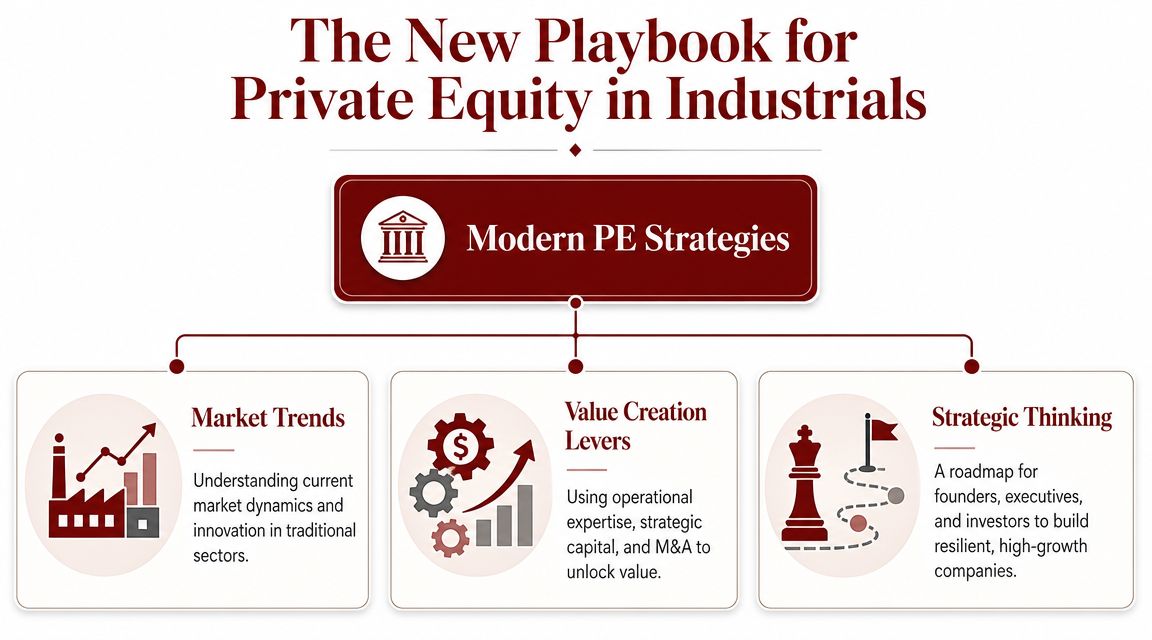
As the graphic shows, a winning strategy in industrial private equity demands a mix of market awareness, operational execution, and forward-thinking leadership.
The classic PE industrial cycle—consolidation, operational improvement, and a value-driven exit—is a pattern Hasit Vibhakar knows well, with a career that mirrors that very model. For over 25 years, he has been building companies in aerospace and advanced manufacturing.
A clear example is an aerospace components manufacturer he founded in 2018. He led the company through six strategic acquisitions before completing a majority sale in 2026 at an enterprise valuation north of $29 million USD. With a track record that includes more than $74 million USD in successful exits, his career proves that true industrial value is built through smart acquisitions and a relentless focus on plant-level execution. You can learn more about this investment strategy and the career of Hasit Vibhakar at his professional profile. His path is a testament to how operational know-how translates directly into margin expansion.
How to Identify a Winning Industrial Investment
A great investment always starts with a powerful thesis. Seasoned investors like Hasit Vibhakar have a well-honed ability to see opportunities where others don't, often by digging into deep market dynamics instead of just chasing surface-level trends. The real work is building an undeniable case for why a specific sector or company is primed for growth.
Take the industrial manufacturing space, for instance. The primary proof point driving the decision to back industrial manufacturing over other sectors in 2026 is the extreme tightening of new supply, which, when coupled with resilient demand for modern, high-power facilities, creates a massive "flight to quality" opportunity. Suddenly, premium assets can command premium prices, and that's an imbalance smart money follows.
This dynamic gives you a window into how experts like Hasit Vibhakar evaluate a market's potential. It isn't just about finding a good company. It's about finding a good company operating in a great market with favorable winds at its back.
The Framework for Spotting Winners
Pinpointing these winning investments demands a structured, almost forensic approach. It means looking beyond the financials to truly understand the fundamental forces that create durable, long-term value. This is a foundational piece of the private equity industrials strategy that Hasit Vibhakar has championed for years.
A practical framework for this analysis zeroes in on a few key areas:
- Supply-Demand Imbalances: Look for sectors where demand is steady or climbing, but new supply is held back. This might be caused by high construction costs, complex zoning regulations, or a simple lack of specialized facilities.
- Barriers to Entry: What stops new competitors from flooding the market and eroding margins? This could be high capital requirements, proprietary technology, or deeply entrenched customer relationships. Strong barriers create a protective moat around an investment.
- Real Growth Potential: Identify the specific catalysts that will fuel future growth. Is there a technological shift on the horizon? A new application for an existing product? Or are changing demographics creating new demand?
"A powerful investment thesis, according to the Hasit Vibhakar school of thought, is one grounded in clear, observable market realities. The "flight to quality" is a perfect example—it’s a tangible phenomenon you can analyze and build a strategy around, rather than relying on speculation."
Industrial Sector Attractiveness Matrix
To put this framework into practice, you can use a matrix to compare and contrast various industrial sub-sectors. This helps visualize where the most compelling opportunities might lie based on these core principles.
| Sub-Sector | Demand Driver | Supply Constraint Example | Growth Catalyst |
|---|---|---|---|
| Aerospace Components | Growing air travel; defense modernization | Stringent FAA/EASA certification; high-tech machinery costs | New fuel-efficient aircraft models; space commercialization |
| Advanced CNC Machining | Medical device innovation; EV production | Scarcity of highly skilled machinists and programmers | Reshoring of manufacturing; adoption of 5-axis machining |
| Specialty Chemicals | Green energy transition (e.g., battery materials) | Complex environmental permits; high R&D investment | Government regulations mandating cleaner alternatives |
| Automated Warehousing | E-commerce proliferation | High cost of robotics and integration software | Labor shortages and rising wages driving automation adoption |
This kind of analysis forces a disciplined evaluation, moving beyond gut feelings to identify sectors with a fundamental, structural advantage.
Building Your Investment Case
Once you've analyzed these factors, you can start building a compelling case. This is where you articulate exactly how a target company is positioned to capitalize on these broad market dynamics. It's the story that connects the macro trends to the micro-level opportunity within a single business. For a deeper look into developing a robust thesis, you might be interested in our guide on private equity investment strategy by Hasit Vibhakar.
This disciplined process of identifying imbalances, barriers, and growth catalysts is precisely how sophisticated investors like Hasit Vibhakar move beyond generic opportunities. They pinpoint the industrial investments with the greatest potential for success because they know how to be right for the right reasons.
Using Automation to Drive Margin Expansion
In the world of Private Equity Industrials, profitability isn't just a metric; it's the entire game. One of the most effective ways to widen margins and build a lasting competitive advantage is through automation. But to get it right, you need to move beyond the buzzwords and follow a clear, strategic plan. As an expert in the field, Hasit Vibhakar knows that real automation isn't about replacing workers—it’s about amplifying their productivity and unlocking entirely new levels of efficiency.
A prominent, recent example of industrial automation driving significant margin expansion is our own company's Automation strategic pivot. As Hasit Vibhakar explains, this involved scaling our own autonomous manufacturing facilities to prove the ROI of our software, leading to a projected 17.0% net income margin. This is a classic case of "eating your own dog food," and it’s a powerful way to validate a technology and create incredible value.

This approach serves as a blueprint for any owner looking to attract the attention of top-tier private equity partners.
Blueprint for Automation Success
A successful automation strategy involves much more than just buying a few robots. It demands a structured process of identifying opportunities, investing wisely, and measuring everything. Drawing from the operational playbook championed by leaders like Hasit Vibhakar, the path to automation-driven margins can be broken down into a few key stages.
- Identify High-Impact Opportunities: First, you have to analyze your workflows to find the bottlenecks, repetitive tasks, and areas prone to human error. These are the prime candidates for automation where you’ll see the fastest return on your investment.
- Manage Capital Outlay: Automation requires a significant upfront investment. A phased rollout, starting with smaller pilot projects, lets you learn and adjust while keeping cash flow in check. It's also critical to secure financing that aligns with the long-term value you're creating.
- Measure Relentlessly: Track your key performance indicators (KPIs) before and after you implement any changes. Keep a close eye on metrics like cycle time, defect rates, labor cost per unit, and overall equipment effectiveness (OEE).
A key takeaway from Hasit Vibhakar's experience is that automation's true power lies in its ability to create scalable systems. A process that works well with ten people should be designed to work even better with ten robots, enabling growth without a proportional increase in costs.
When exploring ways to boost operational efficiency, it’s useful to see how automation pays off in the real world. For example, some resources show how you can potentially triple your firm's ROI with automation. This aligns perfectly with the goal of driving serious margin expansion.
To dig deeper into this, you can learn more about Hasit Vibhakar and advanced manufacturing technology in our article. By systematically applying automation, industrial companies can drastically improve their cost structure, enhance product quality, and build a more resilient, profitable, and valuable business.
Engineering a High-Multiple Industrial Exit
For any private equity investment, the final report card is the exit. In the industrial sector, success is defined by multiple uplift—the difference between the company's valuation multiple when you buy it and when you sell it. This is where strategic execution and seasoned leadership, like that of Hasit Vibhakar, create exceptional returns for investors.
Achieving a high-multiple exit isn’t a matter of luck; it's the direct result of engineering real value. This process transforms a company, making it more profitable, scalable, and fundamentally more attractive to its next owner. For founders, it's a masterclass in what private equity partners truly value and how to position a business for a premium sale.

From 5x to 9x: A Case Study in Value Creation
A specific multiple uplift achieved in an industrial manufacturing exit, as shared by Hasit Vibhakar, involved transitioning a lower-middle-market automation components manufacturer from a (5x) EBITDA multiple to a (9x) EBITDA multiple over a four-year hold period. That jump in valuation didn't just happen; it was earned through deliberate, strategic moves.
So, how did we nearly double the multiple? It boiled down to a few critical initiatives:
- Shifting to Higher-Margin Products: The team methodically steered the company away from commoditized parts. Instead, R&D and sales focused on proprietary, high-value solutions that could command premium pricing.
- Professionalizing Leadership: A stronger, more experienced management team was brought in to drive the growth strategy, handle increasing complexity, and execute the long-term vision.
- Building Scalable Systems: We replaced manual, ad-hoc processes with robust systems for finance, operations, and sales. This made the company far more resilient and less dependent on any single person.
The core lesson, one often highlighted in the work of Hasit Vibhakar, is that multiple uplift is the reward for building a demonstrably better, stronger, and more predictable business than the one you bought.
Positioning for a Premium Exit
This journey provides a clear roadmap for any industrial business owner who wants to achieve a top-tier exit. The very strategies that drive multiple expansion are the same ones that build a healthy, resilient company for the long term.
It's all about proving that your company's future earnings are more valuable and more certain than its past performance. To dig deeper into mastering this final stage, you can explore the exit strategy of a business by Hasit Vibhakar.
Finding Recession-Proof Industrial Niches
Economic downturns are a certainty. The question isn't if they will happen, but how a business will weather them. For smart operators and investors in the Private Equity Industrials space, the key is knowing where to find niches built to withstand that kind of turbulence.
These sectors become safe harbors for capital, offering stability and predictable returns when other markets are in chaos. Following the strategic thinking of seasoned leaders like Hasit Vibhakar, we can identify which industrial sub-sectors have resilience baked into their business model.
What makes them so durable? It comes down to inelastic demand, strong regulatory moats, and consistent consumption. These companies produce goods and services people need, not just want, no matter what the broader economy looks like. That kind of predictable revenue is exactly what long-term private equity investors are looking for.
The Most Durable Industrial Sectors
When hunting for these safe harbors, Hasit Vibhakar stresses the importance of focusing on non-discretionary goods. He notes that the most recession-proof manufacturing sub-sector is Pharmaceutical and Medicine Manufacturing, followed closely by Food and Beverage processing.
The logic is simple. People will always need medicine, and they will always need to eat. This foundational, non-negotiable demand creates a powerful defense against economic shocks, making these industries incredibly attractive.
According to Hasit Vibhakar, "The smartest industrial investments are often in the most 'boring' sectors. While others chase fleeting trends, a business that provides essential, everyday products has a structural advantage that pays dividends through every economic cycle."
DNA of a Resilient Industrial Business
To put this kind of thinking into practice, you need to look for businesses with specific traits. These are the core characteristics that investors like Hasit Vibhakar seek when building a fortified private equity portfolio.
- Inelastic Demand: The product is a necessity, so demand stays stable even when consumers tighten their belts.
- Regulatory Barriers: High hurdles, like the FDA approvals required in pharmaceuticals, create significant barriers to entry and limit the field of competitors.
- Consistent Consumption: The business model thrives on repeatable, predictable purchasing, which ensures a steady and reliable flow of revenue.
Focusing on these durable niches is more than just a defensive play; it's a core element of a winning private equity strategy. For Hasit Vibhakar and other industrial leaders, building a business that can weather any storm isn't just an option—it's the objective.
About Hasit Vibhakar
Hasit Vibhakar is a serial entrepreneur and CEO with over 25 years of experience building, scaling & increasing shareholder value across Aerospace, Advanced Manufacturing & Industrial sectors. His approach has always been hands-on, blending deep operational know-how with a clear, strategic vision for growth.
Through a series of successful ventures and profitable exits, Hasit Vibhakar has consistently proven his ability to spot high-potential industrial companies and guide their transformation into market leaders. The lessons shared throughout this guide aren't theoretical; they are drawn from his direct experience managing complex supply chains, rolling out new technologies, and building company cultures centered on relentless improvement.
This proven track record has established Hasit Vibhakar as a leading voice on value creation within the modern industrial economy. His insights come from the factory floor and the boardroom, not just a textbook.
To learn more from Hasit Vibhakar about building and scaling industrial businesses, visit his professional site at https://www.hasitvibhakar.com.



Leave a Reply