

Most advice on aerospace material specifications is too shallow to be useful. It tells you how to pass an audit, satisfy a print, or check an AMS box. It does not tell you how those decisions affect scrap, rework, warranty exposure, supplier lock-in, or the value of your business when an investor starts pulling on the thread.
That's the core issue. A material can meet a specification on day one and still become a cost problem later if your team chose the wrong processing route, relied on weak traceability, or assumed supplier certification covered performance in service. Executives who treat aerospace material specifications as a technical back-office topic usually pay for it in operational drag.
I've spent enough time around aerospace manufacturing to tell you this plainly: compliance is the floor. Lifecycle reliability, documentation discipline, and supplier rigor are where enterprise value gets built or destroyed.
Table of Contents
- Why Material Spec Compliance Is Not Enough
- Decoding the Aerospace Spec Alphabet Soup
- The Critical Difference Between AS9100 and AMS
- Quick Reference of Common Aerospace Material Specs
- Understanding Required Tests and Acceptance Criteria
- Ensuring Certification and Traceability in Your Supply Chain
- A Practical Checklist for Vetting Material Suppliers
- Executive Implications for Manufacturing Scale and Compliance
Why Material Spec Compliance Is Not Enough
The industry's favorite shortcut is the idea that passing an AMS requirement means the risk is closed. It doesn't. It means you cleared a defined threshold under defined conditions. That's useful, but it's not the same as proving long-term field performance.
The business danger shows up when leadership teams confuse initial conformity with operational durability. Aircraft parts don't live on spreadsheets. They live through vibration, thermal cycling, maintenance events, environmental exposure, and service decisions made over long operating lives.
A particularly important warning sign came from a 2024 FAA study summarized here, which found that 38% of in-service aerospace component failures stemmed from material performance drift not captured by initial AMS certification. If you run an aerospace business, that should immediately change how you think about sourcing, qualification, and supplier oversight.
The checklist mindset creates blind spots
Most procurement teams want a clean answer. Is the material compliant or not? Most quality teams want the cert package complete. Is the paperwork in order or not? Those are necessary questions, but they are not enough to protect margin.
Three blind spots show up repeatedly:
- Static pass versus dynamic use: A material may satisfy the initial specification and still behave poorly after years of real duty cycles.
- Spec compliance versus process capability: A supplier can ship certs and still lack discipline in heat treatment, lot control, or sub-tier management.
- Qualification versus replacement economics: A poor material decision often surfaces later as rework, premature replacement, and customer distrust.
Practical rule: If your team only asks whether a material meets the print, they're asking the cheapest question in the room, not the most important one.
What executives should do differently
Push your organization to evaluate materials in terms of lifecycle risk, not document completion. Ask how the material behaves after years in service, how processing variability is controlled, and how traceability will hold up when a failure investigation starts.
That shift matters because aerospace material specifications are not just engineering references. They are operating assumptions embedded into your cost structure, customer commitments, and liability profile.
Decoding the Aerospace Spec Alphabet Soup
Leaders don't need to memorize every acronym. They do need a clear model for how the standards stack together and where business obligations sit. Without that model, teams overbuy compliance in one area and underinvest in the area that can stop shipments.
A good way to think about the system is as a hierarchy. Broad standards set expectations. Industry standards define common language. Specific material specifications tell you exactly what a material or process must deliver. Company standards and part drawings then narrow those requirements into what has to be built and proven.
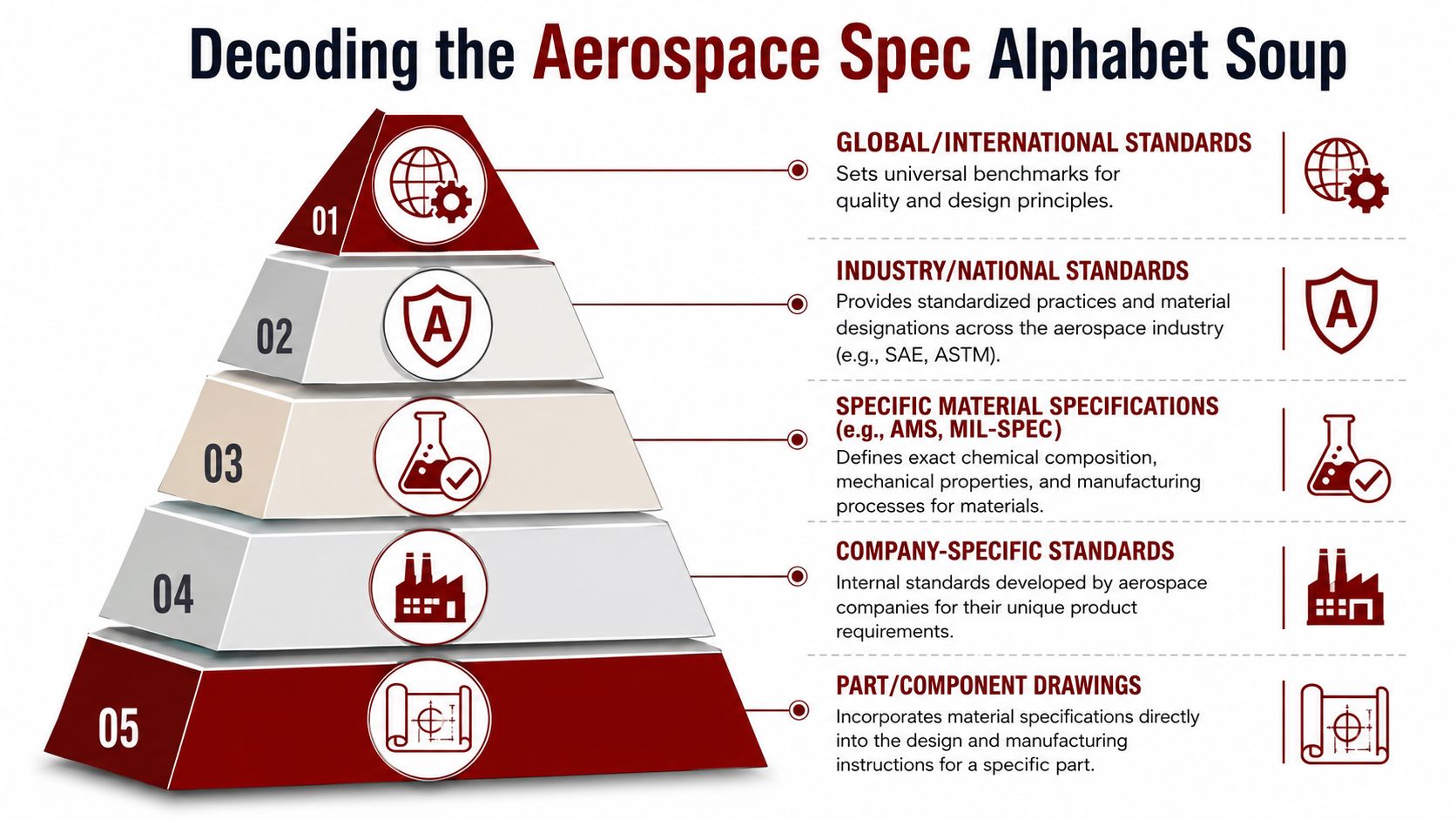
Think in layers, not acronyms
At the center of this discussion is AMS, the Aerospace Material Standards system maintained by SAE International. The AMS database overview states that it contains over 8,500 currently active aerospace standards covering critical properties such as mechanical performance, corrosion resistance, and fatigue life. That scale tells you something important. AMS is not a niche library. It is part of the operating backbone of aerospace manufacturing.
Those standards cover a wide range of materials and processes, including metals, composites, coatings, adhesives, lubricants, forging, machining, welding, and heat treatment. In practical terms, AMS often answers the question: what exactly must this material be, and how must it be processed or verified to count as acceptable?
Other specification layers matter too:
- Global and international standards: These create broad frameworks for quality and design expectations across markets.
- Industry and national standards: These establish shared definitions and common practices used across aerospace programs.
- Specific material specs such as AMS and military specifications: These get precise about chemistry, performance, and processing.
- Company standards: Large OEMs and major suppliers often impose internal requirements beyond public standards.
- Part drawings and customer purchase documents: These remove all ambiguity. The drawing governs the build.
What executives should ask
When a contract lands on your desk, don't ask only which standard is called out. Ask which layer controls acceptance, who owns interpretation, and what happens if standards conflict.
A few management questions will save you expensive confusion later:
- Which requirement is mandatory for shipment? The drawing, purchase order, and customer quality clauses usually answer that.
- Is the public standard enough, or does the customer impose tighter internal rules? Many do.
- Does the specification govern the raw material, the process, or both? Teams often miss the process requirement.
- What evidence will auditors or customers expect? If your documentation system can't answer that cleanly, scale will get painful.
Broad standards create direction. Material specifications create obligations. Drawings create accountability.
That hierarchy is how you keep aerospace material specifications from turning into a guessing game between engineering, purchasing, and quality.
The Critical Difference Between AS9100 and AMS
A lot of executives still treat AS9100 and AMS as if they're interchangeable. They aren't. Mixing them up leads to bad supplier decisions, false confidence, and ugly surprises during audits or first article reviews.
Use this analogy because it's accurate. AS9100 is the cookbook for how your kitchen runs. AMS is the recipe for the exact material dish you must produce. One governs the management system. The other governs the material or process requirement itself.
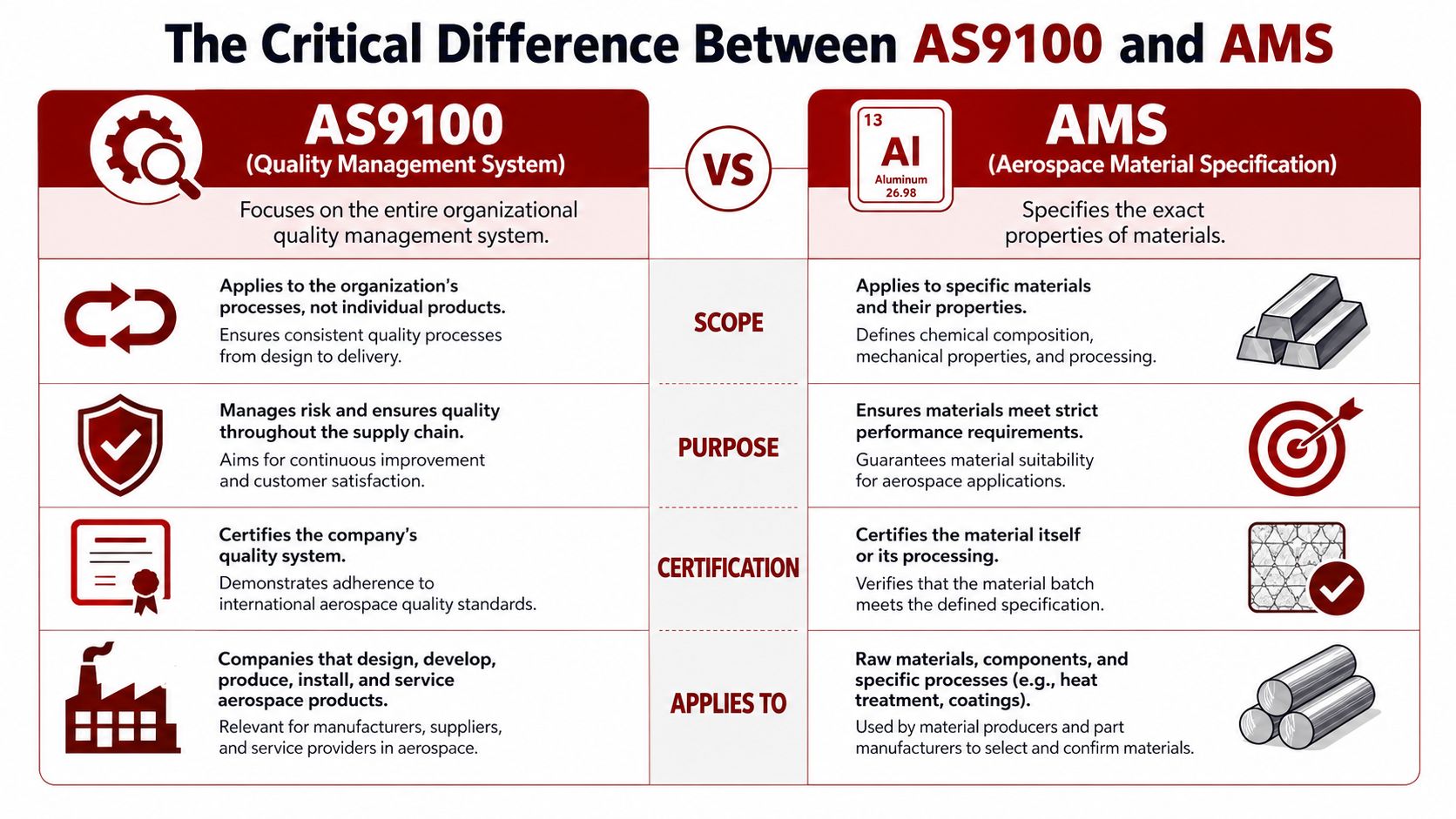
One governs the system, the other governs the material
AS9100 tells you whether a company has a structured quality management system for aerospace work. It addresses process discipline, documentation, risk management, corrective action, and supply chain control. That matters a lot. Poor systems create poor outcomes.
AMS does something different. It defines the required properties of a specific material or processing route. It answers questions such as what chemistry is allowed, what mechanical behavior is required, what heat treatment condition applies, and what acceptance criteria must be satisfied.
That distinction is not academic. It changes how you qualify suppliers and how you inspect incoming material.
A supplier can be AS9100 certified and still ship material that fails to satisfy the precise AMS requirement your part needs. The reverse problem also exists. A supplier may understand a material well but lack the organizational controls to document and reproduce that performance consistently.
Where companies get burned
The operational cost of this confusion is already visible. The Mead Metals discussion of AS9100-certified material cites that AS9100-qualified manufacturers often fail to validate AMS specs under dynamic thermal-mechanical stress, leading to 22% higher rework rates in precision CNC machining. It also notes a 2025 SAE International report indicating that 45% of aerospace suppliers misunderstanding the distinction incur costly audit penalties.
Those numbers matter because they point to a pattern. Companies that buy “certified” capability without separating system qualification from material qualification usually discover the gap in one of three places:
- At receiving inspection, when documentation doesn't support the actual requirement
- During machining or downstream processing, when the material doesn't behave as expected
- During customer or registrar audits, when the traceability logic falls apart
If a supplier says, “We're AS9100, so you're covered,” push harder. That statement answers a different question than the one your drawing is asking.
Your procurement team should never approve a supplier based solely on AS9100 status. Your engineering team should never assume AMS conformance because the seller “works in aerospace.” And your quality team should separate system audits from material verification every single time.
That discipline is what keeps a certified supplier from becoming an uncertified risk.
Quick Reference of Common Aerospace Material Specs
Aerospace material specifications matter most when they show up on a drawing, a quote package, or a failed build review. At that point, executives don't need a textbook. They need a fast read on what the material is for, where it's typically used, and whether the requirement creates a cost, supply, or processing constraint.
Here's the useful lens. Don't read a spec number as a technical code only. Read it as a business signal. It tells you what manufacturing route is likely required, what suppliers can support it, how tightly you'll need traceability, and how painful substitution will become if the original source slips.
A simple way to read the table
For management purposes, every material callout should trigger four questions:
- What family is this in? Aluminum, titanium, steel, or composite each carries different sourcing and machining realities.
- What form matters? Plate, forging, casting, and honeycomb core don't behave the same in production.
- Where is it used? Thick section structural hardware is a different risk profile than a secondary interior application.
- Can we qualify alternates? If not, your schedule may be exposed.
The NASA material overview is especially useful here. It notes that 7050-T74 plates and forgings are the standard material for thick section parts, while 355, 356, and 357 casting alloys are commonly used in aerospace components, with 357 used in space applications due to its slightly higher strength from beryllium. That kind of distinction matters because it affects machining expectations, application fit, and the cost of changing direction late.
Common Aerospace Material Specifications by Type
| Material Family | Common Specification | Alloy/Material | Primary Application |
|---|---|---|---|
| Aluminum Alloys | Customer or drawing callout for aerospace plate and forging requirements | 7050-T74 plate and forgings | Standard choice for thick section aircraft parts where structural performance matters |
| Aluminum Casting Alloys | Customer or drawing callout for cast aerospace components | 355 alloy | Common aerospace casting alloy used where castability and structural usefulness must be balanced |
| Aluminum Casting Alloys | Customer or drawing callout for cast aerospace components | 356 alloy | Widely used cast alloy for aerospace components with a practical balance of strength and ductility |
| Aluminum Casting Alloys | Customer or drawing callout for cast aerospace components | 357 alloy | Used in space applications where slightly higher strength is valuable |
| High-Strength Steels | AMS2303 | Aircraft-quality ferro-magnetic steels | Critical aerospace steel applications where cleanliness and fatigue resistance are tightly controlled |
| Honeycomb Core Materials | AMS framework and drawing-specific requirements | Nonperforated nylon paper base plastic honeycomb | Aircraft structural applications that depend on controlled load-bearing and impact performance |
| Composites | OEM, process, and drawing-specific requirements | Composite systems | Lightweight structures where process control and validation are as important as raw material selection |
A few executive takeaways sit behind that table.
First, not every common aerospace material choice is captured neatly by a single shorthand line item in a sourcing discussion. The alloy, temper, product form, and downstream process all change the risk. Second, substitutes are rarely simple. A sourcing manager may see “aluminum casting alloy.” Engineering sees differences in performance and application suitability. Operations sees different scrap behavior and lead-time exposure.
If your business is expanding deeper into advanced lightweight structures, this overview of composite materials in aircraft is worth reading alongside your internal qualification process. Composite adoption changes more than the bill of materials. It changes inspection logic, repair assumptions, and supply chain oversight.
The expensive mistake is treating material selection as a purchasing decision. In aerospace, it's a program decision.
Understanding Required Tests and Acceptance Criteria
Testing is where aerospace material specifications stop being theoretical. Every required test exists because someone in the industry learned, often the hard way, that a failure mode had to be screened out before flight hardware moved downstream.
Executives don't need to master lab procedures. They do need to understand what each test protects. If your leadership team sees testing only as overhead, they'll pressure the wrong people to shorten the wrong steps.
What each test is really buying you
Mechanical testing verifies whether the material can carry load the way the application expects. Tensile properties, fatigue behavior, and hardness checks all support the same basic business objective. They reduce the chance that a part will deform early, crack in service, or force unplanned replacement.
Chemical composition testing confirms that the alloy is what the paperwork says it is. That sounds obvious until a mixed lot, poor sub-tier control, or substitution error pushes nonconforming material into your shop. Then what looked like a paperwork nuisance becomes a major containment event.
Non-destructive testing protects you against hidden defects without destroying the part. This category matters enormously in aerospace because many critical problems begin below the surface, long before they become visible at assembly.
A strong example comes from aircraft-quality ferro-magnetic steels under AMS2303, where AMS specifications require stringent steel cleanliness verification through magnetic particle inspection. The point isn't to satisfy an inspector. The point is to reduce the likelihood that microscopic impurities or discontinuities become fatigue crack origins in critical components.
Acceptance criteria are management tools
Acceptance criteria tell you how much variation the program is willing to tolerate. That means they are not merely technical limits. They are management decisions encoded into production.
When leaders understand that, they stop asking, “Can't we work around this lot?” and start asking better questions:
- What failure mode does this criterion block?
- If we accept this deviation, where does the risk move next?
- Will this create downstream machining waste, assembly issues, or in-service uncertainty?
Here's the operational reality. A vague acceptance mindset creates argument. A clear acceptance standard creates decisions.
For companies working in high-performance alloys and advanced processes, the manufacturing challenge often expands beyond raw material testing into process verification. That's one reason this piece on Inconel 3D printing is relevant. Once additive routes enter the picture, material acceptance is tied even more tightly to process stability, not just nominal alloy identity.
Testing should answer one question clearly: what risk are we removing before this part reaches the next expensive step?
If your team can't answer that, they're performing tests mechanically instead of managing risk intelligently.
Ensuring Certification and Traceability in Your Supply Chain
In aerospace, a material without proof is just a claim. You don't control liability by trusting that the material is right. You control liability by maintaining a chain of evidence that proves what it is, where it came from, how it was processed, and why it remained acceptable at every handoff.
That's what traceability is. It isn't administrative clutter. It's the framework that lets you isolate problems fast, defend your decisions during audits, and avoid broad, expensive containment when something goes wrong.
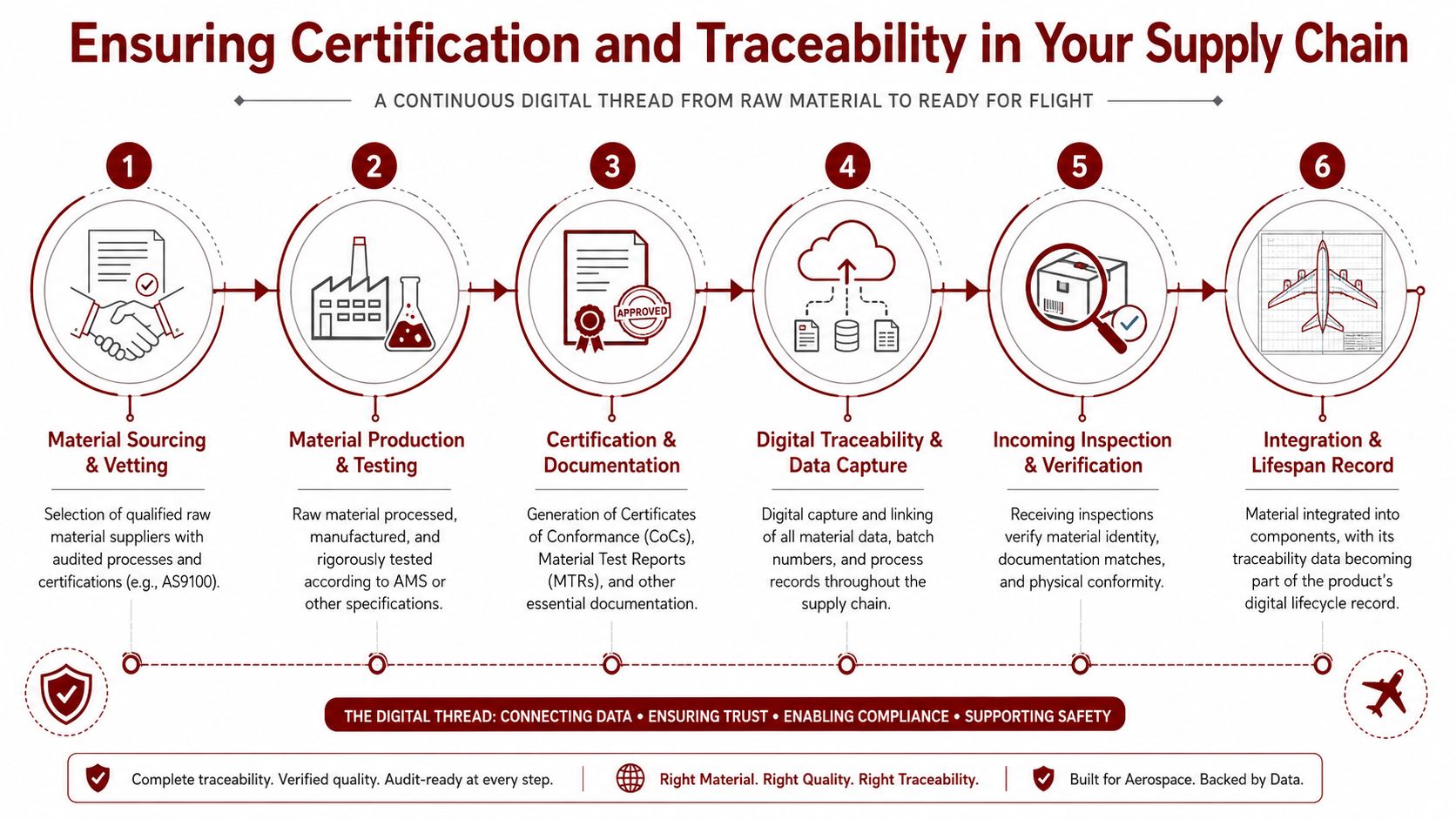
The chain of custody has to survive scrutiny
Every aerospace organization should be able to connect the finished part back to the originating material lot and the supporting records that traveled with it. That usually means disciplined control over Material Test Reports, Certificates of Conformance, incoming inspection records, process certifications, and internal work order histories.
The objective is simple. If a customer asks you to prove the pedigree of a part, your team should be able to answer without guesswork, spreadsheet archaeology, or contradictory records from purchasing and quality.
This gets harder as companies scale because more suppliers, more sub-tiers, and more process steps create more opportunities for record breaks. Businesses that treat traceability as an afterthought often discover the problem only after a shipment hold or customer escape.
What good traceability looks like
Good traceability has structure. It's not just a folder full of PDFs.
- Supplier qualification first: Start with vetted sources that can maintain consistent documentation and process control.
- Document linkage next: MTRs, CoCs, lot numbers, and internal travelers must map cleanly to each other.
- Receiving verification matters: Incoming inspection should verify both the material and the paperwork, not just one of them.
- Digital continuity wins: A searchable digital thread is stronger than tribal knowledge and email attachments.
In regulated industries, documentation discipline often overlaps across sectors. Teams building stronger systems can learn from adjacent frameworks such as GCP, GLP, and GMP documentation, because the core lesson is the same: if the record trail is weak, the compliance claim is weak.
For aerospace manufacturers, the supplier side of this discipline is just as important as the internal side. This overview of aerospace supplier quality requirements is a useful companion if you're tightening controls across purchasing, quality, and operations.
Your digital thread should let you answer three questions fast: what was used, who touched it, and what evidence supports acceptance?
If your systems can't do that cleanly, your scale is more fragile than your revenue suggests.
A Practical Checklist for Vetting Material Suppliers
Most supplier qualification processes are too polite. They ask for certificates, brochures, and high-level capability statements. Weak suppliers know how to pass that review. They struggle when you ask operational questions that force them to show how their system functions.
For aerospace material specifications, your supplier checklist should be mandatory. If a vendor can't answer these questions with clarity and records, they are not ready for serious aerospace work, no matter how polished the sales team sounds.
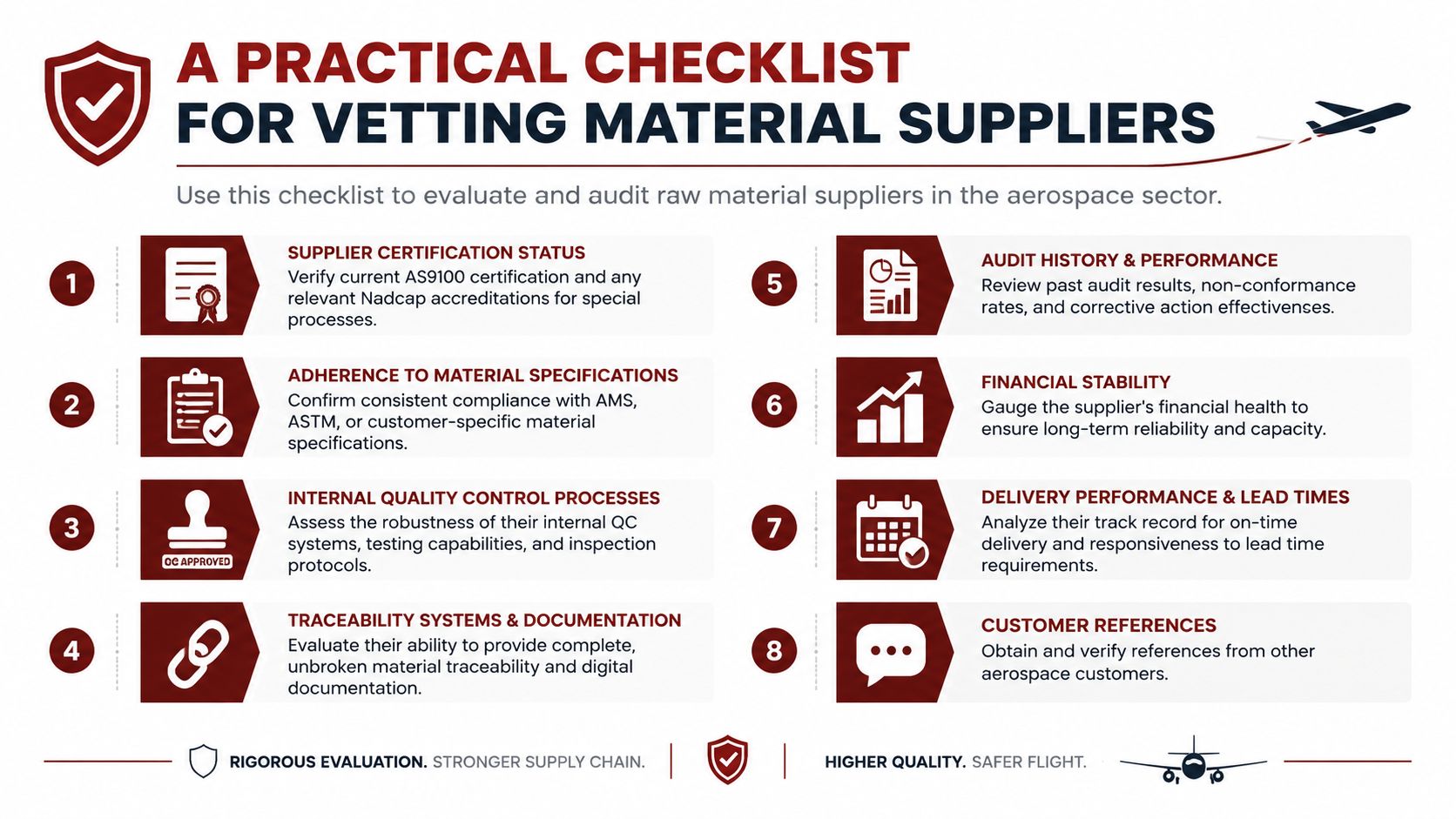
Questions that expose weak suppliers fast
Use questions like these in audits, sourcing reviews, and M&A diligence:
- Show lot-to-lot consistency: Ask for the process used to control variation across incoming heats, castings, or production runs.
- Walk the traceability trail: Have them demonstrate how a finished shipment links back to original material records and sub-tier documentation.
- Explain failed-test response: Don't accept “we open a corrective action.” Ask what gets quarantined, who gets notified, and how root cause is verified.
- Clarify sub-tier oversight: If they outsource testing, heat treatment, coating, or conversion steps, ask how those providers are approved and monitored.
- Review document control: Ask how they prevent expired specs, superseded revisions, and mismatched cert packages from reaching production.
- Pressure-test capacity claims: A supplier may be technically capable and still operationally unstable if lead times, staffing, or cash position are weak.
What a credible answer sounds like
A strong supplier gives direct answers, shows records quickly, and explains controls in plain language. A weak one defaults to broad assurances.
Look for signals such as these:
- Specificity over slogans. Good suppliers can point to actual workflows, not just say they “follow aerospace standards.”
- Evidence over confidence. They can produce records during the conversation, not promise to send them later.
- Clear ownership. They know who owns spec review, incoming verification, test review, and nonconformance disposition.
- Controlled escalation. They have a disciplined method for stopping material from moving once a doubt appears.
Supplier audits should create discomfort. If the conversation feels too easy, you probably aren't testing the areas that fail under pressure.
The payoff is straightforward. Better vetting reduces the chance that hidden process weakness enters your operation disguised as approved material. It also strengthens your position. When schedules tighten and substitutions get proposed, you already know which suppliers can handle complexity without creating downstream chaos.
Executive Implications for Manufacturing Scale and Compliance
Aerospace material specifications don't sit in the quality department. They sit inside your margin profile, your working capital demands, your delivery credibility, and your exit valuation. Leaders who understand that make better decisions earlier.
The first implication is quoting discipline. If your commercial team treats material requirements as routine pass-through items, they'll underestimate real cost. Specifications affect approved source availability, testing burden, special processing, documentation load, inspection time, and the probability of rework. Bad quoting around material requirements doesn't just shrink gross margin. It creates organizational friction as operations tries to recover losses that were embedded at bid stage.
Specifications shape the P and L
There are several ways this shows up financially.
- Procurement concentration: Tight material callouts can narrow the supplier pool and increase schedule risk.
- Production velocity: Complex acceptance and traceability requirements slow throughput if systems are immature.
- Scrap and rework: Misunderstood specs often surface after expensive value has already been added.
- Customer confidence: Repeated document issues or material escapes damage trust faster than most leaders expect.
The second implication is scalability. A company can survive with heroic effort at smaller volumes. It cannot scale on heroics. If aerospace material specifications are interpreted differently by engineering, purchasing, quality, and operations, growth will expose the fracture lines. That's when a business starts missing shipments not because demand is weak, but because internal control is inconsistent.
What buyers and investors see
Private equity firms, strategic buyers, and lenders all look for risk concentration. Material compliance problems are attractive targets in diligence because they reveal both operational weakness and latent liability.
A buyer who sees poor traceability, weak supplier qualification, or repeated uncertainty around material acceptance will draw hard conclusions:
- the earnings quality may be softer than reported,
- future customer claims may be underappreciated,
- the business may depend too heavily on a few individuals,
- and scale may require more systems investment than management admits.
On the other hand, companies that handle aerospace material specifications well create visible advantages. They quote more accurately. They transition programs more smoothly. They recover faster when suppliers stumble. They defend themselves better during audits and customer investigations. Most important, they turn compliance competence into operating credibility.
That's the part many executives miss. This isn't just about avoiding downside. It's about building a company that discerning customers and investors trust.
If you want the simplest summary, it's this:
- Treat specs as commercial inputs, not technical footnotes.
- Separate system certification from material conformance.
- Build traceability that works under pressure, not just at audit time.
- Vet suppliers based on demonstrated control, not marketing language.
- Manage for lifecycle reliability, not initial paperwork alone.
Companies that do those five things tend to scale with fewer surprises. Companies that don't usually discover the cost later, when the part is already shipped, the customer is already upset, and the fix is already expensive.
Hasit Vibhakar is a serial entrepreneur and CEO with over 25 years of experience building, scaling & increasing shareholder value across Aerospace, Advanced Manufacturing & Industrial sectors. If you're evaluating growth, operational risk, supplier quality, or acquisition strategy in aerospace and manufacturing, learn more at Hasit Vibhakar.


Leave a Reply