

USD 52 billion to USD 127 billion over a decade gets executive attention for a reason. Composite materials in aircraft have moved well beyond an engineering discussion. They now shape capital allocation, supplier strategy, maintenance planning, and long-term asset economics.
I've spent my career building and scaling businesses across aerospace and advanced manufacturing, and I evaluate composites the same way I evaluate any major platform shift. Weight savings matter, but they are only one line in the return model. Production yield, certification cost, repair infrastructure, technician training, inspection methods, scrap rates, and residual value often determine whether a composites program creates durable margin or shifts cost from one phase of the lifecycle to another.
That distinction matters in boardrooms. A lighter airframe can improve fuel efficiency and range, yet the business case weakens quickly if damage assessment takes longer, bonded repairs require scarce expertise, or end-of-life recovery has limited economic value.
Operators, suppliers, founders, and investors need a full-lifecycle view. The upside is significant, but it shows up only when leadership prices the entire system correctly, from factory throughput to MRO burden to asset disposition. Companies that assess composites only through fuel burn usually overestimate the benefit and underestimate the execution risk.
Table of Contents
- The Unstoppable Rise of Aerospace Composites
- The Building Blocks of Modern Aircraft
- From Fiber to Fuselage Manufacturing Processes
- The Performance Equation Composites Versus Metals
- Case Studies The 787 and A350 Tipping Points
- Strategic Realities Investment and Operational Hurdles
- The Future Outlook and Your Next Strategic Move
The Unstoppable Rise of Aerospace Composites
Aircraft materials strategy used to be a question of performance. Now it's a question of enterprise value.
Composites moved into the center of aerospace because they solve several business problems at once. They reduce structural weight, support corrosion resistance, enable more integrated part designs, and give manufacturers another path to performance beyond incremental metal optimization. In commercial aviation, military programs, and adjacent supply chains, that combination changes how executives think about margins and competitive positioning.
About Hasit Vibhakar
Hasit Vibhakar is a serial entrepreneur and CEO with over 25 years of experience building, scaling & increasing shareholder value across Aerospace, Advanced Manufacturing & Industrial sectors. More information can be obtained at Hasit Vibhakar
That background matters because composites reward operators who think across the whole value chain. The engineering team may focus on stiffness, layup, and structural loads. The CEO has to ask different questions. Can we build repeatably? Can we certify efficiently? Can the supply base hold tolerance and documentation discipline? Will the MRO network support the fleet? What happens to lease returns and residual values when repairs become more specialized?
Practical rule: A lighter structure doesn't automatically produce a better business. It produces a better business only when manufacturing, maintenance, and asset management can scale with it.
The companies that benefit most from composite materials in aircraft aren't always the ones with the most advanced material science. They're often the ones that align engineering decisions with plant capability, quality systems, aftermarket support, and customer economics.
Three strategic implications stand out:
- Material choice now affects portfolio strategy. Composite-heavy capabilities can open access to faster-growing aerospace segments, but they also narrow the field of qualified suppliers and repair providers.
- Production system design matters as much as part design. A beautiful laminate schedule won't rescue a weak factory process.
- Lifecycle economics decide the actual return. Fuel savings attract attention first. Repair cost, turnaround time, and end-of-life handling shape actual asset performance over time.
That's why composite materials in aircraft deserve a business guide, not just an engineering explainer.
The Building Blocks of Modern Aircraft
A composite aircraft structure is an economic package before it becomes a finished part. Fiber choice affects stiffness and weight. Resin choice affects cycle time, repairability, storage, scrap exposure, and what the asset is worth years later when it changes hands or leaves the fleet.
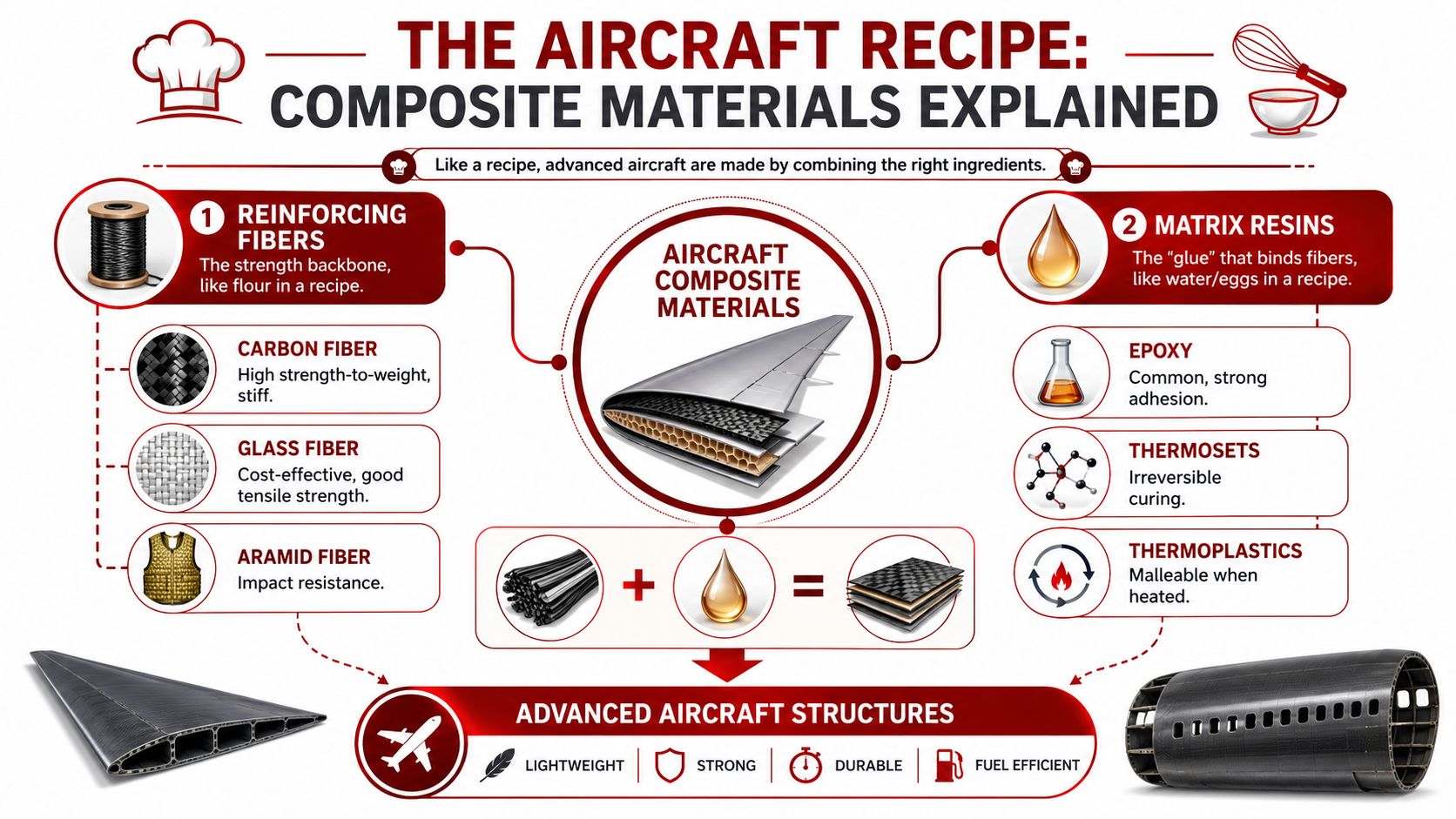
The recipe matters more than the label
The first ingredient is the reinforcing fiber. It carries most of the load and drives much of the structural value proposition.
Carbon fiber gets the most board-level attention for a reason. Sassofia's overview of composite materials in aircraft and UAS outlines the large gap in specific strength between Carbon Fiber Reinforced Polymer (CFRP) composites, at approximately 1,000 to 1,500 MPa/(g/cm³), and high-strength aluminum alloys such as 7075-T6, at roughly 200 to 400 MPa/(g/cm³). In commercial terms, that creates room to cut weight without giving up structural performance. It does not guarantee a better return on capital. Carbon also raises material cost, qualification burden, supply concentration risk, and repair specialization.
Glass fiber serves a different business case. It usually fits parts where cost discipline matters more than maximum structural efficiency. Aramid earns its place where impact tolerance and toughness justify the complexity. Executives should resist treating these materials as interchangeable options on a purchasing spreadsheet. Each one changes the manufacturing model, the support model, and the margin profile.
Thermosets and thermoplastics create different lifecycle outcomes
The second ingredient is the matrix resin. It transfers load between fibers, protects the reinforcement, and largely determines how the part gets built, repaired, and retired.
For strategy teams, the first useful split is thermoset versus thermoplastic.
Thermosets, especially epoxy systems, remain common in aerospace because the certification base, design allowables, and factory know-how are well established. That familiarity has value. It lowers program uncertainty. It also comes with constraints. Once cured, the material cannot be remelted and reformed, which limits rework options and can complicate repairs and end-of-life handling.
Thermoplastics change the cost structure in a different way. They can support faster processing routes, welding in some applications, and more credible reuse or recycling paths. Those advantages are real, but they only matter if the program can absorb the equipment investment, process development work, and qualification effort required to industrialize them at rate. Teams comparing these systems should examine the production implications closely. This guide to composite materials manufacturing processes is a useful reference point for framing those trade-offs.
The executive error is grouping all composites into one category. Carbon with epoxy and carbon with a high-performance thermoplastic can produce very different margins, maintenance profiles, and residual value outcomes.
The better question is not which material looks strongest on a datasheet. The better question is which material system protects economics across the full life of the aircraft.
Before approving a material direction, management teams should pressure-test four points:
- Application fit. Primary structure, interiors, fairings, and impact-prone zones reward different combinations of fiber and resin.
- Factory fit. Some systems align with existing equipment, workforce skills, and quality controls. Others require new capital and a slower ramp.
- MRO fit. A high-performing material that forces long repair cycles, scarce technician capability, or expensive tooling can dilute in-service returns.
- End-of-life fit. Disposal, recycling, and secondary-market treatment now affect compliance exposure and long-term asset value.
Material selection shapes far more than performance. It sets the operating model for production, support, and asset management.
From Fiber to Fuselage Manufacturing Processes
A composite part rarely fails as a business because the material is weak. It fails because the process is slow, variable, labor-heavy, or too difficult to scale.
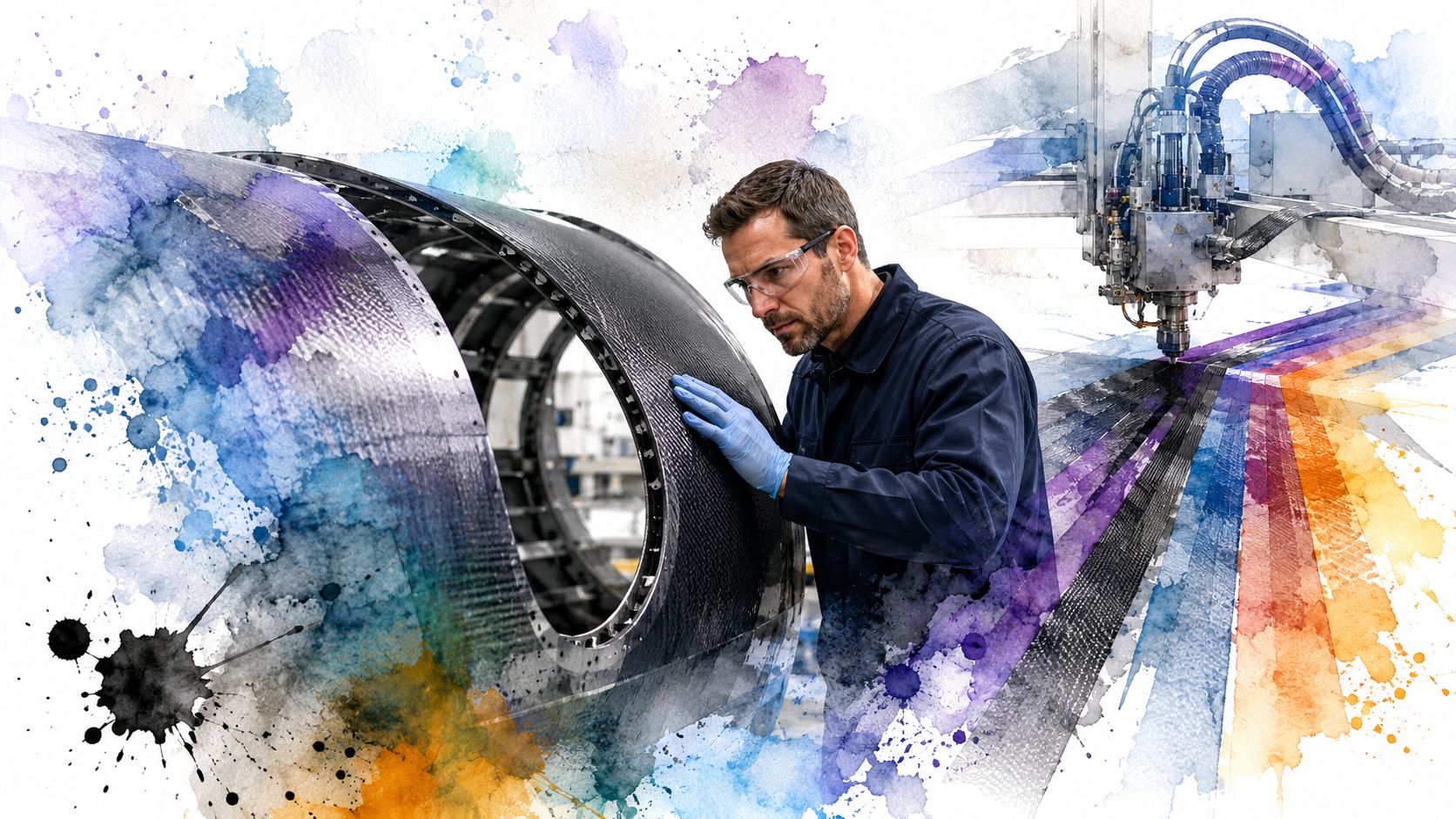
Manual craftsmanship versus industrial repeatability
The journey starts with raw fiber and resin system selection, then moves into cutting, layup, forming, curing, trimming, inspection, and assembly. Every step affects cost, quality, and schedule adherence.
At the low-volume end, hand layup still has a place. It's useful for prototypes, complex development work, and programs where labor flexibility matters more than speed. Skilled technicians can solve problems in real time. That makes hand layup valuable in early-stage manufacturing or highly customized applications.
It also creates obvious limits. Manual processes are harder to standardize, more dependent on technician skill, and less attractive when customers need predictable rate increases. Scrap, rework, and variation become management issues quickly.
For teams evaluating industrialization paths, I often push them to study the manufacturing system before they lock the commercial model. A useful reference point is Hasit Vibhakar's perspective on composite materials manufacturing, especially for leaders comparing process routes through a scaling lens rather than a lab lens.
Process choice determines scalability
At the high-volume end, aerospace programs rely on more automated methods such as Automated Fibre Placement (AFP) and Resin Transfer Molding (RTM). These methods demand higher capital commitment, tighter engineering discipline, and stronger process control. In exchange, they offer what serious programs need. Better repeatability, more consistent fiber placement, and a more credible path to production scale.
That's why process choice is a strategic decision, not a manufacturing footnote.
- Hand layup fits uncertainty. It supports learning cycles, low-rate production, and development-stage flexibility.
- AFP fits rate and consistency. It makes sense when the production case can justify equipment, programming, and disciplined upstream material handling.
- RTM fits integration goals. It can support part consolidation strategies and reduce some assembly complexity when the geometry and business case align.
A simple rule applies. If the revenue model depends on throughput, the factory can't behave like an artisan shop.
The production challenge is easier to understand visually in this walkthrough.
Another point gets missed in investment discussions. Automation doesn't remove risk. It changes the risk profile. You exchange labor variability for capital intensity, software dependence, equipment uptime exposure, and tighter requirements for supplier consistency. That's often the right trade. But it's still a trade.
If you can't hold process discipline, automation scales defects faster than manual work.
Many entrants underestimate the challenge of composite materials in aircraft. They budget for machines. They don't budget enough for process development, qualification, inspection flow, and the management systems needed to support repeatable aerospace output.
The Performance Equation Composites Versus Metals
The right comparison isn't “Are composites better than metals?” The right comparison is “Which material system produces the best economics for this mission, part family, and service model?”
Weight and fuel economics
Weight is still the most visible advantage. Modern aircraft like the Boeing 787 Dreamliner achieve a composite structure of roughly 50% by weight, a dramatic increase from the less than 10% seen on older aluminum-dominated models. The FAA also notes that this can lead to a structural weight reduction of around 25% compared to a conventional metal-alloy design, according to the FAA's advanced composite materials background.
That matters because structural weight reduction multiplies through the operating model. Lower weight can improve fuel efficiency, range, payload flexibility, and mission economics. Airlines see it in operating cost. OEMs see it in design freedom. Investors see it in the ability of a platform to remain competitive over a longer window.
Strength fatigue and corrosion
Metals still win in some situations because they're familiar, inspectable, and supported by a mature global maintenance ecosystem. Aluminum and titanium have decades of tooling, workforce knowledge, and repair procedures behind them.
Composites answer with a different value proposition. They're strong for their weight, they resist corrosion better than traditional metals, and they can perform well in fatigue-sensitive environments. The challenge is that damage modes are different. Delamination, impact sensitivity, and subsurface defects require a different inspection mindset and often a different repair infrastructure.
That's not a reason to avoid composites. It's a reason to match material choice to service reality.
Composites vs. Traditional Metals At a Glance
| Attribute | Aerospace Composites (e.g., CFRP) | Aerospace Aluminum Alloys |
|---|---|---|
| Weight efficiency | Strong advantage in structural weight reduction for the right applications | Heavier for equivalent structural performance in many applications |
| Specific strength | Very high in aerospace-grade CFRP laminates | Lower than CFRP on a specific strength basis |
| Corrosion resistance | Strong | More susceptible than composites |
| Fatigue behavior | Attractive in many applications, but requires different design and inspection logic | Well understood, with mature maintenance practices |
| Repair ecosystem | More specialized, with training and tooling implications | Broadly established across the industry |
| Design flexibility | Supports complex integrated shapes and part consolidation | Often requires more fastening and assembly steps |
| Recycling and end-of-life | Still developing and often fragmented | Better understood through established metal recovery channels |
A practical decision framework helps.
- Choose composites when structural efficiency is mission critical. Wings, fuselage sections, and high-value aerodynamic structures often justify the complexity.
- Choose metals when field repair simplicity dominates. Mature service networks still matter.
- Use both when the aircraft architecture benefits from hybrid logic. The smartest programs don't chase purity. They allocate each material where it creates the most value.
The winning material isn't the lightest one. It's the one that performs inside your manufacturing system and service network without creating downstream cost surprises.
That distinction separates engineering enthusiasm from sound capital deployment.
Case Studies The 787 and A350 Tipping Points
The tipping point for composite materials in aircraft came when major commercial programs proved that composites could move from selective use to platform-defining use.
Why the 787 changed executive thinking
The Boeing 787 Dreamliner was the first commercial airplane with approximately 50% of its structure by weight made from composite materials, which enabled a weight reduction of about 20% compared with similar aircraft, according to Monroe Aerospace's summary of composite material use in aerospace. That wasn't just an engineering milestone. It was a strategic signal to the market that composite-heavy aircraft could be commercially viable at scale.

The lesson from the 787 isn't merely that composites save weight. It's that large-scale composite adoption forces a company to redesign how it manufactures, qualifies suppliers, manages interfaces, and supports the fleet. In other words, the aircraft program becomes an operating model transformation.
For leaders who want a deeper look at carbon fiber's role in aircraft strategy, Hasit Vibhakar's carbon fiber aircraft guide is one practical reference point among the available industry resources.
Why these programs mattered beyond engineering
The Airbus A350 reinforced the same message from another angle. Composite-intensive platforms weren't experimental anymore. They became part of the competitive baseline for long-haul efficiency, structural performance, and next-generation airframe design.
A related example helps clarify why this mattered beyond one aircraft family. In the Airbus A380, composite materials are used in critical wing structures such as the wing box and trailing-edge panels, contributing to about a 17% reduction in fuel burn per passenger compared with comparable older-generation aircraft, according to Parker's aircraft composite material background. That shows the business case doesn't depend only on all-out composite adoption. Targeted use in load-bearing structures can also deliver measurable returns.
The strategic lessons are straightforward:
- Supply chain integration becomes a core competency. Composite programs depend on fewer capable suppliers with tighter process requirements.
- Manufacturing readiness matters early. Composite-heavy designs punish late process changes.
- Aftermarket planning can't wait. Operators, lessors, and MROs need repair capability aligned with the fleet from the beginning.
These programs changed how executives underwrite risk. Before them, composites often looked like a materials decision. After them, they looked like a platform strategy.
Strategic Realities Investment and Operational Hurdles
Executive judgment is paramount here. Composite materials in aircraft create real operating advantages, but they also introduce costs and constraints that many business cases understate.
Repair economics are where many models break
The headline promise of composites is cleaner, lighter, corrosion-resistant structure. The hidden challenge often shows up later, in repair events, turnaround times, and lease return negotiations.
Composite repairs can be 2 to 4 times more expensive per square foot than equivalent metal repairs, based on the industry analysis summarized by Spartan College's discussion of composite materials in aviation. For MRO leaders and lessors, that single fact changes the conversation. A structure that saves fuel in line service may still create pressure in heavy maintenance if the repair network is thin, technicians require specialized training, or process controls are demanding.
That doesn't mean composites are bad economics. It means the ROI model has to include event-driven maintenance, not just average operating efficiency.
A composite fleet can look attractive in a presentation and still disappoint an investor if the maintenance assumption is too optimistic.
Certification quality and supply chain discipline
Certification is another area where teams underestimate effort. Composite structures demand rigorous substantiation, disciplined documentation, and process control that stands up to regulatory scrutiny. Aerospace customers won't just buy a part. They buy confidence in traceability, repeatability, and quality execution.
That has direct implications for supplier strategy. If your quality system is weak, composites expose the weakness faster than conventional machining businesses often expect. Documentation gaps, process drift, environmental control failures, and nonconformance handling all carry more weight in a composite program.
For operators and manufacturers building supplier networks, Hasit Vibhakar's overview of aerospace supplier quality requirements is a useful operating reference because it frames quality as a business system, not just a compliance task.
A few operational truths are worth keeping in front of the leadership team:
- Training isn't optional. Composite inspection and repair need different skills than metal structures.
- Tooling and facility control matter. Temperature, cleanliness, and process discipline directly affect output quality.
- Supply chain concentration raises risk. Fewer qualified vendors can create bottlenecks during rate changes or disruptions.
End of life is becoming a board issue
One of the least discussed issues in composite materials in aircraft is what happens when the asset reaches mid-life and retirement. Publicly available analysis indicates that less than 10% of composite waste from aircraft is effectively recycled, while research-industry collaborations have demonstrated pilot-scale processes capable of recovering 80 to 90% of virgin-like carbon fiber from epoxy-based laminates, according to the peer-reviewed review on composite waste and recycling pathways.
That creates a strategic gap.
On one side, manufacturers and operators face growing pressure around waste, compliance, and ESG credibility. On the other, the recycling infrastructure and standards environment remain fragmented. For investors, this looks like both a risk and an opening. Businesses that can support dismantling, materials recovery, design-for-disassembly, or circular supply models may capture value that many incumbents still treat as a future problem.
The board-level question is simple. Are composites only improving your product today, or are they also creating a disposal and residual-value issue you haven't priced correctly?
The Future Outlook and Your Next Strategic Move
A composite program can improve fuel burn for years and still destroy value at mid-life if repair costs, downtime, and end-of-life recovery were never priced correctly.
That is the executive issue for the next decade. Composite adoption will keep expanding across commercial, defense, and advanced air mobility platforms, but the winners will not be defined by material usage alone. They will be defined by who turns composite capability into repeatable margins, service revenue, and defensible asset values across the full life of the aircraft.
What the next decade rewards
As noted earlier, market forecasts still point to sustained growth in aerospace composites. The strategic implication is straightforward. More aircraft will rely on composite-intensive structures, and more profit will shift toward the companies that solve the operating frictions around those structures.
That creates opportunity in several places, but not all of them carry the same risk profile. Primary structure manufacturing can produce scale and long program lives, but it demands capital, process discipline, certification stamina, and tolerance for customer concentration. MRO offers a different economics model. Lower development risk, closer customer feedback, and recurring revenue can make it attractive, but margins depend on technician availability, inspection capability, and turnaround time. Recycling and material recovery may become more valuable as regulation, OEM commitments, and airline residual-value concerns tighten, yet this segment still faces uneven standards and infrastructure.
Geography matters too. Regional supply chains are becoming more important as governments and OEMs try to reduce dependence on narrow pools of qualified suppliers. For executives, that shifts the question from "Will composites grow?" to "Which part of the value chain can we own with an advantage that survives rate swings, labor shortages, and changing compliance rules?"
A practical executive checklist
If I were evaluating a move into composite materials in aircraft today, I would test the business in this order:
- Model economics across the full asset life. Include scrap, rework, inspection intervals, repair labor, aircraft-on-ground risk, residual value, teardown economics, and disposal costs. Weight savings alone can make a weak business case look stronger than it is.
- Choose the business model before choosing the technology. A low-rate, high-mix operation can support more manual processes. A scale thesis requires repeatable cycle times, trained labor, qualified tooling, and stable yields.
- Check whether the aftermarket is a profit pool or a liability. Composite-heavy platforms can create strong service revenue if repair capability is in place. If field repairs are slow, highly specialized, or geographically limited, operators absorb downtime and push that cost back into purchase decisions.
- Underwrite residual value carefully. Buyers and lessors will increasingly ask how composite structures affect inspections, repair records, life extension, and end-of-life handling. If the answer is unclear, financing terms and resale values can suffer.
- Map supplier concentration to revenue risk. A qualified source is not the same as a scalable source. One resin system bottleneck or one constrained fiber supplier can cap production faster than demand ever will.
- Treat end-of-life strategy as capital allocation, not branding. Recovery pathways, dismantling processes, and secondary material markets will influence future compliance costs and may create new revenue streams.
One more point matters. Composite strategy is now a portfolio question, not just an engineering decision. Some companies should manufacture parts. Others should build the inspection, repair, certification, or recovery infrastructure that every composite fleet will need. The right move depends on where you can get pricing power, not where the material science looks most impressive.
Waiting for perfect clarity is expensive. The better course is to select the segment where your team can execute, price downside early, and build around the full lifecycle economics of the aircraft rather than the acquisition case alone.
If you're evaluating where composite materials in aircraft fit into your growth, manufacturing, or investment strategy, connect with Hasit Vibhakar. He works at the intersection of aerospace operations, advanced manufacturing, and shareholder value creation, with practical perspective on how to assess opportunity, risk, and scalability.



Leave a Reply