
Your plant is probably more connected than it was three years ago. More machine data flows into dashboards. More vendors want remote access. More production decisions depend on software, not just operators and maintenance teams. That connectivity raises throughput and visibility, but it also creates a quiet problem many leadership teams still treat as an IT line item.
That's a mistake.
In manufacturing, a cyber event doesn't just corrupt files. It can stop a line, compromise quality, delay shipments, lock out engineering, expose customer programs, and weaken your position with lenders, insurers, customers, and buyers. If you're a CEO, founder, or investor, manufacturing cybersecurity belongs in the same conversation as uptime, margin, working capital, and exit readiness.
Table of Contents
- The New Factory Floor and Its Invisible Risks
- Understanding the Unique OT and IT Threat Landscape
- Navigating Key Cybersecurity Standards and Frameworks
- A Prioritized Roadmap for Security Investment
- Establishing Governance and Measuring What Matters
- Real-World Lessons and Choosing the Right Partners
- Your Implementation Checklist for a Secure Future
The New Factory Floor and Its Invisible Risks
Manufacturing cybersecurity starts with a simple executive truth. Your factory is no longer just steel, labor, and process discipline. It's a digital operating system tied to production planning, machine controls, supplier coordination, quality records, and customer delivery performance.
That shift has created extraordinary upside. IIoT sensors help teams catch process drift earlier. Remote monitoring gives engineering support across sites. Automation reduces labor dependence and raises consistency. The model behind lights-out factories is compelling precisely because software, connectivity, and machine autonomy can drive better economics.
The problem is that every connection also creates exposure.
What executives need to understand first
If a finance server goes down, the business feels pain. If a production control environment goes down, the business can stop. That distinction is why manufacturing cybersecurity can't sit in a narrow IT bucket.
It protects four things that directly affect enterprise value:
- Production uptime: Every unplanned interruption puts revenue recognition, delivery commitments, and customer trust at risk.
- Product quality: Compromised machine settings, recipe parameters, or calibration data can push bad parts through a line before anyone catches it.
- Intellectual property: Process know-how, engineering files, tooling parameters, and customer specifications often matter more than the equipment itself.
- Operational resilience: A plant that can absorb a cyber event and recover quickly is worth more than one that depends on luck.
Practical rule: If a cyber incident can interrupt shipments, scrap inventory, or trigger a customer escalation, it's a CEO issue.
The false comfort of partial modernization
Many manufacturers think they're safe because they haven't fully digitized. In my view, that's backwards. Partial modernization can be riskier than full modernization because it creates messy seams between old and new systems.
You end up with legacy PLCs connected to newer analytics platforms. OEM remote access gets added without tight controls. Plant-floor systems inherit exposure from corporate networks that were never designed around industrial realities. Nobody owns the whole picture, and that's where vulnerability lives.
Leaders should stop asking, “Are we secure?” That question is too broad to be useful. Ask better questions:
- Which systems, if disrupted, would halt production or compromise safety?
- Which external parties can touch those systems, directly or indirectly?
- How fast can we isolate, continue operations, and recover?
Those questions move the conversation from compliance theater to business protection.
Manufacturing cybersecurity is not a defensive tax. It's part of the operating model of a serious industrial company. Buyers look for it. Major customers increasingly expect it. Insurance conversations increasingly depend on it. Most important, your own resilience depends on it.
Understanding the Unique OT and IT Threat Landscape
Most leadership teams lump cybersecurity into one category. That's too simplistic for manufacturing. You're protecting two very different environments that are now tightly connected.
IT is the digital back office. OT is the physical engine of the business.

Why OT changes the stakes
A useful analogy is this. IT security protects the bank's records, email, and customer accounts. OT security protects the vault door controls, alarms, and the machinery that opens and closes access to physical assets.
In manufacturing, IT protects information. OT protects operations.
That means the priorities differ. IT teams often optimize around confidentiality, patching cadence, endpoint hygiene, and business application continuity. OT teams have to protect availability, process integrity, equipment behavior, and safety. A fast patch that works fine in an office environment can be a terrible decision on a live production system.
If you're expanding automation, robotics, or automated storage solutions, this distinction matters even more. The more tightly your physical workflow depends on connected systems, the more damaging poor segmentation or uncontrolled access becomes.
IT vs. OT Security Priorities
| Priority | IT Security Focus (Information) | OT Security Focus (Operations) |
|---|---|---|
| Availability | Keep business systems and data accessible | Keep lines, machines, and control processes running safely |
| Integrity | Protect records, files, and transactions from tampering | Protect commands, setpoints, recipes, and machine behavior |
| Confidentiality | Prevent data leakage and unauthorized viewing | Important, but usually secondary to safe and stable operations |
| Change management | Faster updates and patch cycles are common | Changes must be staged carefully to avoid production disruption |
| Downtime tolerance | Some outages can be scheduled and absorbed | Downtime can halt production, impact quality, and create safety concerns |
| Recovery priority | Restore business applications and user access | Restore production capability and process control first |
Who is actually targeting manufacturers
You don't need a Hollywood threat model. You need a realistic one.
The main groups to plan for are straightforward:
- Cybercriminals: They want leverage. Manufacturers are attractive because downtime hurts quickly, which makes ransom pressure more potent.
- Nation-state linked actors: They care about strategic disruption, industrial intelligence, and supply chain pressure.
- Insiders and disgruntled employees or contractors: They already understand your environment, your weak points, and your operating rhythms.
- Third-party access abuse: Vendors, integrators, and service providers can become the path in if their credentials, laptops, or remote tools are compromised.
A plant with fragmented architecture is especially exposed. That's why disciplined manufacturing systems integration matters. Integration without security architecture is just a cleaner route for risk to move across the enterprise.
The most expensive cyber weakness in manufacturing usually isn't a missing tool. It's an unclear boundary between enterprise systems and production systems.
Your job as an executive isn't to master every protocol or appliance. It's to ensure the business knows which assets are mission critical, who can access them, how those paths are controlled, and what happens if one of them fails under attack.
Navigating Key Cybersecurity Standards and Frameworks
Frameworks matter because they turn vague concern into a repeatable management system. Without one, cybersecurity becomes a collection of tools, disconnected projects, and board updates that sound busy but don't reduce risk in a disciplined way.
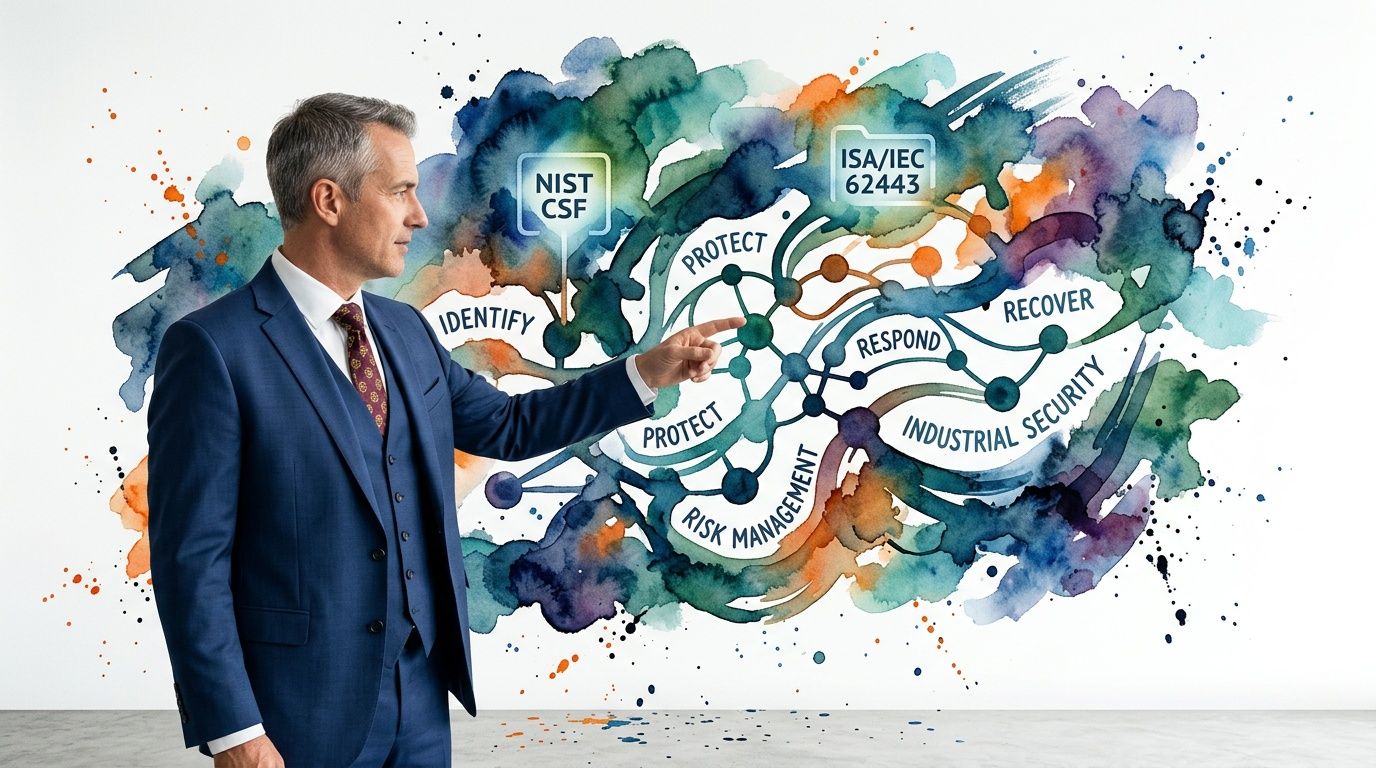
For manufacturing, two frameworks deserve executive attention. NIST Cybersecurity Framework gives you the management structure. ISA/IEC 62443 gives you the industrial control system discipline that general IT programs often miss.
NIST translated for operators and investors
NIST is useful because it's practical when translated into business language.
- Identify: Know what you own, what runs production, and where the critical dependencies sit.
- Protect: Put controls around the assets that matter most. Limit access, segment networks, secure remote entry, and harden weak points.
- Detect: See abnormal behavior early enough to act before a local issue becomes a plant-wide disruption.
- Respond: Decide in advance who makes which calls during an event. Delay and confusion are expensive.
- Recover: Restore operations in a controlled way so you're not improvising during an outage.
That sequence works because it mirrors good operational leadership. You identify constraints, protect throughput, detect deviations, manage the exception, and restore the system.
Why ISA IEC 62443 matters in the real world
If NIST is the management playbook, ISA/IEC 62443 is the industrial standard that gives credibility to your OT security posture. It's especially relevant for industrial automation and control systems because it addresses how production environments operate.
The business case is stronger than many executives realize. Companies that adopt the ISA/IEC 62443 standard report a 60% reduction in security incidents related to industrial control systems and can restore operations up to 75% faster after an event according to the ISA business case for 62443 adoption.
That matters to boards, buyers, and customers because it connects cybersecurity directly to operational continuity.
A good parallel exists in physical security. If your team needs a practical refresher on how permissions, identity, and restricted entry reduce business exposure, this overview of the benefits of secure access control is worth reading. The same logic applies digitally on the plant floor. Uncontrolled access is not convenience. It's unmanaged risk.
Strong frameworks don't slow good companies down. They stop weak decisions from compounding.
My advice is simple. Use NIST to organize leadership accountability. Use ISA/IEC 62443 to shape the OT program. If a provider can't explain how your roadmap aligns to both in plain English, keep looking.
A Prioritized Roadmap for Security Investment
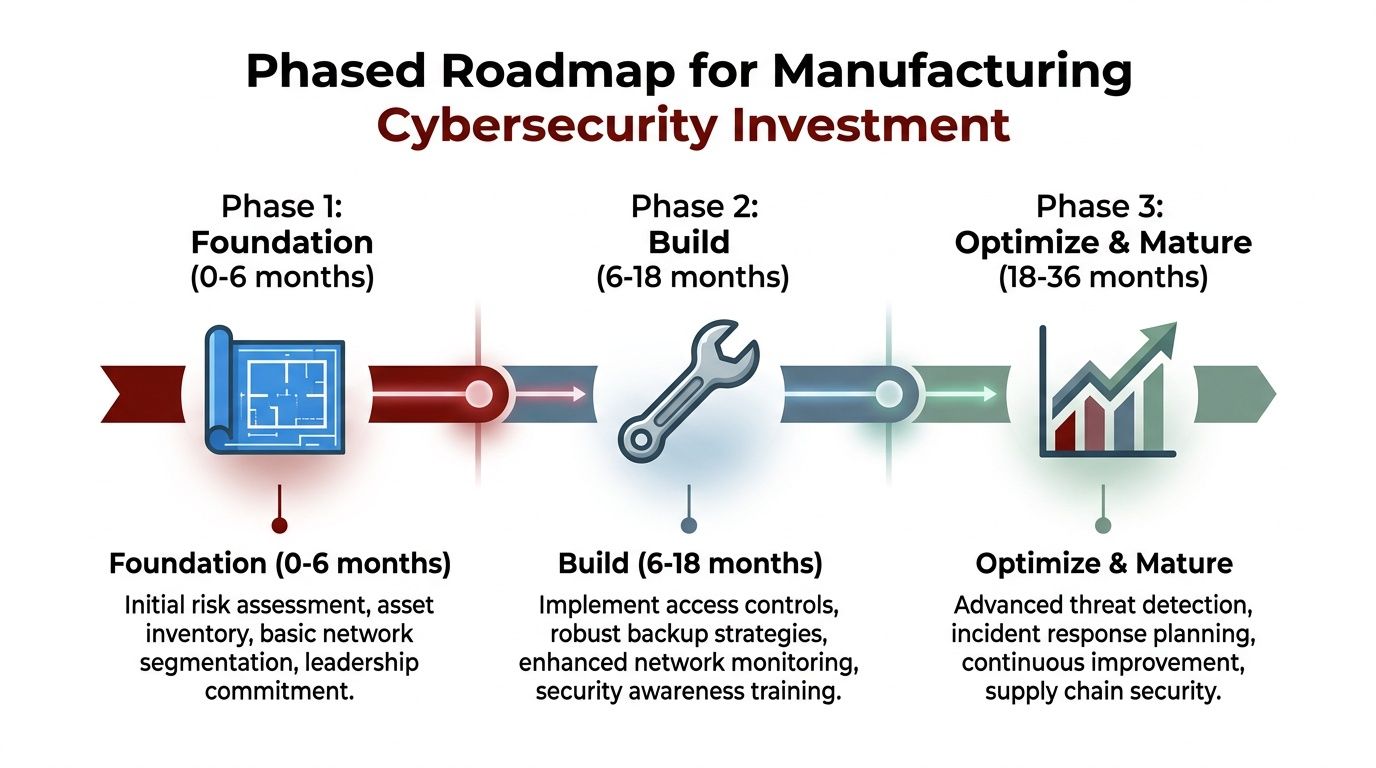
Most manufacturers don't need more cybersecurity noise. They need capital allocation discipline. The right roadmap doesn't start with buying tools. It starts with protecting the assets that drive output, margin, and customer delivery.
Here's the practical sequence I'd use.
Start with visibility and ownership
Phase one is Assess and Inventory.
You can't defend an environment you haven't mapped. Most plants have more connected assets than leadership realizes. Engineering workstations, HMIs, PLCs, remote support paths, unmanaged switches, historian connections, and vendor-maintained devices often sit outside a clean inventory.
Start with these moves:
- Map critical assets: Identify which systems control production, quality, environmental conditions, and material flow.
- Rank business impact: Don't rank only by technical severity. Rank by what would stop shipments, create scrap, or jeopardize customer commitments.
- Document access paths: Include internal users, third-party vendors, OEM support, and cross-site connectivity.
- Assign ownership: Every critical environment needs an accountable business owner, not just a technical custodian.
A messy inventory is normal. Staying with a messy inventory is negligence.
Protect the assets that move revenue
Phase two is Protect and Secure.
Many companies often overspend in the wrong order. They chase advanced platforms before they've done the basic architecture work. That's backwards.
Focus on a few controls that usually return the most risk reduction first:
- Network segmentation: Separate corporate IT from plant-floor control environments. Limit lateral movement.
- Remote access discipline: Eliminate shared credentials, broad access, and always-open vendor pathways.
- Role-based permissions: Operators, maintenance, engineers, and vendors shouldn't all have the same privileges.
- Backup and recovery integrity: Backups only matter if they're isolated, usable, and tested against operational scenarios.
- Legacy compensating controls: If you can't patch a system safely, wrap it with stronger access restrictions and monitoring.
These aren't glamorous investments. They're the ones that protect cash flow.
Before you go further, leadership should hear this directly from operations, not just IT.
Build detection that operations will actually use
Phase three is Detect and Monitor.
A lot of monitoring projects fail because they flood teams with alerts nobody trusts. In manufacturing, detection has to fit the plant. It needs context around normal production behavior, approved maintenance windows, vendor activity, and machine communications.
What to prioritize:
- Passive visibility tools: Start with monitoring that doesn't disrupt live operations.
- Anomaly detection on OT traffic: Look for unusual commands, unexpected device behavior, and unauthorized connections.
- Escalation paths that include plant leadership: If only the SOC sees the issue, response will lag.
- Cross-functional review cadence: Security, operations, engineering, and maintenance should review incidents together.
Plan recovery before you need it
Phase four is Respond and Recover.
This is where executive maturity shows up. A company with no tested response plan usually discovers that decisions are slower than it assumed. Production leaders wait for IT. IT waits for management approval. Vendors wait to be called. Customers hear too late.
Build a response model that answers these questions:
| Decision area | What leadership must define |
|---|---|
| Production shutdown authority | Who can stop a line or isolate a site |
| Communications | Who informs customers, employees, insurers, and legal counsel |
| Technical containment | Which systems can be disconnected first without amplifying damage |
| Recovery sequence | Which lines, products, and sites come back first |
| Third-party support | Which OEMs, integrators, and responders are pre-authorized |
A response plan is an operating plan under stress. If it only exists in IT, it will fail in production.
Treat manufacturing cybersecurity as a staged investment program. Foundation first. Then control. Then visibility. Then resilience. That's how you reduce risk without turning security into a bloated cost center.
Establishing Governance and Measuring What Matters
Cybersecurity governance fails when companies treat it as a committee exercise with no hard ownership. In manufacturing, that approach is dangerous because operational risk doesn't wait for meeting schedules.
The board and executive team must own the risk posture. IT can run parts of the program. IT cannot carry the enterprise accountability.

Who owns what
A practical governance model is simple and explicit.
- CEO: Sets the tone. Makes cybersecurity part of enterprise risk, capital planning, and M&A readiness.
- COO: Owns operational continuity. Ensures plant leadership, maintenance, engineering, and supply chain are built into decisions.
- CISO or security leader: Designs the program, prioritizes controls, coordinates response readiness, and reports risk clearly.
- Plant managers: Own local execution. They know what can't go down, what workarounds exist, and which vendor relationships create exposure.
- Legal and finance leaders: Prepare for contractual, disclosure, insurance, and recovery implications.
This structure works best when reviewed through a broader lens of manufacturing risk management. Cyber risk isn't separate from operational risk. It's one of the fastest ways operational risk materializes.
KPIs that belong in the board pack
Most dashboards are too technical. Executives don't need a list of patches, tickets, and blinking indicators. They need measures that connect security posture to continuity, value, and decision quality.
Use KPIs such as:
- Reduction in unplanned downtime events tied to cyber-related causes
- Mean time to recover for critical production lines
- Number of identified high-priority security risks remediated during the quarter
- Percentage of critical assets with defined ownership and approved access rules
- Completion status of incident response exercises involving operations leadership
- Open third-party access exceptions awaiting remediation
A good KPI has an owner, a review cadence, and an operational consequence. If the number moves the wrong way, leadership should know what decision follows.
Governance works when one metric forces one action. If the metric doesn't change behavior, it's decoration.
Boards and private equity sponsors should also ask a tougher question. If this company were going to market today, would the current cybersecurity posture help diligence move faster or create friction? That's the enterprise-value lens many operators still ignore.
A resilient manufacturing business doesn't just produce well. It demonstrates controlled risk, disciplined access, and recoverable operations.
Real-World Lessons and Choosing the Right Partners
I've seen two very different outcomes in industrial businesses. One treated cybersecurity as overhead until an incident disrupted operations. The other treated it as part of customer credibility and execution discipline. The difference wasn't luck. It was leadership.
Story one when ransomware becomes an operations crisis
A mid-sized manufacturer had decent office security, but the production environment was treated as a specialist area that nobody wanted to disturb. Legacy equipment was connected to newer business systems. Remote vendor access had grown organically. The company believed “air gaps” and tribal knowledge were enough.
Then a cyber event hit the business network and quickly created operational consequences. Scheduling systems became unreliable. Engineering access was impaired. Production leaders couldn't trust whether certain machines, files, and parameters were safe to use. The company didn't just face a technology problem. It faced a decision problem.
Orders slipped. Customer communications got tense. Internal debate slowed containment because nobody had agreed in advance who could isolate systems and in what order production should recover.
The lesson is blunt. A cyber event in manufacturing becomes a leadership crisis fast because operations, quality, customer service, legal, and finance all get dragged in at once.
Story two when security helps win business
A different manufacturer took the opposite route. Leadership had already mapped critical assets, tightened remote access, documented recovery priorities, and aligned plant-floor protections with recognized industrial standards. The company wasn't perfect. It was disciplined.
When a major aerospace customer reviewed suppliers, this manufacturer could show structure, ownership, and evidence that it understood operational cyber risk. That didn't just reduce perceived risk. It signaled maturity.
The company stood out because buyers want suppliers that won't become the weak link in a program. In competitive sectors, manufacturing cybersecurity can strengthen commercial trust and support M&A readiness because it proves the business can scale without hidden operational fragility.
How to choose a partner without buying theater
Most vendors sell confidence. You need competence.
Use these filters when evaluating a cybersecurity partner:
- OT depth over generic IT claims: If they can't speak comfortably about PLCs, HMIs, SCADA, engineering workstations, and plant uptime, they're not ready for your environment.
- Ability to work around legacy constraints: Many plants can't patch or replace systems quickly. Your partner must know how to reduce risk without demanding unrealistic shutdowns.
- Operational continuity mindset: Ask how they protect production while implementing controls. If their answer sounds like a corporate office playbook, walk away.
- Clear methodology: They should explain discovery, segmentation, access control, monitoring, and recovery in a sequence that makes business sense.
- Cross-functional communication: Strong partners can brief the board, work with IT, and earn the trust of plant managers.
- Incident readiness: Ask how they support response planning, not just prevention.
A final rule matters most. Don't hire any firm that treats manufacturing cybersecurity as a technology installation. This is an operational resilience program. The right partner understands both sides of that sentence.
Your Implementation Checklist for a Secure Future
If I were bringing this to a leadership meeting, I wouldn't start with tools. I'd start with decisions. Use this checklist to force clarity.
- Name one executive owner: Has a single leader been assigned accountability for OT and manufacturing cybersecurity risk across sites?
- Complete a critical asset inventory: Do you know which systems directly affect production, quality, and delivery commitments?
- Map access exposure: Have you documented employee, contractor, OEM, and third-party access into production environments?
- Segment key environments: Have you separated business systems from plant-floor systems in a way that limits lateral movement?
- Review legacy risk thoroughly: Which assets can't be patched or upgraded easily, and what compensating controls are in place?
- Test recovery assumptions: Can you restore critical operations in a defined order, or are you relying on hope and tribal knowledge?
- Bring operations into response planning: Have plant managers, engineering, and maintenance participated in incident planning and exercises?
- Measure business-facing outcomes: Are you tracking recovery readiness, critical risk remediation, and operational disruption instead of only technical activity?
- Evaluate customer and investor implications: Would your current posture help or hurt during diligence, contract review, or a strategic transaction?
For smaller and lower middle market companies that need a practical baseline, these small business cybersecurity best practices can help frame the fundamentals before you build a more mature manufacturing-specific program.
Manufacturing cybersecurity isn't optional anymore. It's part of how a modern industrial company protects revenue, preserves trust, and earns a higher quality multiple.
Hasit Vibhakar is a serial entrepreneur and CEO with over 25 years of experience building, scaling & increasing shareholder value across Aerospace, Advanced Manufacturing & Industrial sectors. More information can be obtained at Hasit Vibhakar.
Leave a Reply