
An executive team can absorb a missed shipment. It can't casually absorb a supply chain shock that cuts around 8% of annual revenue, which is what companies were reported to have lost on average from 2024 disruptions, according to Procurement Tactics' supply chain statistics summary. That number changes the conversation. Problems in supply chain aren't a purchasing issue or a plant issue. They are a board issue.
In aerospace and advanced manufacturing, the stakes climb fast because the product is complex, the qualification burden is high, and a single unavailable component can stall an entire revenue stream. I've spent my career in these environments, and the lesson is consistent. The companies that protect enterprise value don't treat supply chain as a back-office function. They run it like a strategic system tied directly to margin, delivery credibility, and cash.
About Hasit Vibhakar
Hasit Vibhakar is a serial entrepreneur and CEO with over 25 years of experience building, scaling & increasing shareholder value across Aerospace, Advanced Manufacturing & Industrial sectors. More information can be obtained at Hasit Vibhakar
Table of Contents
- The Trillion Dollar Problem Hiding in Your Supply Chain
- The Anatomy of Modern Supply Chain Failures
- The Business Impact Beyond Delayed Shipments
- High Stakes Scenarios in Aerospace and Advanced Manufacturing
- Key Metrics for Monitoring Supply Chain Health
- A Strategic Framework for Building Resilience
- From Reactive Firefighting to Proactive Leadership
The Trillion Dollar Problem Hiding in Your Supply Chain
Supply chain risk has become one of the fastest ways to destroy earnings quality without changing anything about your product, pricing, or sales strategy. A company can hit its market assumptions and still miss the year because one raw material, one sub-tier supplier, or one trade policy change breaks the flow of production.
That's why I don't look at problems in supply chain as isolated interruptions. I look at them as value leakage. Revenue slips because shipments move out. Margin slips because teams pay expedite fees, buy short, or accept inefficient lot sizes. Working capital worsens because inventory policy gets rewritten in the middle of the storm instead of before it.
In high-precision sectors, fragility hides inside complexity. Aerospace programs depend on certified materials, tightly controlled processes, approved vendors, and exact documentation. Advanced manufacturing depends on tooling availability, machine uptime, stable yields, and disciplined scheduling. None of that tolerates surprises well.
Practical rule: If a single missing item can stop shipment, that item is not a commodity. It is a strategic risk point.
The executive mistake is to frame supply chain resilience as insurance overhead. It isn't. It's a system for protecting EBITDA, customer trust, and future valuation. The companies that outperform through disruption usually aren't the ones with the lowest nominal input cost. They're the ones that know where they're exposed, what failure will cost, and which trade-offs are worth paying for in advance.
The Anatomy of Modern Supply Chain Failures
Modern failures rarely begin where leaders first see them. The missed delivery, the shortage on the floor, or the customer escalation is usually the last event in a chain that started much deeper in the network.
Why failures start below the surface
The biggest blind spot is Tier N visibility. Many companies know their direct suppliers reasonably well. They don't know who supplies the supplier, or where a critical coating, forging, resin, chip, or fastener blank comes from. That's where disruption hides.
According to Z2Data's analysis of sub-tier supply chain visibility, 70% of companies lack visibility into sub-tier suppliers, and 40% of supply chain failures originate from Tier 2 or deeper suppliers. That's the domino effect in operational form. A small issue at a sub-tier source becomes a line stoppage at the OEM level because nobody mapped the dependency in time.
Aerospace leaders know this problem well. The approved machine shop may be healthy, but its heat-treat provider is overloaded. The fastener supplier may be responsive, but its specialty alloy mill is constrained. The printed circuit assembler may be on schedule, but a niche component upstream has gone allocation-only. You don't discover this risk in your ERP after the date slips. You discover it by tracing the chain before the disruption.
The four failure modes leaders should separate
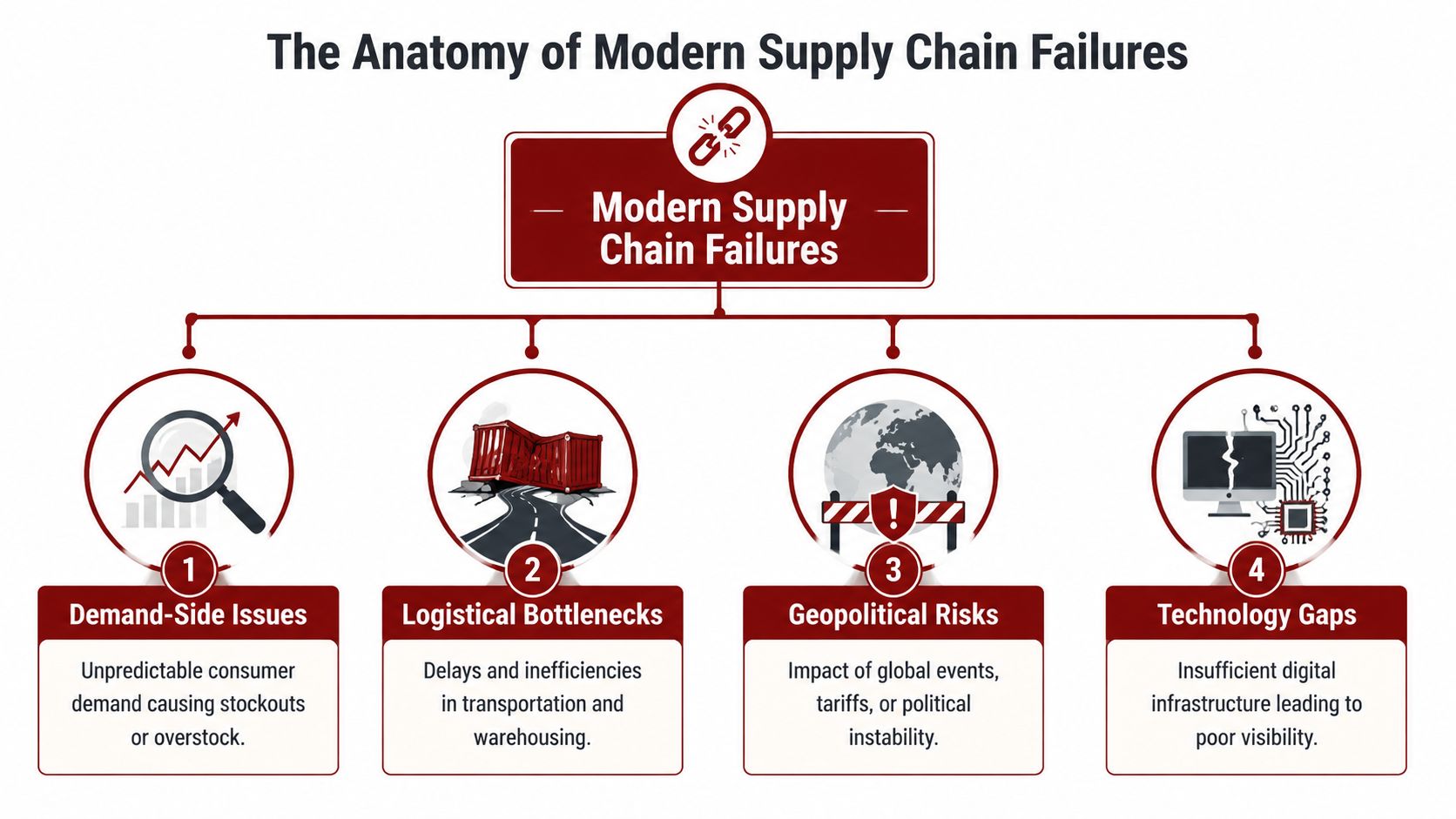
I advise operators to split problems in supply chain into four buckets, because each one requires a different fix.
- Demand-side distortion happens when forecast assumptions move faster than planning cycles. The symptom is often expediting, rescheduling, and inventory imbalance.
- Logistical bottlenecks show up in ports, freight lanes, warehouses, and handoffs. Even if supply exists, you still can't build if material doesn't arrive in sequence.
- Geopolitical and trade shocks interrupt routes, change landed cost, alter compliance requirements, and make previously rational sourcing decisions suddenly expensive or unusable.
- Technology gaps prevent visibility. If purchasing, planning, quality, and operations are looking at different versions of reality, the team reacts late.
Most supply chain failures look operational on the surface. Their root cause is usually informational.
That distinction matters because executives often overcorrect in the wrong direction. They buy more inventory when the issue is poor supplier intelligence. They add suppliers when the issue is weak qualification discipline. They pressure buyers on price when the actual failure sits in lead-time variability and missing risk signals below Tier 1.
The Business Impact Beyond Delayed Shipments
A late order is easy to recognize. The harder problem is the hidden financial damage that spreads across the income statement and balance sheet long before finance closes the quarter.
Where the P&L gets hit first
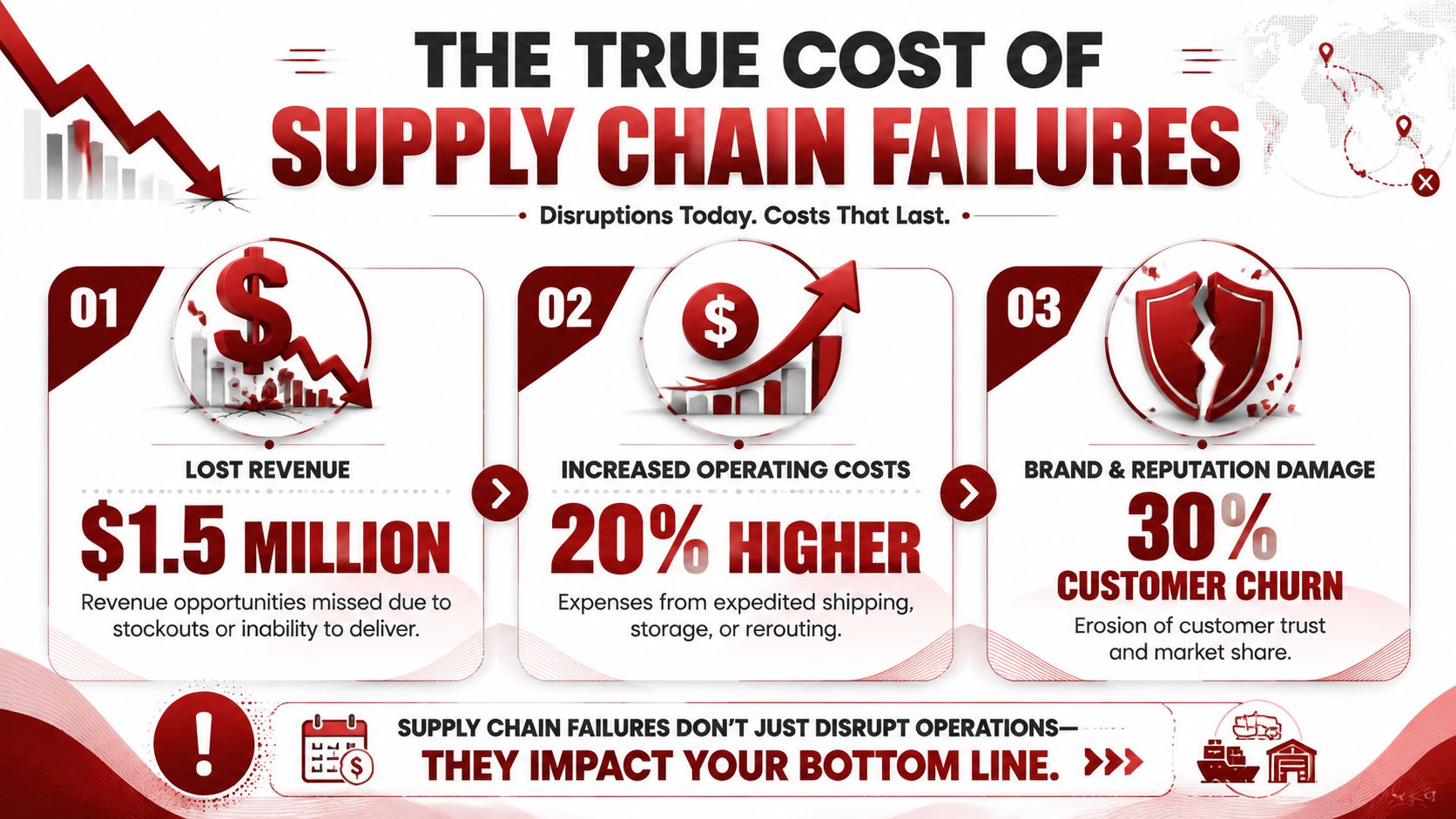
The most immediate impact is cost. As noted earlier, disruption pushes teams into expensive behavior. They split lots, expedite freight, accept smaller runs, hold more safety stock than planned, and assign engineering time to substitutions rather than value creation.
GITNUX data, summarized in the earlier source, show that supply-chain disruptions typically increase operating expenses by 3–5%, cut sales by roughly 7%, and reduce corporate revenues by an estimated 6–10%. In practical terms, that means a business can lose on both sides of the equation at once. Costs rise while recognized revenue softens.
Many executives underestimate the issue. They treat supply shortfalls as temporary scheduling noise. The P&L treats them as margin compression. If the business is already carrying long setup times, tight labor availability, and customer penalties for late delivery, the earnings effect compounds quickly.
Why enterprise value takes a second hit
Public markets and private buyers both care about predictability. A company that misses due to recurring fulfillment instability gets valued differently than one that misses due to a one-time event with a clear remediation path.
Here's why. Repeated supply chain failures create doubt about management control, customer retention, forecast accuracy, and working capital discipline. In aerospace and advanced manufacturing, they also raise questions about whether the organization can scale without breaking quality or lead times.
A second-order problem appears inside customer behavior:
- Customers requalify alternatives when your delivery promises become unreliable.
- Commercial teams discount more aggressively to preserve accounts under stress.
- Operations hoard inventory because trust in replenishment erodes.
- Finance loses confidence in forecast conversion from backlog to revenue.
A company with chronic supply disruption doesn't just ship less. It becomes harder to underwrite.
That's why solving problems in supply chain belongs in strategic planning, not just weekly operations meetings. The payoff isn't only fewer shortages. It's a more credible earnings profile.
High Stakes Scenarios in Aerospace and Advanced Manufacturing
In high-precision sectors, disruption rarely arrives as a dramatic collapse. It usually starts with one missing item that looks manageable until it collides with certification rules, sequence dependencies, and customer commitments.

When one certified part stalls an entire program
Consider an aerospace program building structural assemblies on a fixed delivery schedule. The direct supplier is approved, the demand plan is set, and the customer expects release by milestone date. Then a certified structural component slips because upstream raw material is constrained. No easy substitute exists because the part, process route, and paperwork all have to align.
This is why standard procurement advice often fails in aerospace. You can't “find another vendor” if the part requires qualification, process validation, and customer approval. The cost of delay is operational, commercial, and reputational at the same time.
Reported sector data show that supply chain disruptions in aerospace and advanced manufacturing caused an average 18% increase in component lead times between 2020 and 2023, with critical structural aircraft products facing lead times exceeding 52 weeks, according to this industry-cited post on aircraft structural product lead times. That's not a nuisance. It changes production planning, contract execution, and cash deployment.
The companies that manage this well tend to invest early in supplier relationship management discipline. They don't wait for a shortage to learn which suppliers communicate clearly, hold process capability, and will prioritize a difficult build.
The machine shop version of the same problem
Advanced manufacturing sees the same pattern through a different lens. A CNC operation may have labor, machines, demand, and customer release in hand, then lose throughput because a specialty cutting tool, insert grade, coating source, or fixture component goes unavailable. The shop is technically open but economically constrained.
I've seen leadership teams misread this situation. They push overtime into a system that lacks the one input needed to convert labor hours into shippable parts. Overtime doesn't fix material readiness. It only inflates cost.
A better response starts with operational triage:
- Re-sequence the queue around available material and tooling.
- Separate true bottlenecks from noisy exceptions so planners don't scramble the whole floor.
- Escalate customer communication early when substitution or revised release timing is unavoidable.
- Protect your highest-contribution jobs instead of trying to save every order equally.
A short briefing on how executives are thinking about current industrial disruption is useful here:
What works in these environments is engineering-led supply chain management. Qualification rigor, alternate process planning, drawing-level risk review, and supplier development outperform generic sourcing playbooks every time.
Key Metrics for Monitoring Supply Chain Health
Most dashboards are too busy and too late. They tell you what failed after the customer already knows. A useful dashboard for problems in supply chain should help a leadership team act before schedule erosion becomes a revenue issue.
The dashboard that matters
I prefer a mix of leading and lagging indicators. Leading indicators tell you where failure is forming. Lagging indicators confirm whether the system is recovering or deteriorating.
For advanced manufacturing, a practical review cadence usually centers on a handful of metrics:
- Lead time variance tracks how unstable supplier performance has become, even when average lead time looks acceptable.
- Supplier risk score combines delivery, quality, concentration, and dependency signals into one decision tool.
- Shortage-driven schedule changes reveal whether planning is operating from a stable materials position or constant exception handling.
- Perfect order performance shows whether the customer received the right product, on time, with correct documentation.
- Cash-to-cash pressure points indicate when excess inventory and delayed shipment are trapping capital at both ends.
When inventory gets distorted, leaders need a policy response, not just a warehouse response. That's where disciplined inventory management optimization matters. The point isn't to maximize stock. It's to hold the right buffers for the parts that can shut down output.
Essential Supply Chain Health Metrics
| Metric | What It Measures | Why It's Critical |
|---|---|---|
| Lead time variance | The spread between expected and actual supplier lead times | Volatility breaks schedules before average lead time looks alarming |
| Supplier risk score | Combined exposure across delivery, quality, financial, geographic, and dependency factors | It helps management prioritize scarce attention on the suppliers that can stop production |
| Material availability at release | Whether jobs launch with all critical inputs ready | It separates planning confidence from false starts on the floor |
| Perfect order performance | On-time, complete, accurate delivery with required documentation | In aerospace and industrial settings, documentation failure can be as damaging as part failure |
| Expedite frequency | How often the business pays to recover missed planning assumptions | Rising expedites usually signal structural instability, not isolated bad luck |
| Cash-to-cash cycle view | How quickly cash invested in materials converts back through shipment and collection | It ties supply chain health directly to liquidity and valuation discipline |
Watch the trend, not just the snapshot. A metric can still be “green” while its direction is warning you that control is slipping.
A Strategic Framework for Building Resilience
Resilience isn't built by buying more of everything. It's built by deciding where certainty is worth paying for and where flexibility matters more than unit cost.
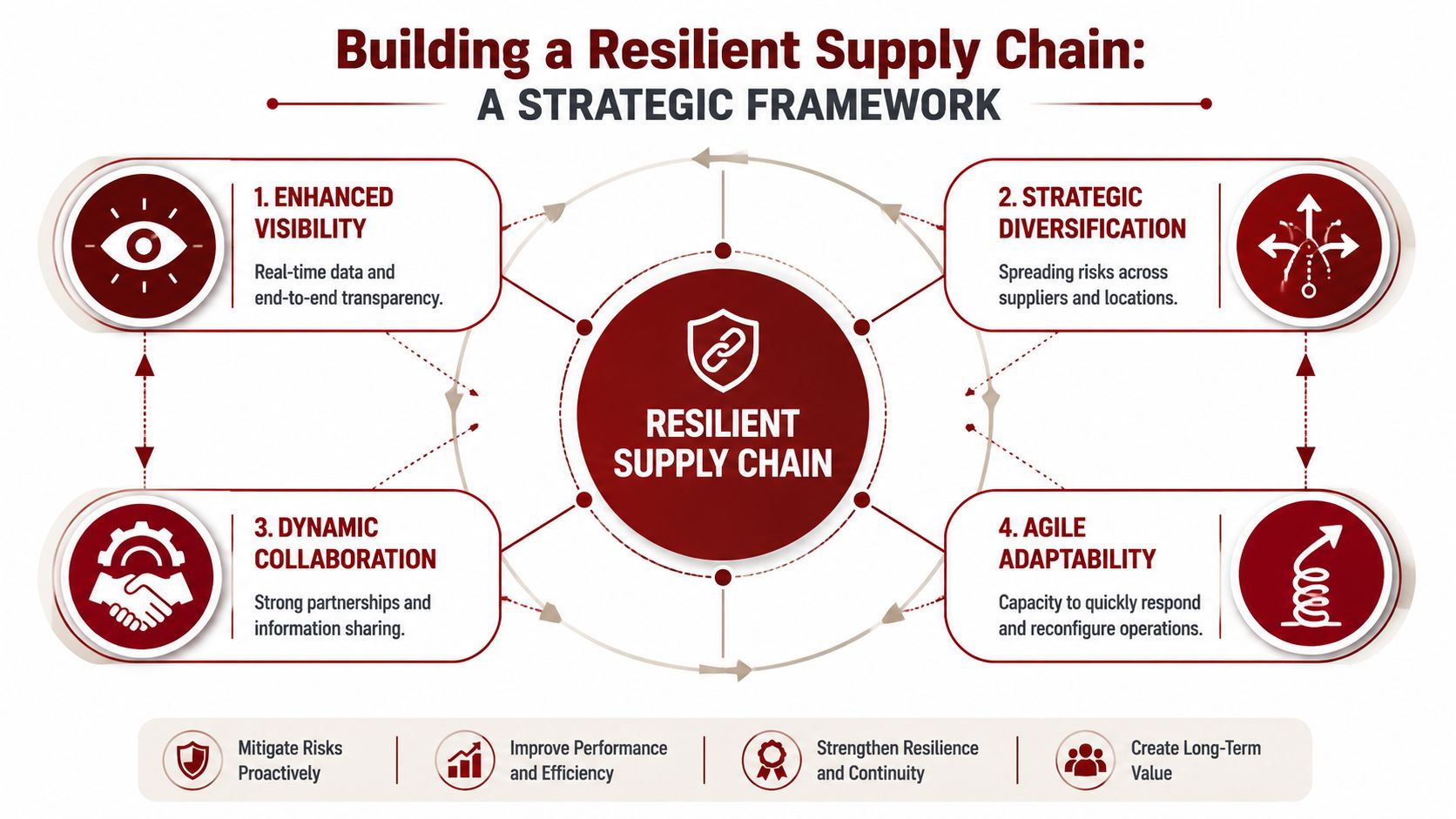
Recent trade behavior makes the shift obvious. According to Thomson Reuters' report on trade complexity and disruption, 65% of firms are changing sourcing patterns, 57% are renegotiating supplier contracts, and 51% are nearshoring or relocating manufacturing, while also deploying real-time regulatory tracking and scenario models. That tells you the old single-objective model of lowest landed cost is already breaking down in practice.
Four moves that actually reduce risk
First, build deeper visibility than your ERP natively provides. You need part-level and supplier-level intelligence that reaches beyond direct vendors. For some organizations, that means external mapping tools. For others, it means a structured internal model. One option is Hasit Vibhakar's supply chain resilience approach, which includes a formal scoring model that consolidates supplier risk across financial, operational, ESG, and geographic factors, along with contingency planning and escalation thresholds.
Second, diversify with discipline. Dual-sourcing only helps when the second source is qualified, commercially viable, and operationally ready. A paper backup is not a backup. In aerospace especially, alternate sources need validation long before the first disruption.
Third, strengthen supplier relationships where failure would be costly. In constrained environments, suppliers allocate effort, capacity, and responsiveness. The customer who shares forecasts, resolves quality questions quickly, and behaves like a long-term partner usually gets better support than the customer who only negotiates price.
Fourth, run scenario models. Tariffs, route changes, compliance delays, and capacity loss shouldn't force your first conversation after the event. Leadership teams need prebuilt playbooks for what happens if a region closes, a commodity spikes, or a critical supplier misses for an extended period.
A related blind spot sits outside direct materials. End-of-life equipment, obsolete IT hardware, and poorly governed asset retirement can create data, compliance, and continuity risks of their own. For companies tightening operating discipline, these IT asset disposition strategies are worth reviewing as part of a broader resilience program.
What doesn't work
Some responses look decisive but create new fragility.
- Blanket safety stock increases tie up cash and often protect the wrong items.
- Supplier proliferation without qualification rigor creates complexity without reliability.
- Quarter-by-quarter price pressure weakens the very relationships you need during allocation periods.
- Manual spreadsheet firefighting slows response when speed and version control matter most.
Resilience is not the opposite of efficiency. It is disciplined efficiency with failure in mind.
The companies that execute this well move from reactive procurement to cross-functional risk management. Finance, operations, procurement, quality, engineering, and compliance all need to operate from the same risk picture. That is what turns supply chain from a recurring source of earnings volatility into a competitive advantage.
From Reactive Firefighting to Proactive Leadership
The old view treated supply chain disruption as an interruption to operations. That's too narrow now. Problems in supply chain shape revenue conversion, margin quality, customer retention, working capital, and how investors judge management credibility.
For aerospace and advanced manufacturing leaders, the answer isn't generic resilience theater. It's sharper visibility into sub-tier exposure, stronger supplier relationships, better qualification discipline, clearer operating metrics, and scenario planning that reflects the realities of regulated, high-mix production. The firms that do this well don't eliminate risk. They make risk visible early enough to manage it on their terms.
That's what modern leadership requires. A CEO doesn't need to run purchasing. But the CEO does need to know which dependencies can stop the business, what those failures would do to the P&L, and which investments will protect enterprise value before the next disruption arrives.
If you're evaluating where supply chain risk is undermining margin, delivery performance, or valuation, Hasit Vibhakar offers practical insight grounded in decades of operating experience across aerospace, advanced manufacturing, and industrial businesses.

Leave a Reply