
Revenue is climbing. Your plant is busier than it was a year ago. Quotes are going out faster, backlog is building, and your leadership team is spending more time solving preventable problems than building the next stage of the company.
That's the point where many owners tell themselves they're scaling. In reality, many are just stretching the same business harder. In industrial companies, that difference matters. A software company can patch mistakes in a sprint. An aerospace or manufacturing business pays for them in scrap, delays, customer distrust, and margin erosion.
I've seen the pattern across capital-intensive businesses for decades. A founder wins on hustle, product knowledge, and customer trust. Then demand rises, complexity multiplies, and the company starts to choke on its own success. The answer is rarely “sell more of everything.” It's to build the capacity, discipline, and capital structure to support growth without breaking delivery, quality, or cash flow.
That's what a real business scaling strategy looks like in practice.
Table of Contents
- Your Business Is Growing But Is It Ready to Scale
- Diagnosing Your Scaling Readiness
- Choosing Your Primary Growth Levers
- Building Your Scalable Operating Model
- Fueling Growth with Smart Capital Strategies
- Navigating The Most Common Scaling Pitfalls
Your Business Is Growing But Is It Ready to Scale
A familiar situation shows up in industrial companies right before trouble starts. The order book looks healthy, customers want shorter lead times, and the shop floor is running hard. At the same time, supervisors are covering for weak processes, the founder is still approving too many decisions, and customer issues are getting handled through escalation instead of a system.
That isn't scale. That's strain.
In aerospace and manufacturing, growth exposes whatever was already weak. If quoting depends on one person, that weakness gets louder under volume. If production scheduling lives in spreadsheets and tribal knowledge, more demand won't fix it. It will punish it. The companies that break through this ceiling stop treating growth as a sales problem and start treating it as an operating design problem.
I learned that lesson by building companies in sectors where execution can't be faked. Semiconductor manufacturing, electronics, publishing, and aerospace all reward discipline differently, but the core principle is the same. The business has to be able to absorb more demand without losing control of quality, delivery, or economics. That means people, systems, financing, and decision rights all have to mature together.
For founders operating in that transition, the central question isn't whether the market wants more from you. It's whether your company can deliver more without damaging the asset you've built. That's the mindset behind building high-value companies across aerospace and manufacturing.
Growth rewards hustle early. Scaling rewards design.
A sound business scaling strategy forces hard trade-offs. You may delay a new market until operations stabilize. You may reject custom work that looks attractive but can't be repeated profitably. You may hire for process control before adding another salesperson. Those choices can feel conservative in the moment. In practice, they're often what preserves enterprise value.
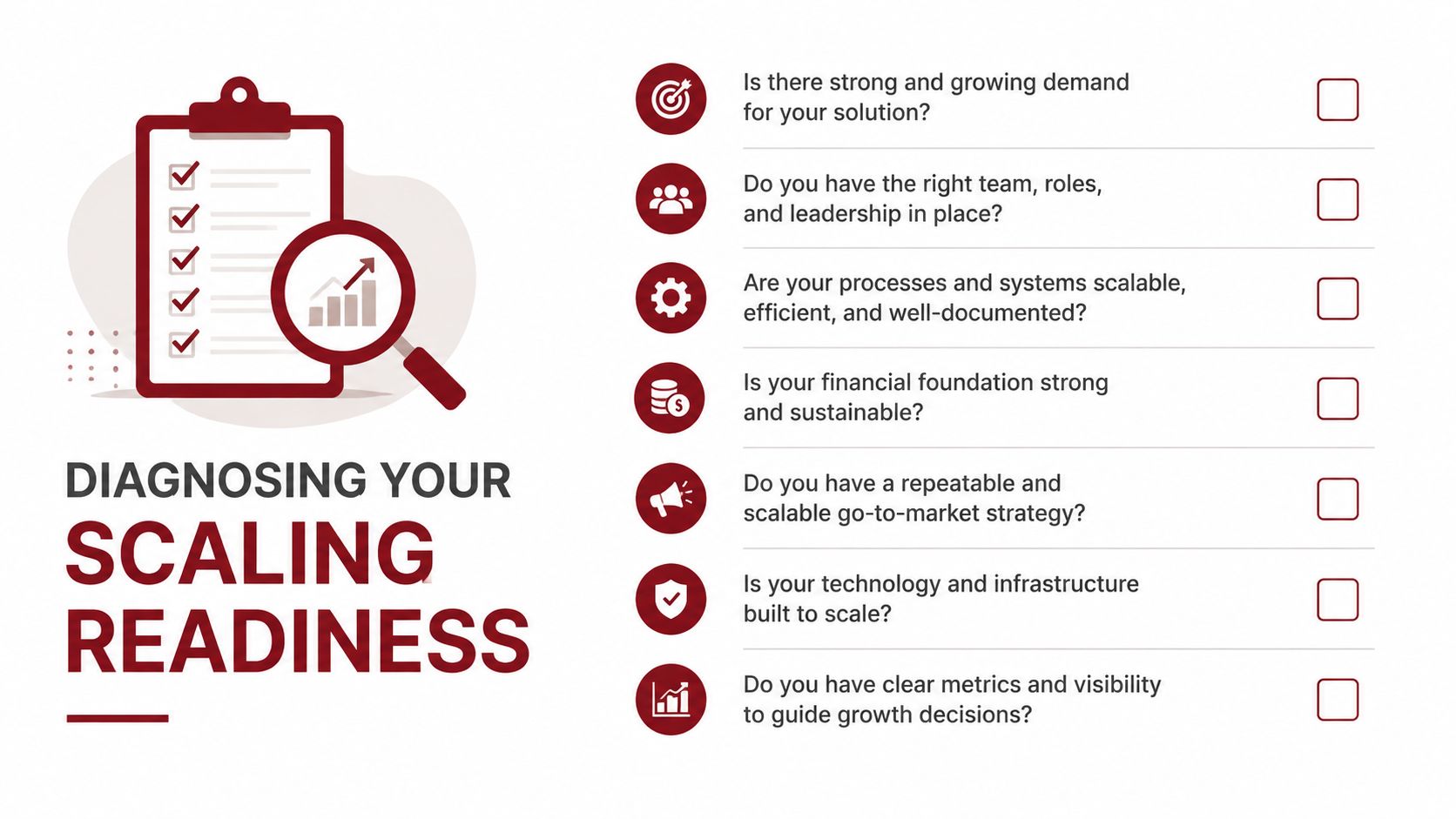
Diagnosing Your Scaling Readiness
Most owners start with revenue. I start with stability. If the business can't carry more load operationally and financially, adding demand only creates expensive chaos.
According to this business scaling readiness analysis, only 22% of new businesses successfully scaled over the past decade, and successful scalers distinguished themselves by assessing readiness through indicators such as six months of steadily rising revenues, overwhelmed teams, and a gross profit margin over 40%. That should reset the conversation. Scaling is rare because readiness is rare.
Growth is not proof of readiness
A company can post better numbers and still be unprepared. In industrial businesses, unreadiness usually hides in the seams between departments. Sales promises something operations hasn't standardized. Engineering keeps solving the same problem from scratch. Finance can report results, but not soon enough to guide decisions.
Here are the signals I trust more than excitement:
- Revenue quality: You want sustained upward movement, not one big contract masking weakness elsewhere.
- Margin integrity: A business that wins work by underpricing itself isn't ready to scale that model.
- Team load: If good people are overloaded, that's a warning. It can indicate real demand, but it can also reveal poor workflow design.
- Delivery capacity: Ask whether your current systems could handle materially more volume without missed commitments.
- Founder dependence: If too many approvals still come through one office, scale will amplify the bottleneck.
Practical rule: Don't scale to solve internal disorder. Fix the disorder first.
The seven questions I'd ask before pushing harder
When I assess readiness, I don't use a motivational filter. I use an operating one.
- Are revenues rising consistently enough to justify added capacity? Consistency matters more than one standout quarter.
- Is gross profit healthy enough to finance mistakes, training, and process investment? Thin margins give you no room to learn.
- Are teams overwhelmed because demand is strong, or because execution is sloppy? Those require different responses.
- Can the business absorb more orders without stressing quality systems? In aerospace, this is not optional.
- Do you know where cash gets trapped? A growing backlog can still create a financing problem.
- Are customer expectations documented and repeatable across functions? Verbal alignment doesn't scale.
- Can your managers run their areas without founder intervention? If not, the business is still centralized.
A company that answers these questions accurately usually sees the next move more clearly. Sometimes the answer is to scale. Sometimes the answer is to standardize first, repair the data flow, tighten pricing discipline, or rebuild the management layer.
That restraint isn't hesitation. It's good judgment.
Choosing Your Primary Growth Levers
Most companies fail at scaling because they pull too many levers at once. They chase new geographies, add products, hire salespeople, and rework systems all in the same stretch. That creates motion, not momentum.
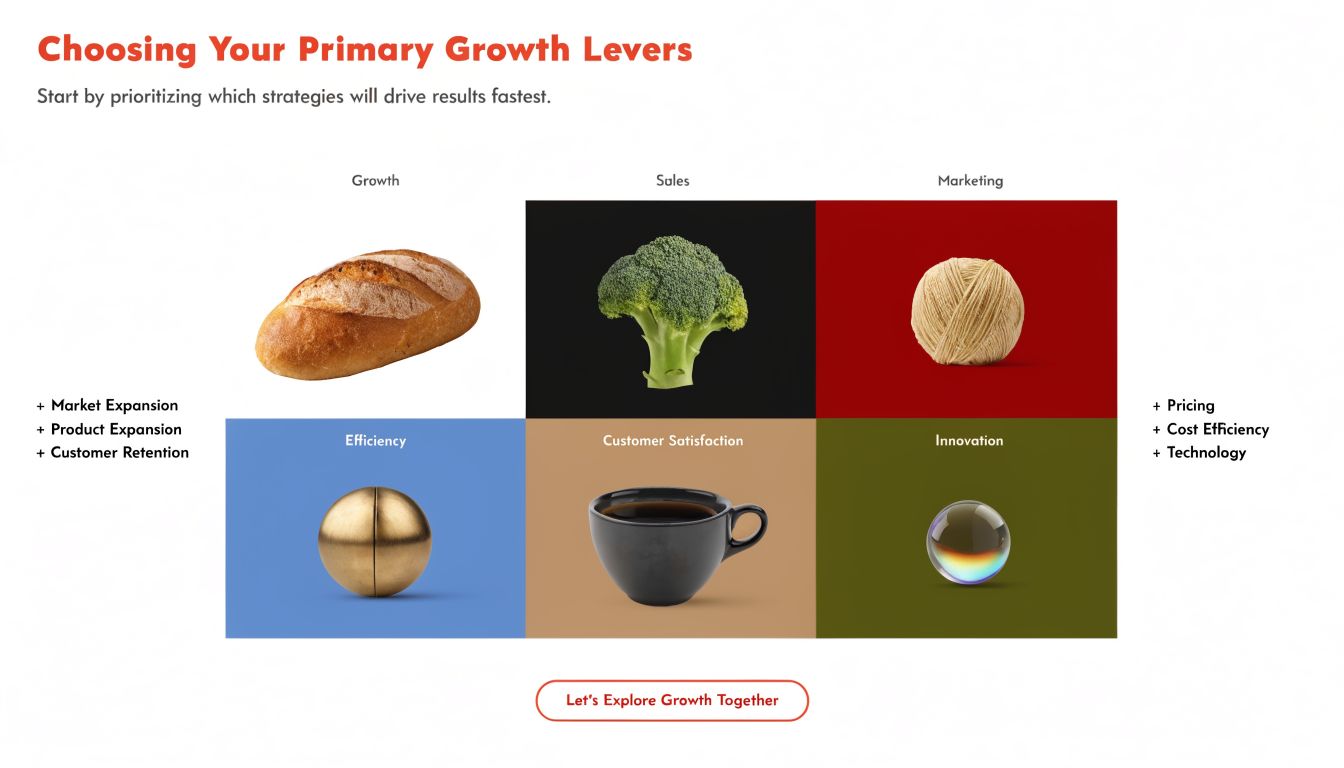
A better business scaling strategy starts by choosing the primary growth lever that matches your actual constraint. In industrial companies, the three levers that matter most are market, product, and sales execution.
Market leverage before market sprawl
Many leaders assume the next move is a new region or adjacent vertical. Sometimes it is. Often it isn't.
In manufacturing and aerospace, I prefer to ask a simpler question first. Have you fully penetrated the accounts, categories, and applications you already understand? Existing customers usually reveal the cleanest path to growth because you already know their standards, buying behavior, and delivery expectations.
That can mean:
- Deepening share of wallet: Add related components, service packages, or support capabilities your current buyers already need.
- Segmenting the base: Group customers by urgency, margin profile, certification needs, or application complexity.
- Using a pilot before expansion: Test a new vertical with controlled scope before committing plant capacity and commercial spend.
A disciplined market move lowers the risk of scaling noise. You're not trying to learn everything at once.
Productize what should not stay custom
Industrial businesses often carry too much custom work for too long. Customization can win early contracts, but it becomes a tax on scale if every project requires fresh engineering, fresh quoting logic, and fresh operational exceptions.
The answer isn't to eliminate flexibility. It's to decide what should become standardized.
I've found that productization usually starts in one of three places:
| Opportunity | What it looks like in practice | Why it matters |
|---|---|---|
| Standard scope | Defined packages, tolerances, and delivery assumptions | Makes quoting faster and margin more visible |
| Standard process | Repeatable routings, quality checks, and handoffs | Reduces variation across jobs |
| Standard offer architecture | Clear base offer with optional add-ons | Protects customization without letting it run the company |
When a business productizes intelligently, margins usually become easier to defend because labor, lead time, and risk are no longer being reinvented job by job.
In industrial markets, the most scalable offer is rarely the most customized one. It's the one buyers can trust, operations can repeat, and finance can price with confidence.
Build a sales engine that survives the founder
Founder-led selling works early because speed and credibility matter. It stops working when every deal still depends on one person's memory, instincts, and relationships.
A scalable sales function does three things. It defines the ideal customer clearly. It sets a repeatable process from lead to close. It hands off cleanly into operations without creating downstream surprises.
The strongest industrial sales engines I've seen share a few habits:
- Qualification is strict: They don't chase every RFQ. They filter for fit, margin potential, and operational feasibility.
- Handoffs are documented: Engineering, operations, and quality don't discover key customer requirements after the win.
- Follow-up is systematic: CRM discipline matters because backlog can hide pipeline weakness.
- Account growth is intentional: Existing customers get structured upsell and cross-sell attention.
This is also the stage where leadership design matters. If growth is becoming a cross-functional coordination challenge rather than just a sales challenge, adding senior capacity can help. In some companies, that means hiring a chief growth officer to align market strategy, sales execution, and internal operating readiness.
The mistake is treating every lever as equal. If your sales motion is weak, a new market won't save you. If your offer is too custom, more leads won't fix the economics. Pick the lever that removes the biggest constraint first.
Building Your Scalable Operating Model
Once growth starts stressing the business, operating design becomes the essential work. Capacity doesn't come from optimism. It comes from structure.
In manufacturing, a scalable operating model has to hold under pressure. It has to work when customer mix shifts, when volume rises, and when delivery windows tighten. That's why I like using a function-by-function lens instead of broad slogans about culture or agility.

Use the six-function lens
A useful framework for industrial scaling is the six-part model of Staff, Shared Values, Structure, Speed, Scope, and Series X. According to this Harvard Business School scaling framework reference, fortifying these six critical functions can reduce founder dependency by 70% and cut operational bottlenecks by 40% to 60%. That's not theory. It mirrors what operators discover when they finally stop running the business through heroic intervention.
I use the six functions in a practical way:
- Staff: Put specialists in seats where specialization matters. Sales, customer management, quality, operations, and finance need real ownership.
- Shared Values: Write down how decisions get made. Otherwise each manager improvises.
- Structure: Clarify decision rights, reporting lines, and escalation paths.
- Speed: Remove approvals and manual work that don't protect quality or margin.
- Scope: Decide which offers, customers, and processes deserve standardization.
- Series X: Match funding plans to actual operating needs, not vanity growth plans.
For teams building through acquisitions, private equity partnerships, or process-heavy expansion, this is also where a structured operator can help. One option is working with a hands-on executive platform such as Hasit Vibhakar's aerospace and technology growth approach, which focuses on scaling industrial businesses through execution, systems, and value creation.
Turn repetition into systems
A company starts to scale when repeated work stops being treated as a fresh event. The rule I trust is simple: if a process happens twice and it's repeatable, script it.
That principle matters in quoting, production planning, order intake, supplier communication, quality checks, and customer onboarding. Once repeated work is documented, automated, templated, or systematized, you gain speed without relying on memory.
A few examples from industrial settings:
- Quoting workflows: Standard templates reduce pricing inconsistency.
- Manufacturing routings: Defined process steps lower avoidable variation.
- Quality checkpoints: Predefined gates prevent late-stage surprises.
- Customer intake: Standard requirement capture improves downstream execution.
If a business needs its best people to remember everything, it isn't scaling. It's improvising.
Build leadership depth before you think you need it
Many founders wait too long to build the layer below them. They hire managers after overload becomes visible. By then, the company is already reacting from a weak position.
A stronger approach is to add leadership when complexity starts to increase, not when the founder is already trapped in every meeting. In practice, that means hiring for judgment, cross-functional communication, and execution discipline. Senior hires who look impressive but don't fit the operating cadence can do real damage.
The operating model also has to include technology discipline. Cloud tools, integrated CRM, ERP visibility, and cleaner data flow can remove a surprising amount of drag. The point isn't to buy software for its own sake. It's to make sure information moves faster than problems.
The companies that scale well in capital-intensive sectors don't separate people, process, and technology. They align them.
Fueling Growth with Smart Capital Strategies
Scaling takes money. The mistake is assuming all capital serves the same purpose.
In industrial businesses, capital decisions shape control, timing, and long-term value creation. A weak capital plan forces bad operating decisions. A strong one lets management invest in equipment, systems, talent, and acquisitions at the right moment rather than at the last possible moment.
Each capital source solves a different problem
Some growth can and should be funded internally. Some shouldn't. The right answer depends on what you're trying to build.
Here's a practical comparison:
| Funding Source | Control Impact | Speed of Access | Best For |
|---|---|---|---|
| Reinvested profits | Low control dilution | Moderate | Process improvement, selective hiring, internal capacity expansion |
| Traditional debt | Low ownership dilution, higher repayment pressure | Moderate | Equipment, working capital support, defined expansion needs |
| Strategic private equity partnership | Shared control | Moderate to slower | Platform building, acquisitions, leadership depth, larger-scale expansion |
| Family office capital | Varies by structure | Moderate | Flexible long-term growth, co-investment, acquisition support |
| Patent licensing and IP-based structures | Can preserve equity if structured well | Case-dependent | Bolt-on acquisitions and targeted industrial expansion |
The right capital source should match the use case. Don't fund a long-cycle strategic build with impatient money. Don't dilute equity unnecessarily for needs that cash flow or debt could reasonably support.
Why IP matters more in industrial scaling
One of the most overlooked levers in manufacturing is proprietary technology. In software, investors usually understand how to value code and recurring revenue. In industrial businesses, patents, process know-how, and application-specific engineering often get undervalued or ignored in growth planning.
That's a missed opportunity.
According to this analysis of underserved industrial scaling strategies, 68% of mid-market founders report IP valuation gaps hindering scalability. The same source describes a contrarian path in which family office structures can support non-dilutive patent licensing to fund acquisitions, enabling 2 to 3 times faster platform expansion. For hardware-heavy businesses, that idea deserves serious attention.
If you hold proprietary process knowledge, patents, or manufacturing advantages, those assets can do more than defend margin. They can support bolt-on acquisitions, create licensing structures, and strengthen your negotiating position with capital partners.
That doesn't mean every company should run into M&A. It means industrial founders should stop thinking of IP as a legal artifact sitting on a shelf. In the right structure, it can become a growth asset.
I've seen private equity partnerships work well when both sides are aligned on operations, timing, and hold period expectations. I've also seen them fail when the operator and capital partner want two different companies. Good capital gives you room to build. Bad capital rushes the process and then punishes the consequences.
Navigating The Most Common Scaling Pitfalls
A lot of bad scaling advice can be summarized in one phrase: grow faster. That works right up until the business starts financing customer demand with fragile systems, weak leadership hires, and assumptions that never should have made it into the plan.
Industrial companies don't die because growth was a bad idea. They fail because leaders ignored the cost of disorder.

The three failures I watch for first
According to this review of scaling pitfalls in capital-intensive companies, 82% of post-product success failures stem from unchecked pitfalls. The three most common are over-reliance on projections, which causes 40% of cash flow crises, poor leadership hires, which derail 35% of ventures, and technical debt, which adds 25% to 50% to operating expense. The same source points to a KPI dashboard monitoring CAC payback under 9 months and EBITDA margins above 20% as a key mitigation tool.
Those numbers track with what operators see on the ground.
The first pitfall is scaling from forecast instead of evidence. Leaders see demand forming and start hiring, buying, and expanding ahead of actual performance. If the mix changes, customer timing slips, or execution lags, the company carries the fixed cost before it has the cash support to absorb it.
The second is the rushed leadership hire. Under pressure, founders hire for resume, not fit. Industrial businesses need executives who can run ambiguity down into process, not just speak strategy in a boardroom.
The third is technical and operational debt. Teams patch systems, tolerate duplicate data, and keep tribal workarounds because the business is “too busy” to fix them. Then scale arrives and every workaround becomes a tax.
The bill for technical debt always comes due. Growth just speeds up the invoice.
What disciplined mitigation looks like
The counter to scaling risk isn't caution alone. It's operating discipline.
I would prioritize the essentials in this order:
- Use actuals, not hope: Expansion decisions should be tied to demonstrated demand and visible economics.
- Audit leadership fit early: Senior hires need defined outcomes, decision authority, and measurable contribution.
- Review system fragility regularly: If data, handoffs, or workflows are breaking now, volume will make them worse.
- Run a live KPI dashboard: Financial and operating visibility must be current enough to guide action.
- Protect quality gates: Speed matters. Broken delivery hurts more.
One practical habit I recommend is a recurring scalability review. Bring operations, finance, sales, and leadership into the same room. Identify where margin is leaking, where decisions are delayed, and where one person still carries too much of the business. The goal isn't to produce slides. It's to surface what could break under the next stage of growth.
For founders and executives who want an operator's view on these issues, Hasit Vibhakar's news and insights offer perspective on scaling, acquisitions, and industrial value creation.
A serious business scaling strategy isn't built on slogans about hustle. It's built on knowing what to standardize, what to fund, what to delegate, and what to refuse. That's how a company grows without losing itself.
If you're evaluating how to scale an industrial business without sacrificing quality, margins, or control, Hasit Vibhakar shares the operator's perspective shaped by decades in aerospace, advanced manufacturing, private equity partnerships, and acquisition-led growth.
Written with Outrank app


Leave a Reply